
Pulp Fiction, 1921 · page 88 of 204
Adventure Magazine Cover, October 10, 1921 — page 88: what you’re looking at
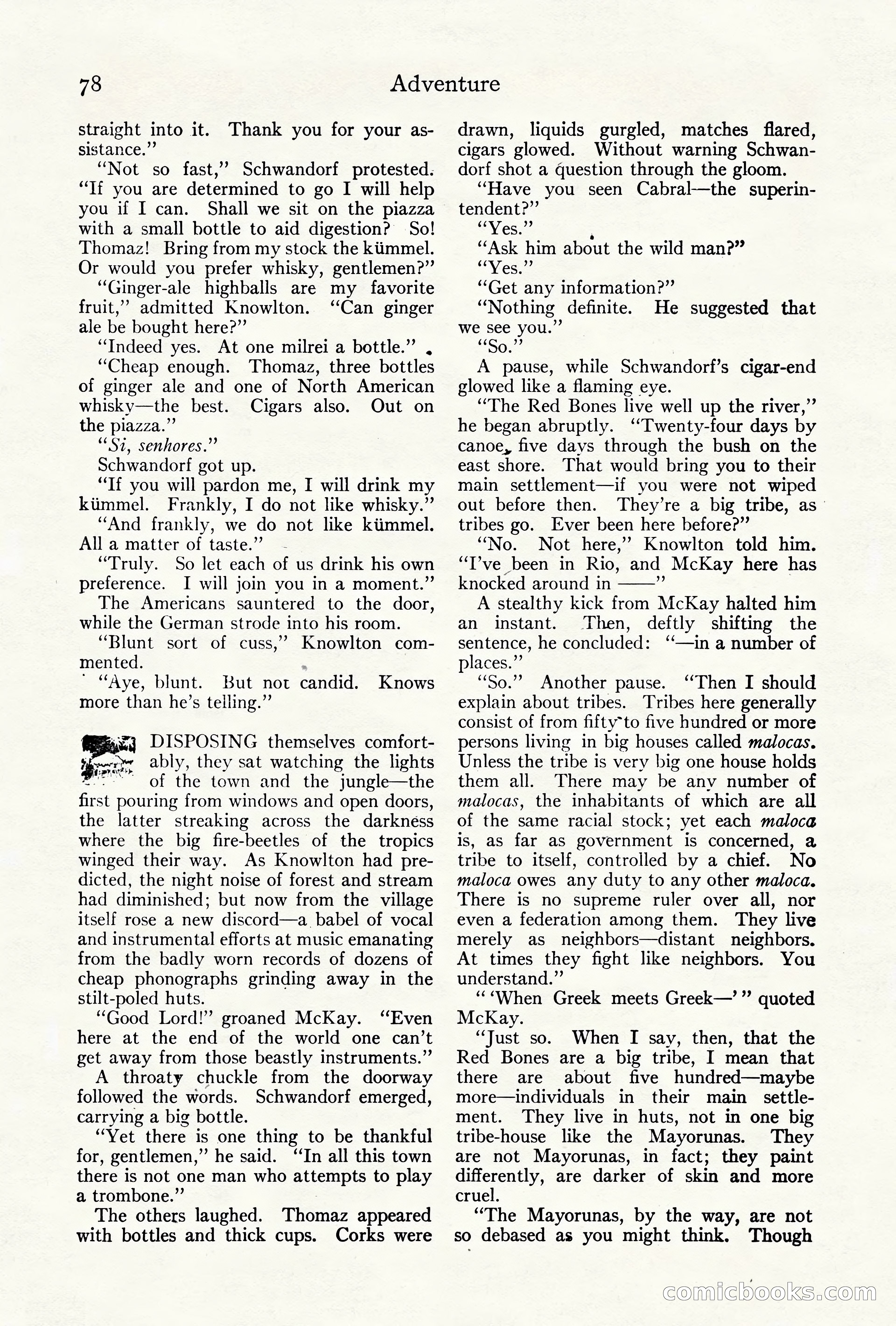
A restored page from Pulp Fiction, 1921. Page through the whole issue in the reader above.
📄 Transcribed text from this page (OCR, searchable)
Machine-transcribed from the original scan — historical spelling and the odd misread are preserved.
78 straight into it. sistance.” ‘Not so fast,’”? Schwandorf protested: “If you are determined to go I will help you if I can. Shall we sit on the piazza with a small bottle to aid digestion? So! Thomaz! Bring from my stock the kimmel. Or would you prefer whisky, gentlemen?”’ “Ginger-ale highballs are my favorite fruit,” admitted Knowlton. ‘Can ginger ale be bought here?”’ “Indeed yes. At one milrei a bottle.” , “Cheap enough. Thomaz, three bottles of ginger ale and one of North American whisky—the best. Cigars also. Out on the piazza.” ‘Sz, senhores.”’ Schwandorf got up. “Tf you will pardon me, I will drink my kiimmel. Frankly, I do not like whisky.” “And frankly, we do not like kiimmel. All a matter of taste.” - “Truly. So let each of us drink his own preference. I will join you in a moment.” The Americans sauntered to the door, while the German strode into his room. “Blunt sort of cuss,” Knowlton com- mented. ' “Aye, blunt. But not candid. Knows more than he’s telling.”’ Thank you for your as- xj DISPOSING themselves comfort- . et ably, they sat watching the lights wr of the town and the jungle—the first pouring from windows and open doors, the latter streaking across the darkness where the big fire-beetles of the tropics winged their way. As Knowlton had pre- dicted, the night noise of forest and stream had diminished; but now from the village itself rose a new discord—a_ babel of vocal and instrumental efforts at music emanating from the badly worn records of dozens of cheap phonographs grinding away in the stilt-poled huts. “Good Lord!” groaned McKay. ‘Even here at the end of the world one can’t get away from those beastly instruments.” A throaty chuckle from the doorway followed the words. Schwandorf emerged, carrying a big bottle. “Vet there is one thing to be thankful for, gentlemen,” he said. “In all this town there is not one man who attempts to play a trombone.” The others laughed. Thomaz appeared with bottles and thick cups. Corks were Adventure drawn, liquids gurgled, matches flared, cigars glowed. Without warning Schwan- dorf shot a question through the gloom. ‘““Have you seen Cabral—the superin- tendent?”’ “Ves” : ‘““Ask him about the wild man?” Ves.” ‘“‘Get any information?” “Nothing definite. He suggested that we see you.” “So. 9 A pause, while Schwandorf’s cigar-end glowed like a flaming eye. “The Red Bones live well up the river,” he began abruptly. ‘Twenty-four days by canoe, five days through the bush on the east shore. That would bring you to their main settlement—if you were not wiped out before then. tribes go. Ever been here before?”’ “No. Not here,’ Knowlton told him. “T’ve been in Rio, and McKay here has knocked around in A stealthy kick from McKay halted him an instant. Then, deftly shifting the sentence, he concluded: ‘“‘—in a number of places.” “So.” Another pause. “Then I should explain about tribes. Tribes here generally consist of from fifty*to five hundred or more persons living in big houses called malocas. Unless the tribe is very big one house holds them all. There may be anv number of malocas, the inhabitants of which are all of the same racial stock; yet each maloca is, aS far as government is concerned, a tribe to itself, controlled by a chief. No maloca owes any duty to any other maloca. There is no supreme ruler over all, nor even a federation among them. They live merely as neighbors—distant neighbors. At times they fight like neighbors. You understand.” ‘“““When Greek meets Greek—’”’ McKay. ‘“‘Just so. When I say, then, that the Red Bones are a big tribe, I mean that there are about five hundred—maybe more—individuals in their main settle- ment. They live in huts, not in one big tribe-house like the Mayorunas. They are not Mayorunas, in fact; they paint differently, are darker of skin and more cruel. “The Mayorunas, by the way, are not so debased as you might think. Though quoted JOO Conn) S Cc They’re a big tribe, as’ C@