
Pulp Fiction, 1921 · page 85 of 204
Adventure Magazine Cover, October 10, 1921 — page 85: what you’re looking at
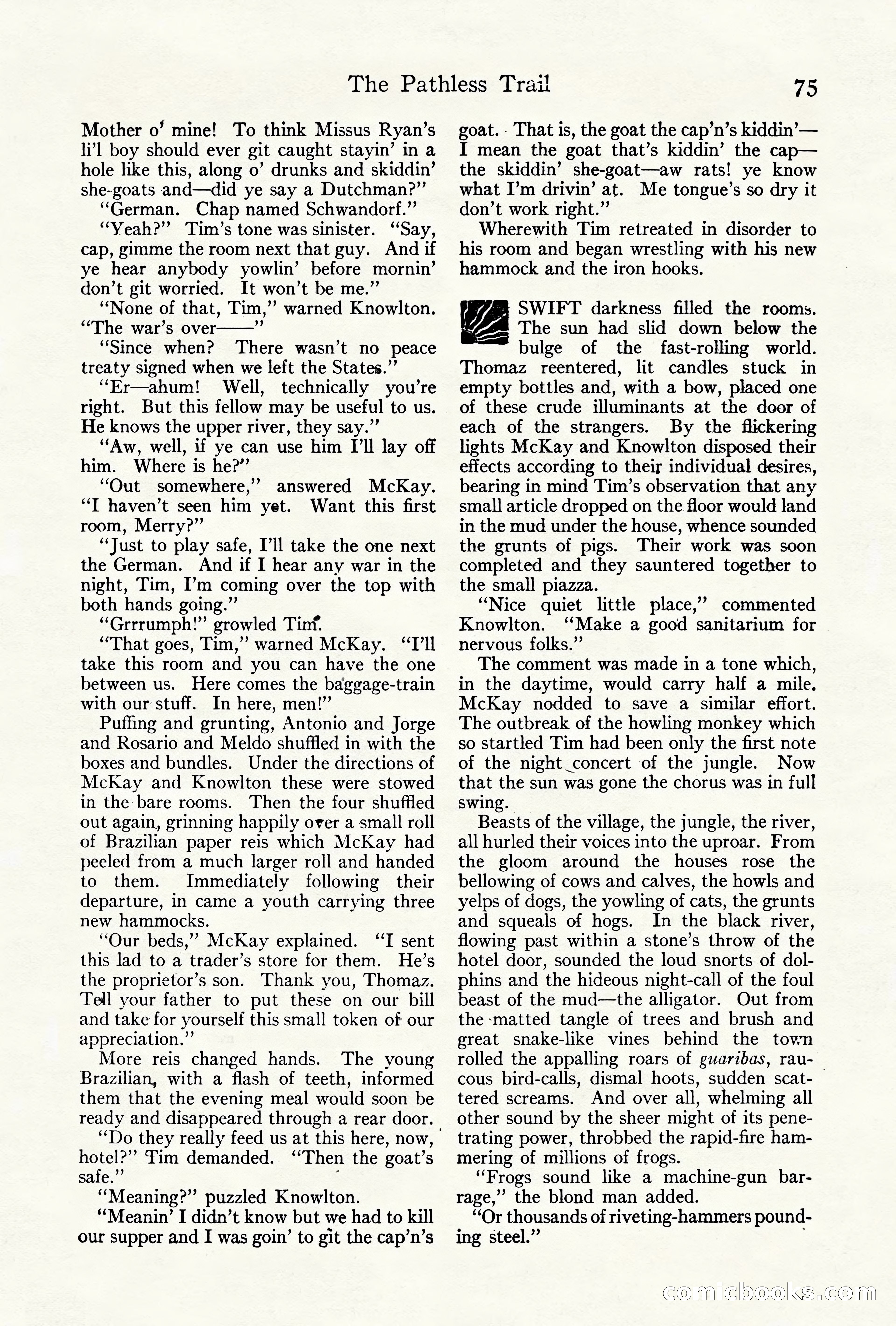
A restored page from Pulp Fiction, 1921. Page through the whole issue in the reader above.
📄 Transcribed text from this page (OCR, searchable)
Machine-transcribed from the original scan — historical spelling and the odd misread are preserved.
The Pathless Trail Mother o’ mine! To think Missus Ryan’s li’l boy should ever git caught stayin’ in a hole like this, along o’ drunks and skiddin’ she-goats and—did ye say a Dutchman?” “German. Chap named Schwandorf.”’ ‘““Yeah?’’ Tim’s tone was sinister. ‘Say, cap, gimme the room next that guy. And if ye hear anybody yowlin’ before mornin’ don’t git worried. It won’t be me.” ‘“‘None of that, Tim,”’ warned Knowlton. ‘The war’s over ‘Since when? There wasn’t no peace treaty signed when we left the States.” ‘“Er—ahum! Well, technically you’re right. But-this fellow may be useful to us. He knows the upper river, they say.” ‘““Aw, well, if ye can use him [’ll lay off him. Where is he?”’ “Out somewhere,’ answered McKay. “T haven’t seen him yet. Want this first room, Merry?” “Just to play safe, I'll take the one next the German. And if I hear any war in the night, Tim, I’m coming over the top with both hands going.” “Grrrumph!” growled Tint. ‘“‘That goes, Tim,” warned McKay. ‘“‘T’ll take this room and you can have the one between us. Here comes the baggage-train with our stuff. In here, men!” Puffing and grunting, Antonio and Jorge and Rosario and Meldo shuffled in with the boxes and bundles. Under the directions of McKay and Knowlton these were stowed in the bare rooms. Then the four shuffled out again, grinning happily over a small roll of Brazilian paper reis which McKay had peeled from a much larger roll and handed to them. Immediately following their departure, in came a youth carrying three new hammocks. “Our beds,’ McKay explained. “TI sent this lad to a trader’s store for them. He’s the proprietor’s son. Thank you, Thomaz. Tell your father to put these on our bill and take for yourself this small token of our appreciation.” More reis changed hands. The young Brazilian, with a flash of teeth, informed them that the evening meal would soon be ready and disappeared through a rear door. | “Do they really feed us at this here, now, hotel?” Tim demanded. “Then the goat’s safe.”’ “Meaning?” puzzled Knowlton. “Meanin’ I didn’t know but we had to kill our supper and I was goin’ to git the cap’n’s 75 goat. - That is, the goat the cap’n’s kiddin’— I mean the goat that’s kiddin’ the cap— the skiddin’ she-goat—aw rats! ye know what I’m drivin’ at. Me tongue’s so dry it don’t work right.” Wherewith Tim retreated in disorder to his room and began wrestling with his new hammock and the iron hooks. Za The sun had slid down below the bulge of the fast-rolling world. Thomaz reentered, lit candles stuck in empty bottles and, with a bow, placed one of these crude illuminants at the door of each of the strangers. By the flickering lights McKay and Knowlton disposed their effects according to theiy individual desires, bearing in mind Tim’s observation that any small article dropped on the floor would land in the mud under the house, whence sounded the grunts of pigs. Their work was soon completed and they sauntered together to the small piazza. “Nice quiet little place,’ commented Knowlton. ‘‘Make a good sanitarium for nervous folks.” The comment was made in a tone which, in the daytime, would carry half a mile. McKay nodded to save a similar effort. The outbreak of the howling monkey which so startled Tim had been only the first note of the night_concert of the jungle. Now that the sun was gone the chorus was in full swing. Beasts of the village, the jungle, the river, all hurled their voices into the uproar. From the gloom around the houses rose the bellowing of cows and calves, the howls and yelps of dogs, the yowling of cats, the grunts and squeals of hogs. In the black river, flowing past within a stone’s throw of the hotel door, sounded the loud snorts of dol- phins and the hideous night-call of the foul beast of the mud—the alligator. Out from the matted tangle of trees and brush and great snake-like vines behind the town SWIFT darkness filled the rooms. rolled the appalling roars of guwaribas, rau-_ cous bird-calls, dismal hoots, sudden scat- tered screams. And over all, whelming all other sound by the sheer might of its pene- trating power, throbbed the rapid-fire ham- mering of millions of frogs. “Frogs sound like a machine-gun bar- rage,” the blond man added. “Or thousands of riveting-hammers pound- ing steel.” DOOLK C@