
Pulp Fiction, 1921 · page 83 of 204
Adventure Magazine Cover, October 10, 1921 — page 83: what you’re looking at
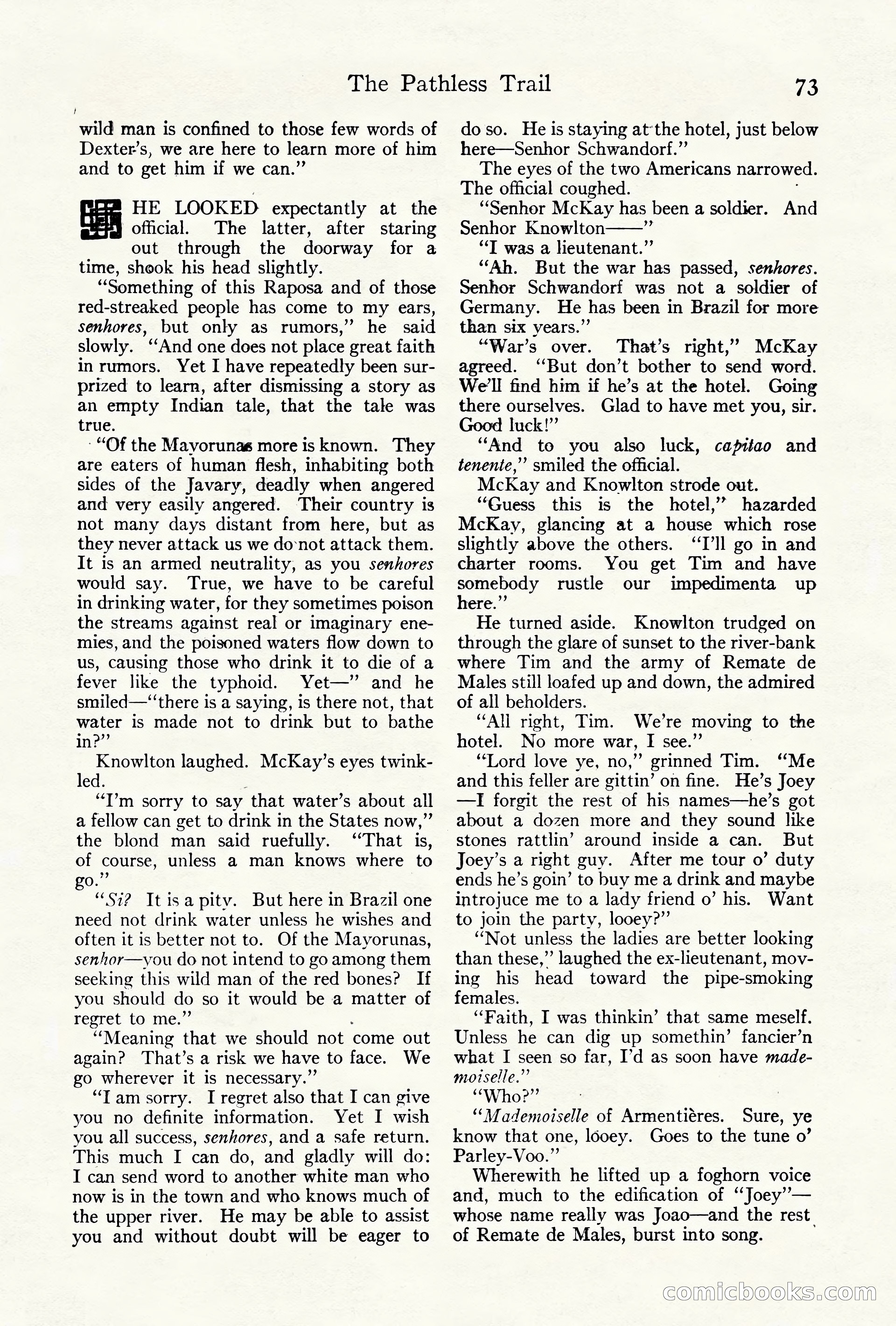
A restored page from Pulp Fiction, 1921. Page through the whole issue in the reader above.
📄 Transcribed text from this page (OCR, searchable)
Machine-transcribed from the original scan — historical spelling and the odd misread are preserved.
The Pathless Trail wild man is confined to those few words of Dexter’s, we are here to learn more of him and to get him if we can.” HE LOOKED expectantly at the official. The latter, after staring out through the doorway for a time, shook his head slightly. ‘Something of this Raposa and of those red-streaked people has come to my ears, senhores, but only as rumors,” he said slowly. ‘And one does not place great faith inrumors. Yet I have repeatedly been sur- prized to learn, after dismissing a story as an empty Indian tale, that the tale was true. ~“Of the Mavorunas more is known. They are eaters of human flesh, inhabiting both sides of the Javary, deadly when angered and very easily angered. Their country is not many days distant from here, but as they never attack us we donot attack them. It is an armed neutrality, as you senhores would say. True, we have to be careful in drinking water, for they sometimes poison the streams against real or imaginary ene- mies, and the poisoned waters flow down to us, causing those who drink it to die of a fever like the typhoid. Yet—” and he smiled—“‘there is a saying, is there not, that water is made not to drink but to bathe in?” Knowlton laughed. McKay’s eyes twink- led. “I’m sorry to say that water’s about all a fellow can get to drink in the States now,’ the blond man said ruefully. “That is, of course, unless a man knows where to go.” “$7? It isa pity. But here in Brazil one need not drink water unless he wishes and often it is better not to. Of the Mavyorunas, senhor—you do not intend to go among them seeking this wild man of the red bones? If you should do so it would be a matter of regret to me.’ “Meaning that we should not come out again? That’s a risk we have to face. We go wherever it is necessary.” “Tam sorry. I regret also that I can give you no definite information. Yet I wish you all success, senhores, and a safe return. This much I can do, and gladly will do: I can send word to another white man who now is in the town and who knows much of the upper river. He may be able to assist you and without doubt will be eager to 73 doso. He is staying at the hotel, just below here—Senhor Schwandorf.”’ The eyes of the two Americans narrowed. The official coughed. ‘“‘Senhor McKay has been a soldier. Senhor Knowlton : “T was a heutenant.” ‘“‘Ah. But the war has passed, senhores. Senhor Schwandorf was not a soldier of Germany. He has been in Brazil for more than six years.” “War’s over. That’s right,” McKay agreed. ‘But don’t bother to send word. We'll find him if he’s at the hotel. Going there ourselves. Glad to have met you, sir. Good luck!” ‘‘And to you also luck, tenente,”’ smiled the official. McKay and Knowlton strode out. “Guess this is the hotel,’ hazarded McKay, glancing at a house which rose slightly above the others. ‘‘TI’ll go in and charter rooms. You get Tim and have somebody rustle our impedimenta up here.”’ He turned aside. Knowlton trudged on through the glare of sunset to the river-bank where Tim and the army of Remate de Males still loafed up and down, the admired of all beholders. “All right, Tim. We’re moving to the hotel. No more war, I see.” ‘Lord love ye, no,” grinned Tim. ‘Me and this feller are gittin’ on fine. He’s Joey —I forgit the rest of his names—he’s got about a dozen more and they sound like stones rattlin’ around inside a can. But Joey’s a right guy. After me tour o’ duty ends he’s goin’ to buy me a drink and maybe introjuce me to a lady friend o’ his. Want to join the party, looey?”’ “Not unless the ladies are better looking than these,” laughed the ex-lieutenant, mov- ing his head toward the pipe-smoking females. “Faith, I was thinkin’ that same meself. Unless he can dig up somethin’ fancier’n what I seen so far, I’d as soon have made- moiselle.”’ “Whore” ' “Mademoiselle of Armentiéres. Sure, ye know that one, looey. Goes to the tune o’ Parley-Voo.”’ Wherewith he lifted up a foghorn voice and, much to the edification of ‘“‘Joey’’— And capitao and whose name really was Joao—and the rest of Remate de Males, burst into song. MICLOOOK C@