
Pulp Fiction, 1921 · page 66 of 204
Adventure Magazine Cover, October 10, 1921 — page 66: what you’re looking at
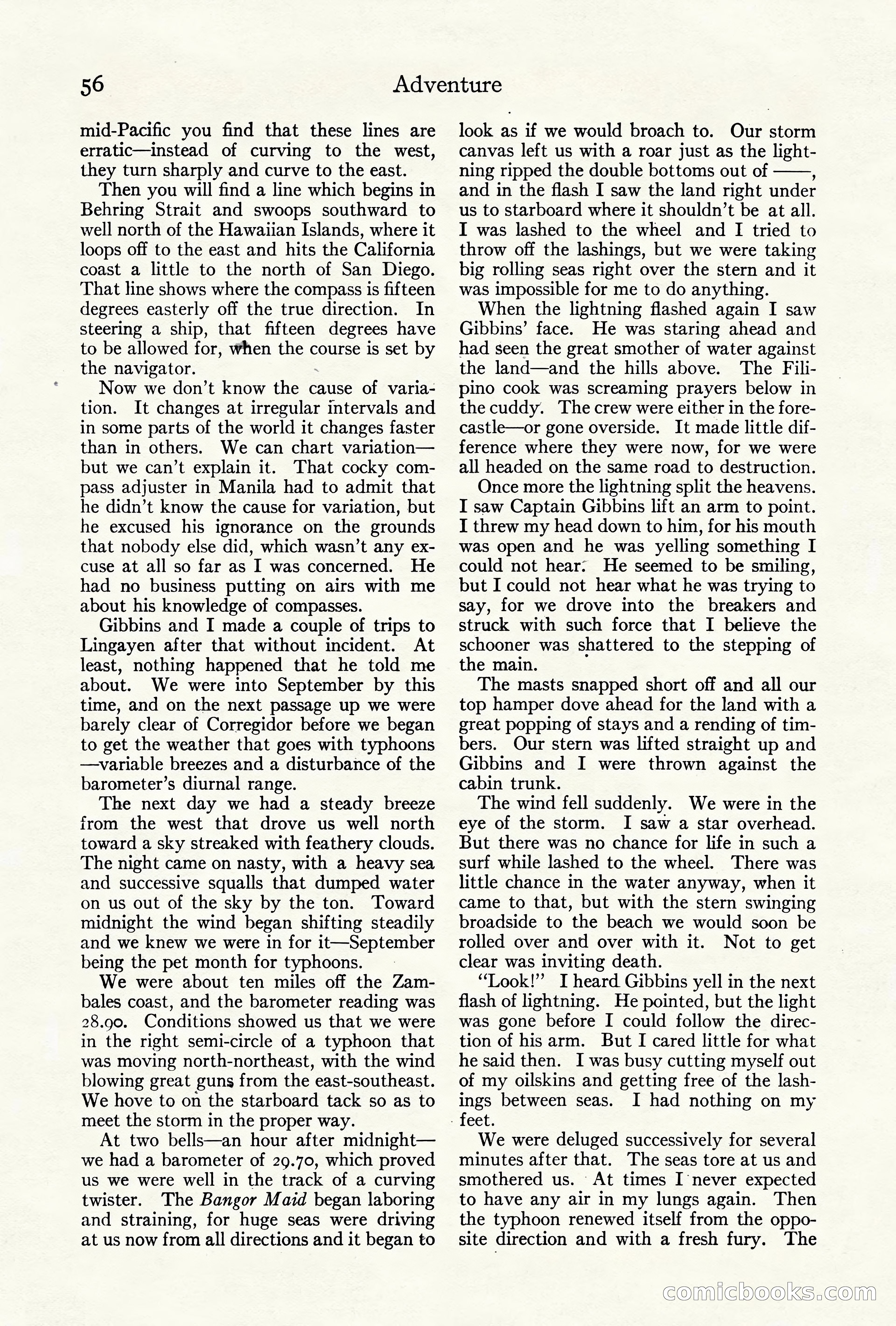
A restored page from Pulp Fiction, 1921. Page through the whole issue in the reader above.
📄 Transcribed text from this page (OCR, searchable)
Machine-transcribed from the original scan — historical spelling and the odd misread are preserved.
56 mid-Pacific you find that these lines are erratic—instead of curving to the west, they turn sharply and curve to the east. Then you will find a line which begins in Behring Strait and swoops southward to well north of the Hawaiian Islands, where it loops off to the east and hits the California coast a little to the north of San Diego. That line shows where the compass is fifteen degrees easterly off the true direction. In steering a ship, that fifteen degrees have to be allowed for, when the course is set by the navigator. Now we don’t know the cause of varia- tion. It changes at irregular intervals and in some parts of the world it changes faster than in others. We can chart variation— but we can’t explain it. That cocky com- pass adjuster in Manila had to admit that he didn’t know the cause for variation, but he excused his ignorance on the grounds that nobody else did, which wasn’t any ex- cuse at all so far as I was concerned. He had no business putting on airs with me about his knowledge of compasses. Gibbins and I made a couple of trips to Lingayen after that without incident. At least, nothing happened that he told me about. We were into September by this time, and on the next passage up we were barely clear of Corregidor before we began to get the weather that goes with typhoons —variable breezes and a disturbance of the barometer’s diurnal range. The next day we had a steady breeze from the west that drove us well north toward a sky streaked with feathery clouds. The night came on nasty, with a heavy sea and successive squalls that dumped water on us out of the sky by the ton. Toward midnight the wind began shifting steadily and we knew we were in for it—September being the pet month for typhoons. We were about ten miles off the Zam- bales coast, and the barometer reading was 28.90. Conditions showed us that we were in the right semi-circle of a typhoon that was moving north-northeast, with the wind blowing great guns from the east-southeast. We hove to on the starboard tack so as to meet the storm in the proper way. At two bells—an hour after midnight— we had a barometer of 29.70, which proved us we were well in the track of a curving twister. The Bangor Maid began laboring and straining, for huge seas were driving at us now from all directions and it began to Adventure look as if we would broach to. Our storm canvas left us with a roar just as the light- ning ripped the double bottoms out of and in the flash I saw the land right under us to starboard where it shouldn’t be at all. I was lashed to the wheel and I tried to throw off the lashings, but we were taking big rolling seas right over the stern and it was impossible for me to do anything. When the lightning flashed again I saw Gibbins’ face. He was staring ahead and had seen the great smother of water against the land—and the hills above. The Fili- pino cook was screaming prayers below in the cuddy. The crew were either in the fore- castle—or gone overside. It made little dif- ference where they were now, for we were all headed on the same road to destruction. Once more the lightning split the heavens. I saw Captain Gibbins lift an arm to point. I threw my head down to him, for his mouth was open and he was yelling something I could not hear: He seemed to be smiling, but I could not hear what he was trying to say, for we drove into the breakers and struck with such force that I believe the schooner was shattered to the stepping of the main. The masts snapped short off and all our top hamper dove ahead for the land with a great popping of stays and a rending of tim- bers. Our stern was lifted straight up and Gibbins and I were thrown against the cabin trunk. The wind fell suddenly. We were in the eye of the storm. I saw a star overhead. But there was no chance for life in such a surf while lashed to the wheel. There was little chance in the water anyway, when it came to that, but with the stern swinging broadside to the beach we would soon be rolled over and over with it. Not to get clear was inviting death. “Look!” I heard Gibbins yell in the next flash of lightning. He pointed, but the light was gone before I could follow the direc- tion of his arm. But I cared little for what he said then. I was busy cutting myself out of my oilskins and getting free of the lash- ings between seas. I had nothing on my . feet. We were deluged successively for several minutes after that. The seas tore at us and smothered us. At times I never expected to have any air in my lungs again. Then the typhoon renewed itself from the oppo- site direction and with a fresh fury. The COnmiclbooks Cc C@