
Pulp Fiction, 1921 · page 21 of 204
Adventure Magazine Cover, October 10, 1921 — page 21: what you’re looking at
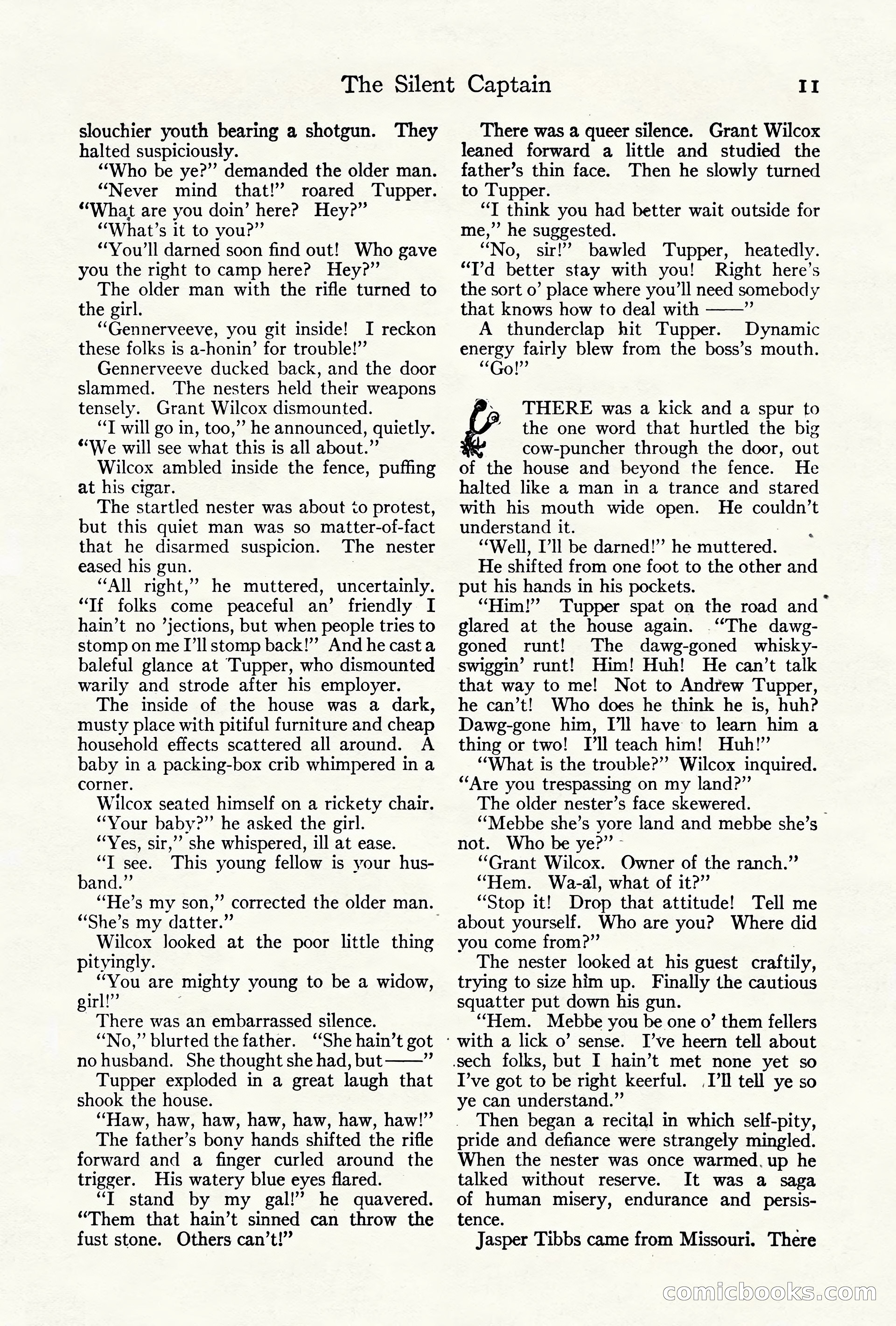
A restored page from Pulp Fiction, 1921. Page through the whole issue in the reader above.
📄 Transcribed text from this page (OCR, searchable)
Machine-transcribed from the original scan — historical spelling and the odd misread are preserved.
The Silent Captain slouchier youth bearing a shotgun. They halted suspiciously. “Who be ye?” demanded the older man. “Never mind that!” roared Tupper. ‘‘What are you doin’ here? Hey?” ‘‘What’s it to you?” ‘*You’ll darned soon find out! Who gave you the right to camp here? Hey?” The older man with the rifle turned to the girl. “‘“Gennerveeve, you git inside! I reckon these folks is a-honin’ for trouble!” Gennerveeve ducked back, and the door slammed. The nesters held their weapons tensely. Grant Wilcox dismounted. “T will go in, too,” he announced, quietly. “We will see what this is all about.” Wilcox ambled inside the fence, puffing at his cigar. The startled nester was about to protest, but this quiet man was so matter-of-fact that he disarmed suspicion. The nester eased his gun. | “All right,” he muttered, uncertainly. “If folks come peaceful an’ friendly I hain’t no ’jections, but when people tries to stomp on me I’! stomp back!”’ And he cast a baleful glance at Tupper, who dismounted warily and strode after his employer. The inside of the house was a dark, musty place with pitiful furniture and cheap household effects scattered all around. A baby in a packing-box crib whimpered in a corner. Wilcox seated himself on a rickety chair. “Your baby?” he asked the girl. “Yes, sir,” she whispered, ill at ease. “T see. This young fellow is your hus- band.” “‘He’s my son,” *“‘She’s my datter.” Wilcox looked at the poor little thing pityingly. “Vou are mighty young to be a widow, girl!” There was an embarrassed silence. “No,” blurted the father. “She hain’t got no husband. She thought she had, but ——” Tupper exploded in a great laugh that shook the house. “Haw, haw, haw, haw, haw, haw, haw!” The father’s bony hands shifted the rifle forward and a finger curled around the trigger. His watery blue eyes flared. “T stand by my gal!” he quavered. “Them that hain’t sinned can throw the fust stone. Others can’t!” corrected the older man. II There was a queer silence. Grant Wilcox leaned forward a little and studied the father’s thin face. Then he slowly turned to Tupper. “T think you had better wait outside for me,” he suggested. “No, sir!’ bawled Tupper, heatedly. “T’d better stay with you! Right here’s the sort 0’ place where you’ll need somebody that knows how to deal with A thunderclap hit Tupper. Dynamic energy fairly blew from the boss’s mouth. “Col THERE was a kick and a spur to ‘the one word that hurtled the big i cow-puncher through the door, out of the house and beyond the fence. He halted like a man in a trance and stared with his mouth wide open. He couldn’t understand it. “Well, I'll be darned!” he muttered. He shifted from one foot to the other and put his hands in his pockets. “Him!” glared at the house again. “The dawg- goned runt! The dawg-goned whisky- swiggin’ runt! Him! Huh! He can’t talk that way to me! Not to Andrew Tupper, he can’t! Who does he think he is, huh? Dawg-gone him, I'll have to learn him a thing or two! J’ll teach him! Huh!” ‘‘What is the trouble?” Wilcox inquired. ‘Are you trespassing on my land?” The older nester’s face skewered. Tupper spat on the road and~ ‘“‘Mebbe she’s yore land and mebbe she’s — not. Who be ye?” - “Grant Wilcox. Owner of the ranch.” “Hem. Wa-al, what of it?” “Stop it! Drop that attitude! Tell me about yourself. Who are you? Where did you come from?” The nester looked at his guest craftily, trying to size him up. Finally the cautious squatter put down his gun. “Hem. Mebbe you be one o’ them fellers ‘ with a lick o’ sense. I’ve heern tell about .sech folks, but I hain’t met none yet so I’ve got to be right keerful. I'll tell ye so ye can understand.”’ _ Then began a recital in which self-pity, pride and defiance were strangely mingled. When the nester was once warmed. up he talked without reserve. It was a saga of human misery, endurance and _ persis- tence. Jasper Tibbs came from Missouri. There cCoOmicoooks C@