
Pulp Fiction, 1921 · page 190 of 204
Adventure Magazine Cover, October 10, 1921 — page 190: what you’re looking at
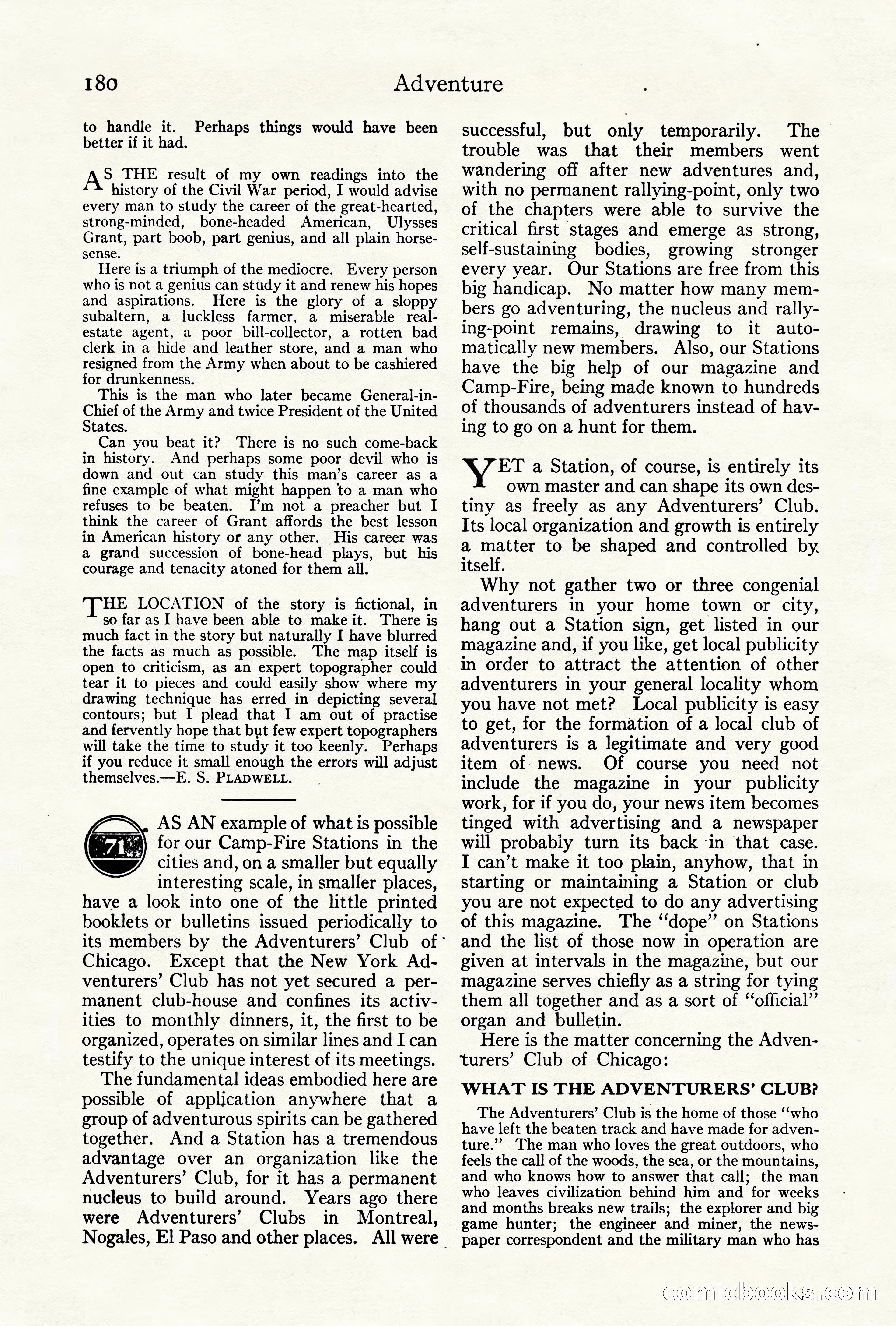
A restored page from Pulp Fiction, 1921. Page through the whole issue in the reader above.
📄 Transcribed text from this page (OCR, searchable)
Machine-transcribed from the original scan — historical spelling and the odd misread are preserved.
180 to handle it. Perhaps things would have been better if it had. A® THE result of my own readings into the history of the Civil War period, I would advise every man to study the career of the great-hearted, strong-minded, bone-headed American, Ulysses Grant, part boob, part genius, and all plain horse- sense. Here is a triumph of the mediocre. Every person who is not a genius can study it and renew his hopes and aspirations. Here is the glory of a sloppy subaltern, a luckless farmer, a miserable real- estate agent, a poor bill-collector, a rotten bad clerk in a hide and leather store, and a man who resigned from the Army when about to be cashiered for drunkenness. This is the man who later became General-in- Chief of the Army and twice President of the United States. Can you beat it? There is no such come-back in history. And perhaps some poor devil who is down and out can study this man’s career as a fine example of what might happen to a man who refuses to be beaten. I’m not a preacher but I think the career of Grant affords the best lesson in American history or any other. His career was a grand succession of bone-head plays, but his courage and tenacity atoned for them all. ‘THE LOCATION of the story is fictional, in so far as I have been able to makeit. There is much fact in the story but naturally I have blurred the facts as much as possible. The map itself is open to criticism, as an expert topographer could tear it to pieces and could easily show where my . drawing technique has erred in depicting several contours; but I plead that I am out of practise and fervently hope that but few expert topographers will take the time to study it too keenly. Perhaps if you reduce it small enough the errors will adjust themselves.—E. S. PLADWELL. AS AN example of what is possible for our Camp-Fire Stations in the cities and, on a smaller but equally interesting scale, in smaller places, have a look into one of the little printed booklets or bulletins issued periodically to its members by the Adventurers’ Club of ° Chicago. Except that the New York Ad- venturers’ Club has not yet secured a per- manent club-house and confines its activ- ities to monthly dinners, it, the first to be organized, operates on similar lines and I can testify to the unique interest of its meetings. The fundamental ideas embodied here are possible of application anywhere that a group of adventurous spirits can be gathered together. And a Station has a tremendous advantage over an organization like the Adventurers’ Club, for it has a permanent nucleus to build around. Years ago there were Adventurers’ Clubs in Montreal, Nogales, El Paso and other places. All were _ Adventure successful, but only temporarily. The trouble was that their members went wandering off after new adventures and, with no permanent rallying-point, only two of the chapters were able to survive the critical first stages and emerge as strong, self-sustaining bodies, growing stronger every year. Our Stations are free from this big handicap. No matter how many mem- bers go adventuring, the nucleus and rally- ing-point remains, drawing to it auto- matically new members. Also, our Stations have the big help of our magazine and Camp-Fire, being made known to hundreds of thousands of adventurers instead of hav- ing to go on a hunt for them. Y ET a Station, of course, is entirely its own master and can shape its own des- tiny as freely as any Adventurers’ Club. Its local organization and growth is entirely a matter to be shaped and controlled by. itself. Why not gather two or three congenial adventurers in your home town or city, hang out a Station sign, get listed in our magazine and, if you like, get local publicity in order to attract the attention of other adventurers in your general locality whom you have not met? Local publicity is easy to get, for the formation of a local club of adventurers is a legitimate and very good item of news. Of course you need not include the magazine in your publicity work, for if you do, your news item becomes tinged with advertising and a newspaper will probably turn its back in that case. I can’t make it too plain, anyhow, that in starting or maintaining a Station or club you are not expected to do any advertising of this magazine. The “dope” on Stations and the list of those now in operation are given at intervals in the magazine, but our magazine serves chiefly as a string for tying them all together and as a sort of “‘official’’ organ and bulletin. Here is the matter concerning the Adven- ‘turers’ Club of Chicago: WHAT IS THE ADVENTURERS’ CLUB? The Adventurers’ Club is the home of those ‘‘who have left the beaten track and have made for adven- ture.”” The man who loves the great outdoors, who feels the call of the woods, the sea, or the mountains, and who knows how to answer that call; the man who leaves civilization behind him and for weeks and months breaks new trails; the explorer and big game hunter; the engineer and miner, the news- paper correspondent and the military man who has MICLO©OOKS Cc C@