
Pulp Fiction, 1921 · page 171 of 204
Adventure Magazine Cover, October 10, 1921 — page 171: what you’re looking at
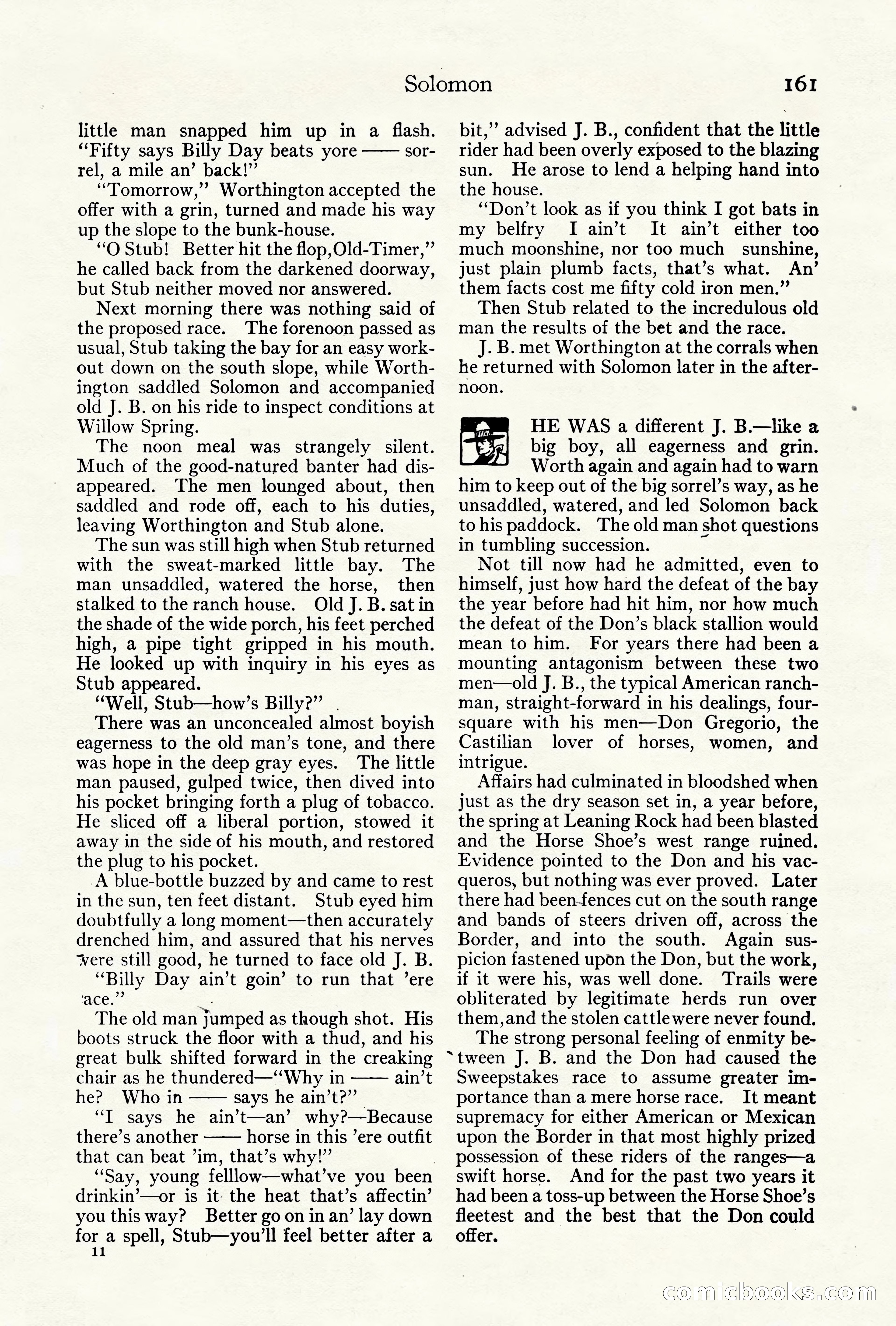
A restored page from Pulp Fiction, 1921. Page through the whole issue in the reader above.
📄 Transcribed text from this page (OCR, searchable)
Machine-transcribed from the original scan — historical spelling and the odd misread are preserved.
Solomon little man snapped him up in a flash. “Fifty says Billy Day beats yore sor- rel, a mile an’ back!” “Tomorrow,” Worthington accepted the offer with a grin, turned and made his way up the slope to the bunk-house. “O Stub! Better hit the flop,Old-Timer,”’ he called back from the darkened doorway, but Stub neither moved nor answered. Next morning there was nothing said of the proposed race. The forenoon passed as usual, Stub taking the bay for an easy work- out down on the south slope, while Worth- ington saddled Solomon and accompanied old J. B. on his ride to inspect conditions at Willow Spring. The noon meal was strangely silent. Much of the good-natured banter had dis- appeared. The men lounged about, then saddled and rode off, each to his duties, leaving Worthington and Stub alone. The sun was still high when Stub returned with the sweat-marked little bay. The man unsaddled, watered the horse, then stalked to the ranch house. Old J. B. satin the shade of the wide porch, his feet perched high, a pipe tight gripped in his mouth. He looked up with inquiry in his eyes as Stub appeared. “Well, Stub—how’s Billy?” . There was an unconcealed almost boyish eagerness to the old man’s tone, and there was hope in the deep gray eyes. The little man paused, gulped twice, then dived into his pocket bringing forth a plug of tobacco. He sliced off a liberal portion, stowed it away in the side of his mouth, and restored the plug to his pocket. A blue-bottle buzzed by and came to rest in the sun, ten feet distant. Stub eyed him doubtfully a long moment—then accurately drenched him, and assured that his nerves ‘were still good, he turned to face old J. B. “Billy Day ain’t goin’ to run that ’ere aCe. The old man jumped as though shot. His boots struck the floor with a thud, and his great bulk shifted forward in the creaking chair as he thundered—‘“‘Why in ain’t he? Who in says he ain’t?” “T says he ain’t—an’ why?—Because there’s another horse in this ’ere outfit that can beat ’im, that’s why!” “Say, young felllow—what’ve you been drinkin’—or is it the heat that’s affectin’ you this way? Better goon inan’ lay down for a spell, Stub—you’ll feel better after a 11 161 bit,’’ advised J. B., confident that the little rider had been overly exposed to the blazing sun. He arose to lend a helping hand into the house. “Don’t look as if you think I got bats in my belfry I ain’t It ain’t either too much moonshine, nor too much sunshine, just plain plumb facts, that’s what. An’ them facts cost me fifty cold iron men.” Then Stub related to the incredulous old man the results of the bet and the race. J. B. met Worthington at the corrals when he returned with Solomon later in the after- noon. a HE WAS a different J. B.—like a big boy, all eagerness and grin. Worth again and again had to warn him to keep out of the big sorrel’s way, as he unsaddled, watered, and led Solomon back to his paddock. The old man shot questions in tumbling succession. Not till now had he admitted, even to himself, just how hard the defeat of the bay the year before had hit him, nor how much the defeat of the Don’s black stallion would | mean to him. For years there had been a mounting antagonism between these two men—old J. B., the typical American ranch- man, straight-forward in his dealings, four- square with his men—Don Gregorio, the Castilian lover of horses, women, and intrigue. Affairs had culminated in bloodshed when just as the dry season set in, a year before, the spring at Leaning Rock had been blasted and the Horse Shoe’s west range ruined. Evidence pointed to the Don and his vac- queros, but nothing was ever proved. Later there had been-fences cut on the south range and bands of steers driven off, across the Border, and into the south. Again sus- picion fastened upon the Don, but the work, if it were his, was well done. ‘Trails were obliterated by legitimate herds run over them,and the stolen cattlewere never found. The strong personal feeling of enmity be- ~tween J. B. and the Don had caused the Sweepstakes race to assume greater im- portance than a mere horse race. It meant supremacy for either American or Mexican upon the Border in that most highly prized possession of these riders of the ranges—a swift horse. And for the past two years it had been a toss-up between the Horse Shoe’s fleetest and the best that the Don could offer. | NOOK C@