
Pulp Fiction, 1921 · page 16 of 204
Adventure Magazine Cover, October 10, 1921 — page 16: what you’re looking at
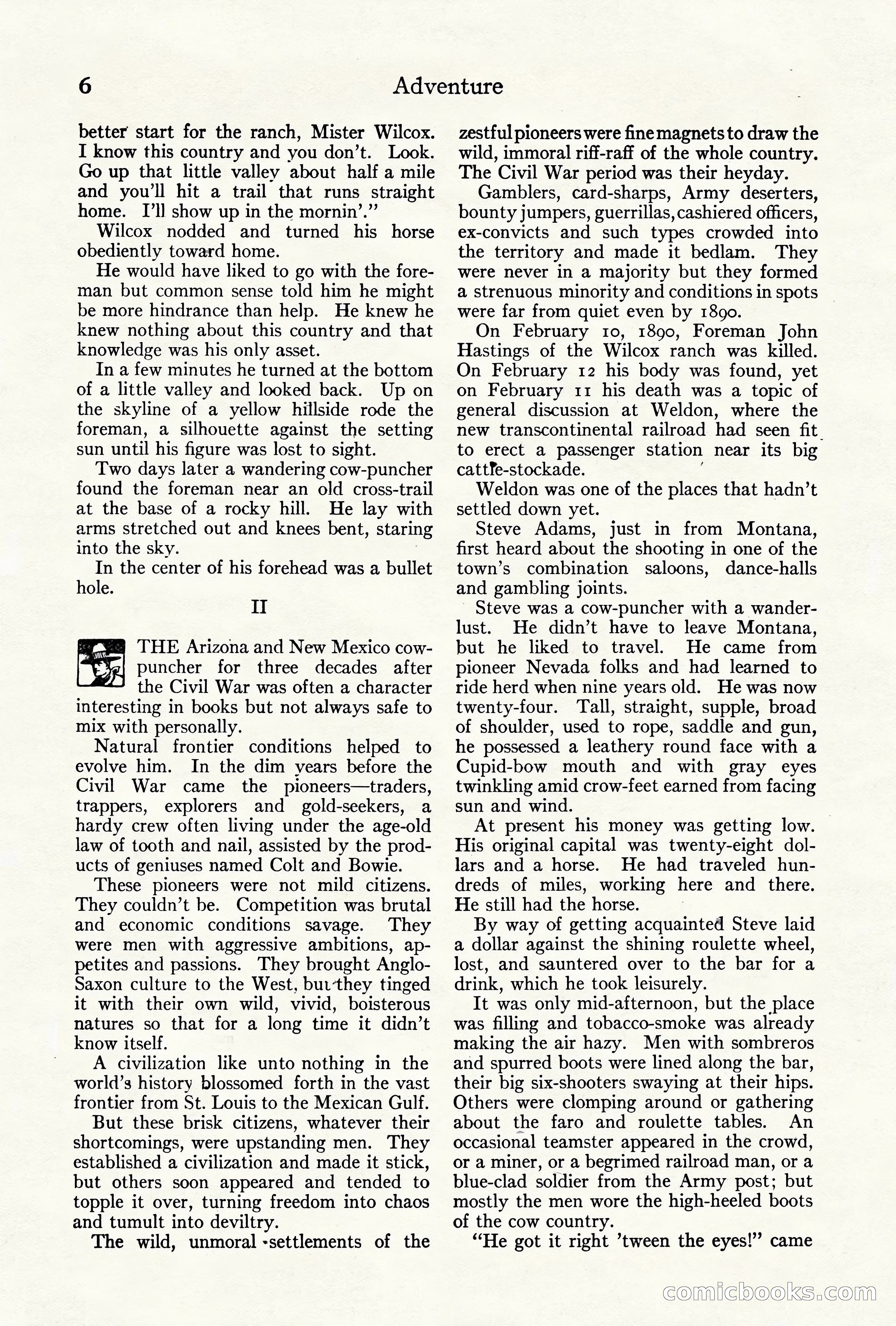
A restored page from Pulp Fiction, 1921. Page through the whole issue in the reader above.
📄 Transcribed text from this page (OCR, searchable)
Machine-transcribed from the original scan — historical spelling and the odd misread are preserved.
6 better start for the ranch, Mister Wilcox. I know this country and you don’t. Look. Go up that little valley about half a mile and you'll hit a trail that runs straight home. I’l] show up in the mornin’.” Wilcox nodded and turned his horse obediently toward home. He would have liked to go with the fore- man but common sense told him he might be more hindrance than help. He knew he knew nothing about this country and that knowledge was his only asset. In a few minutes he turned at the bottom of a little valley and looked back. Up on the skyline of a yellow hillside rode the foreman, a silhouette against the setting sun until his figure was lost to sight. Two days later a wandering cow-puncher found the foreman near an old cross-trail at the base of a rocky hill. He lay with arms stretched out and knees bent, staring into the sky. In the center of his forehead was a bullet hole. IT mea THE Arizona and New Mexico cow- ¥g| puncher for three decades after the Civil War was often a character interesting in books but not always safe to mix with personally. Natural frontier conditions helped to evolve him. In the dim years before the Civil War came the pioneers—traders, trappers, explorers and_ gold-seekers, a hardy crew often living under the age-old law of tooth and nail, assisted by the prod- ucts of geniuses named Colt and Bowie. These pioneers were not mild citizens. They couldn’t be. Competition was brutal and economic conditions savage. They were men with aggressive ambitions, ap- petites and passions. They brought Anglo- Saxon culture to the West, but‘they tinged it with their own wild, vivid, boisterous natures so that for a long time it didn’t know itself. A civilization like unto nothing in the world’s history blossomed forth in the vast frontier from St. Louis to the Mexican Gulf. But these brisk citizens, whatever their shortcomings, were upstanding men. They established a civilization and made it stick, but others soon appeared and tended to topple it over, turning freedom into chaos and tumult into deviltry. The wild, unmoral -settlements of the Adventure zestful pioneers were fine magnets to draw the wild, immoral riff-raff of the whole country. The Civil War period was their heyday. Gamblers, card-sharps, Army deserters, bounty jumpers, guerrillas, cashiered officers, ex-convicts and such types crowded into the territory and made it bedlam. They were never in a majority but they formed a strenuous minority and conditions in spots | were far from quiet even by 1890. On February 10, 1890, Foreman John Hastings of the Wilcox ranch was killed. On February 12 his body was found, yet on February 11 his death was a topic of general discussion at Weldon, where the new transcontinental railroad had seen fit. to erect a passenger station near its big cattfe-stockade. Weldon was one of the places that hadn’t settled down yet. Steve Adams, just in from Montana, first heard about the shooting in one of the town’s combination saloons, dance-halls and gambling joints. _ Steve was a cow-puncher with a wander- lust. He didn’t have to leave Montana, but he liked to travel. He came from pioneer Nevada folks and had learned to ride herd when nine years old. He was now twenty-four. Tall, straight, supple, broad of shoulder, used to rope, saddle and gun, he possessed a leathery round face with a Cupid-bow mouth and with gray eyes twinkling amid crow-feet earned from facing sun and wind. At present his money was getting low. His original capital was twenty-eight dol- lars and a horse. He had traveled hun- dreds of miles, working here and there. He still had the horse. By way of getting acquainted Steve laid a dollar against the shining roulette wheel, lost, and sauntered over to the bar for a drink, which he took leisurely. It was only mid-afternoon, but the place was filling and tobacco-smoke was already making the air hazy. Men with sombreros and spurred boots were lined along the bar, their big six-shooters swaying at their hips. Others were clomping around or gathering about the faro and roulette tables. An occasional teamster appeared in the crowd, or a miner, or a begrimed railroad man, or a blue-clad soldier from the Army post; but mostly the men wore the high-heeled boots of the cow country. “He got it right tween the eyes!” came cCommicoooks C@©