
Pulp Fiction, 1921 · page 147 of 204
Adventure Magazine Cover, October 10, 1921 — page 147: what you’re looking at
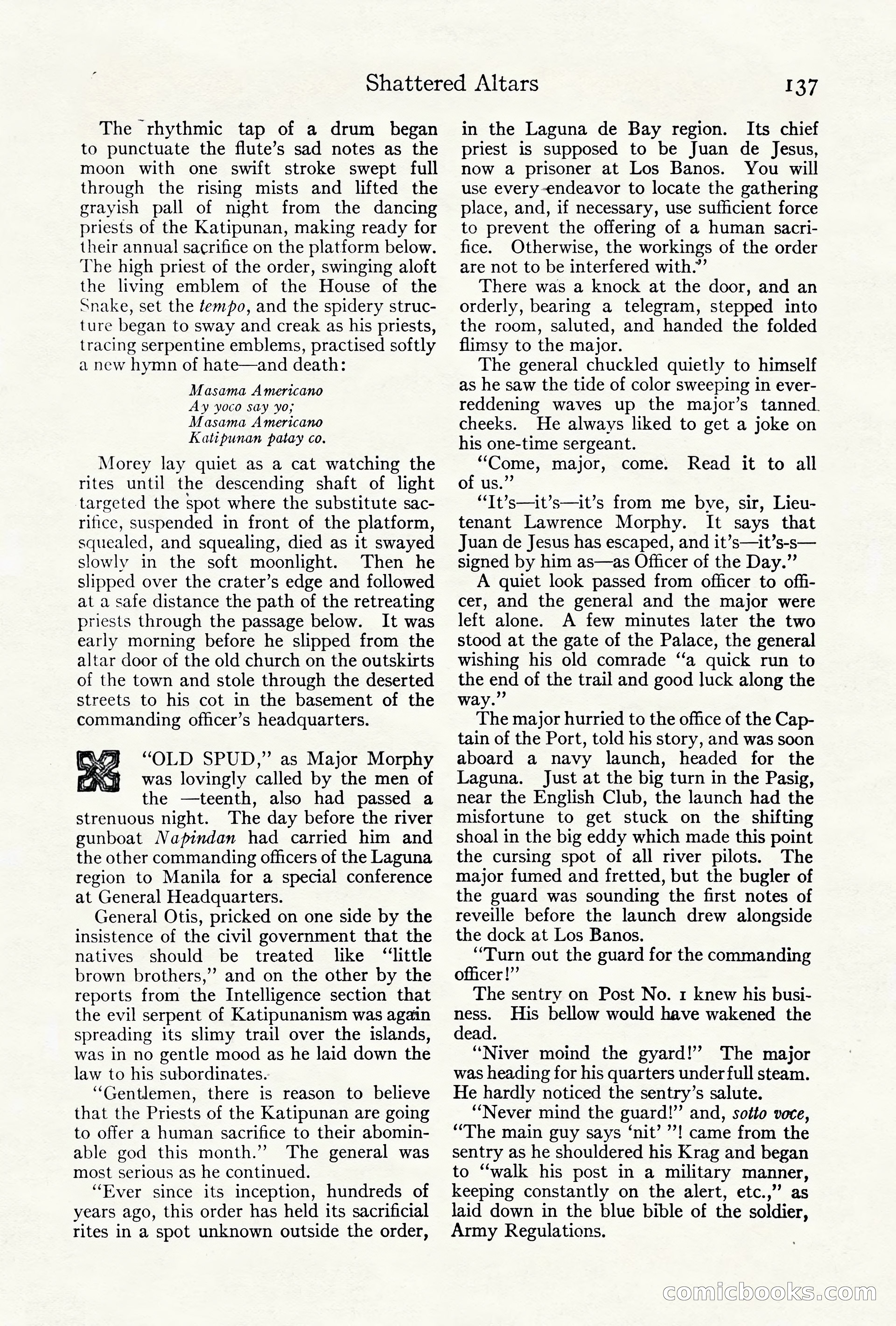
A restored page from Pulp Fiction, 1921. Page through the whole issue in the reader above.
📄 Transcribed text from this page (OCR, searchable)
Machine-transcribed from the original scan — historical spelling and the odd misread are preserved.
Shattered Altars The rhythmic tap of a drum began to punctuate the flute’s sad notes as the moon with one swift stroke swept full through the rising mists and lifted the grayish pall of night from the dancing priests of the Katipunan, making ready for their annual sacrifice on the platform below. The high priest of the order, swinging aloft the living emblem of the House of the Snake, set the tempo, and the spidery struc- ture began to sway and creak as his priests, tracing serpentine emblems, practised softly a new hymn of hate—and death: Masama Americano Ay yoco say yo; Masama Americano Katipunan patay co. Morey lay quiet as a cat watching the rites until the descending shaft of light targeted the spot where the substitute sac- rifice, suspended in front of the platform, squealed, and squealing, died as it swayed slowly in the soft moonlight. Then he slipped over the crater’s edge and followed at a safe distance the path of the retreating priests through the passage below. It was early morning before he slipped from the altar door of the old church on the outskirts of the town and stole through the deserted streets to his cot in the basement of the commanding officer’s headquarters. “OLD SPUD,” as Major Morphy was lovingly called by the men of the —teenth, also had passed a strenuous night. The day before the river gunboat Napindan had carried him and the other commanding officers of the Laguna region to Manila for a special conference at General Headquarters. General Otis, pricked on one side by the insistence of the civil government that the natives should be treated like “‘little brown brothers,” and on the other by the reports from the Intelligence section that the evil serpent of Katipunanism was again spreading its slimy trail over the islands, was in no gentle mood as he laid down the law to his subordinates. “Gentlemen, there is reason to believe that the Priests of the Katipunan are going to offer a human sacrifice to their abomin- able god this month.’ The general was most serious as he continued. “Ever since its inception, hundreds of years ago, this order has held its sacrificial rites in a spot unknown outside the order, 137 in the Laguna de Bay region. Its chief priest is supposed to be Juan de Jesus, now a prisoner at Los Banos. You will use every-endeavor to locate the gathering place, and, if necessary, use sufficient force to prevent the offering of a human sacri- fice. Otherwise, the workings of the order are not to be interfered with.”’ There was a knock at the door, and an orderly, bearing a telegram, stepped into the room, saluted, and handed the folded flimsy to the major. The general chuckled quietly to himself as he saw the tide of color sweeping in ever- reddening waves up the major’s tanned. cheeks. He always liked to get a joke on his one-time sergeant. “Come, major, come. of us.” “It’s—it’s—it’s from me bve, sir, Lieu- tenant Lawrence Morphy. It says that Juan de Jesus has escaped, and it’s—it’s-s— signed by him as—as Officer of the Day.” A quiet look passed from officer to offi- cer, and the general and the major were left alone. A few minutes later the two stood at the gate of the Palace, the general wishing his old comrade ‘“‘a quick run to the end of the trail and good luck along the way.” The major hurried to the office of the Cap- tain of the Port, told his story, and was soon aboard a navy launch, headed for the Laguna. Just at the big turn in the Pasig, near the English Club, the launch had the misfortune to get stuck on the shifting shoal in the big eddy which made this point the cursing spot of all river pilots. The major fumed and fretted, but the bugler of the guard was sounding the first notes of reveille before the launch drew alongside the dock at Los Banos. “Turn out the guard for the commanding officer!” The sentry on Post No. 1 knew his busi- ness. His bellow would have wakened the dead. ‘“Niver moind the gyard!’? The major was heading for his quarters under full steam. He hardly noticed the sentry’s salute. ‘Never mind the guard!” and, sotto voce, “The main guy says ‘nit’ ”’! came from the sentry as he shouldered his Krag and began to “walk his post in a military manner, keeping constantly on the alert, etc.,’”’ as laid down in the blue bible of the soldier, Army Regulations. Read it to all C@ DOOLK