
Pulp Fiction, 1921 · page 84 of 200
Adventure Magazine Cover — page 84: what you’re looking at
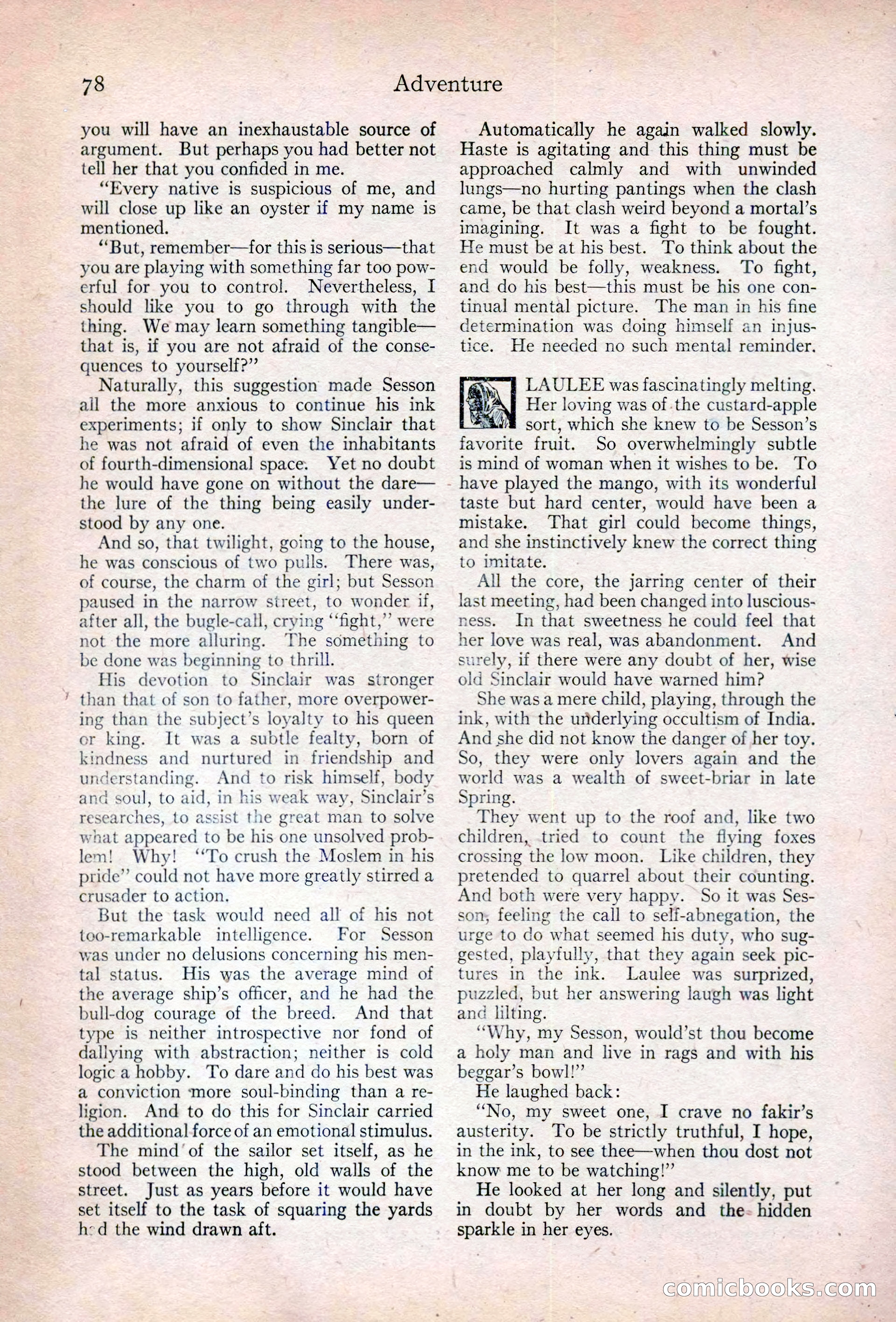
A restored page from Pulp Fiction, 1921. Page through the whole issue in the reader above.
📄 Transcribed text from this page (OCR, searchable)
Machine-transcribed from the original scan — historical spelling and the odd misread are preserved.
~ 78 you will have an inexhaustable source of argument. But perhaps you had better not tell her that you confided in me. “Every native is suspicious of me, and will close up like an oyster if my name is mentioned. “But, remember—for this is serious—that you are playing with something far too pow- erful for you to control. Nevertheless, I should like you to go through with the thing. We may learn something tangible— that is, if you are not afraid of the conse- quences to yourself?” Naturally, this suggestion made Sesson all the more anxious to continue his ink experiments; if only to show Sinclair that he was not afraid of even the inhabitants of fourth-dimensional space. Yet no doubt he would have gone on without the dare— the lure of the thing being easily under- stood by any one. And so, that twilight, going to the house, he was conscious of two pulls. There was, of course, the charm of the girl; but Sesson paused in the narrow street, to wonder if, after all, the bugle-call, crying ‘“‘fight,” were not the more alluring. The something to be done was beginning to thrill. His devotion to Sinclair was stronger than that of son to father, more overpower- ing than the subject’s loyalty to his queen or king. It was a subtle fealty, born of kindness and nurtured in friendship and understanding. And to risk himself, body and soul, to aid, in his weak way, Sinclair’s researches, to assist the great man to solve what appeared to be his one unsolved prob- lem! Why! ‘‘To crush the Moslem in his pride” could not have more greatly stirred a crusader to action. But the task would need all of his not too-remarkable intelligence. For Sesson was under no delusions concerning his men- tal status. His was the average mind of the average ship’s officer, and he had the bull-dog courage of the breed. And that type is neither introspective nor fond of dallying with abstraction; neither is cold logic a hobby. To dare and do his best was a conviction more soul-binding than a re- ligion. And to do this for Sinclair carried the additional force of an emotional stimulus. The mind of the sailor set itself, as he stood between the high, old walls of the street. Just as years before it would have set itself to the task of squaring the yards hed the wind drawn aft. Adventure Automatically he again walked slowly. Haste is agitating and this thing must be approached calmly and with unwinded lungs—no hurting pantings when the clash came, be that clash weird beyond a mortal’s imagining. It was a fight to be fought. He must be at his best. To think about the end would be folly, weakness. To fight, and do his best—this must be his one con- tinual mental picture. The man in his fine cetermination was doing himself an injus- tice. He needed no such mental reminder. aay Her loving was of .the custard-apple 4 sort, which she knew to be Sesson’s favorite fruit. So overwhelmingly subtle is mind of woman when it wishes to be. To LAULEE was fascinatingly melting. - have played the mango, with its wonderful taste but hard center, would have been a mistake. That girl could become things, and she instinctively knew the correct thing to imitate. All the core, the jarring center of their last meeting, had been changed into luscious- ness. In that sweetness he could feel that her love was real, was abandonment. And surely, if there were any doubt of her, wise old Sinclair would have warned him? She was a mere child, playing, through the ink, with the underlying occultism of India. And she did not know the danger of her toy. So, they were only lovers again and the world was a wealth of sweet-briar in late Spring. They went up to the roof and, like two children, .tried to count the flying foxes crossing the low moon. Like children, they pretended to quarrel about their counting. And both were very happy. So it was Ses- son; feeling the call to self-abnegation, the urge to do what seemed his duty, who sug- gested, playfully, that they again seek pic- tures in the ink. Laulee was surprized, puzzled, but her answering laugh was light and lilting. “Why, my Sesson, would’st thou become a holy man and live in rags and with his beggar’s bowl!” He laughed back: “No, my sweet one, I crave no fakir’s austerity. To be strictly truthful, I hope, in the ink, to see thee—when thou dost not know me to be watching!’ He looked at her long and silently, put in doubt by her words and the- hidden sparkle in her eyes. EOMNICLOOO© Col,