
Pulp Fiction, 1921 · page 77 of 200
Adventure Magazine Cover — page 77: what you’re looking at
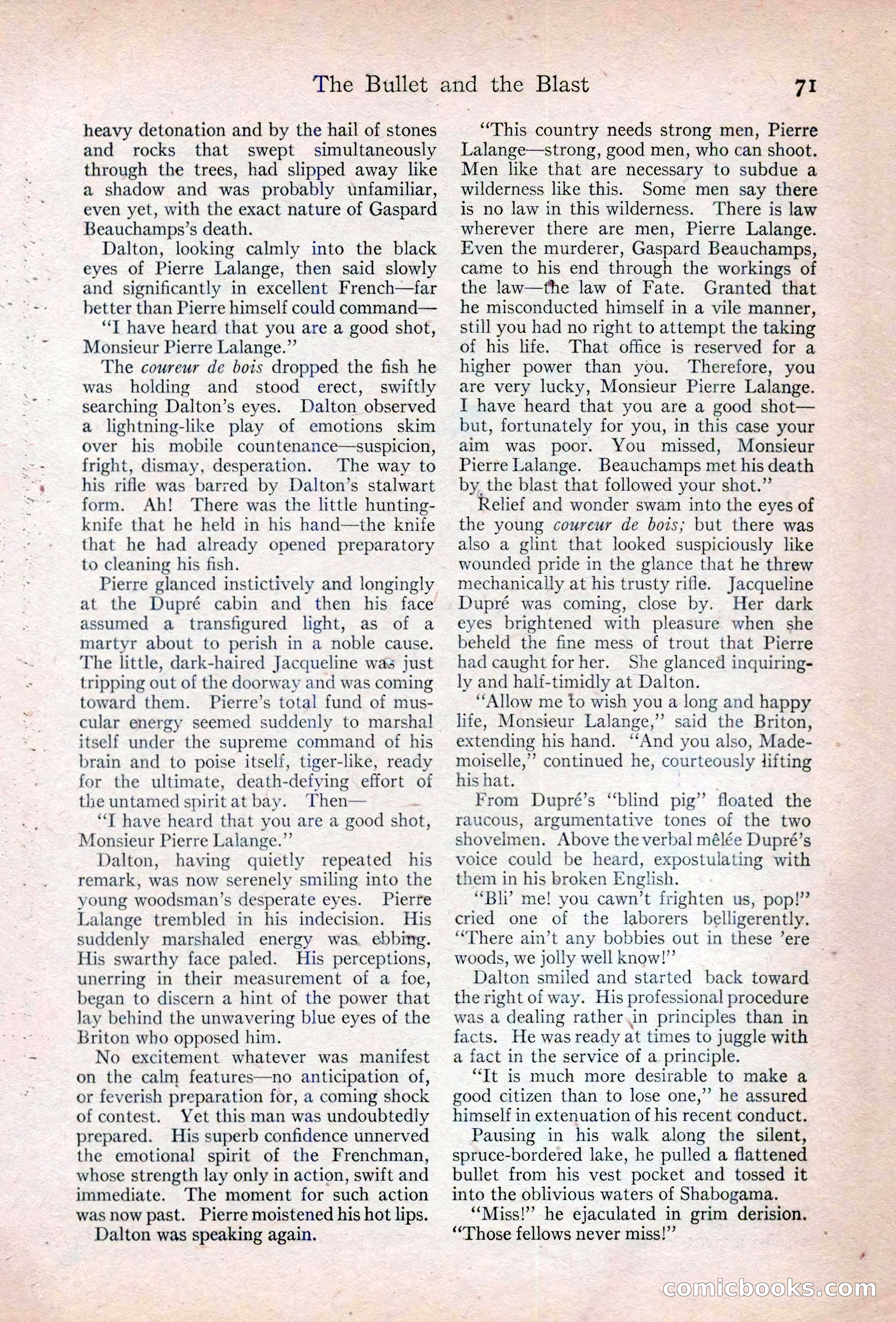
A restored page from Pulp Fiction, 1921. Page through the whole issue in the reader above.
📄 Transcribed text from this page (OCR, searchable)
Machine-transcribed from the original scan — historical spelling and the odd misread are preserved.
The Bullet and the Blast heavy detonation and by the hail of stones and rocks that swept simultaneously through the trees, had slipped away like a shadow and was probably unfamiliar, even yet, with the exact nature of Gaspard Beauchamps’s death. Dalton, looking calmly into the black eyes of Pierre Lalange, then said slowly and significantly in excellent French—far better than Pierre himself could command— ““T have heard that you are a good shot, Monsieur Pierre Lalange.”’ The coureur de bots dropped the fish he was holding and _ stood erect, swiftly searching Dalton’s eyes. Dalton observed a lightning-like play of emotions skim over his mobile countenance—suspicion, fright, dismay, desperation. The way to his rifle was barred by Dalton’s stalwart form. Ah! There was the little hunting- knife that he held in his hand—the knife that he had already opened preparatory to cleaning his fish. Pierre glanced instictively and longingly at the Dupré cabin and then his face assumed a transfigured light, as of a martyr about to perish in a noble cause. The little, dark-haired Jacqueline was just tripping out of the doorway and was coming toward them. Pierre’s total fund of mus- cular energy seemed suddenly to marshal itself under the supreme command of his brain and to poise itself, tiger-hke, ready for the ultimate, death-defying effort of the untamed spirit at bay. Then— “T have heard that you are a good shot, Monsieur Pierre Lalange.”’ Dalton, having quietly repeated his remark, was now serenely smiling into the young woodsman’s desperate eyes. Pierre Lalange trembled in his indecision. His suddenly marshaled energy was. ebbing. His swarthy face paled. His perceptions, unerring in their measurement of a foe, began to discern a hint of the power that lay behind the unwavering blue eyes of the Briton who opposed him. No excitement whatever was manifest on the calm features—no anticipation of, or feverish preparation for, a coming shock of contest. Yet this man was undoubtedly prepared. His superb confidence unnerved the emotional spirit of the Frenchman, whose strength lay only in action, swift and immediate. The moment for such action was now past. Pierre moistened his hot lips. Dalton was speaking again. 71 “This country needs strong men, Pierre Lalange—strong, good men, who can shoot. Men like that are necessary to subdue a wilderness like this. Some men say there is no law in this wilderness. There is law wherever there are men, Pierre Lalange. Even the murderer, Gaspard Beauchamps, came to his end through the workings of the law—the law of Fate. Granted that he misconducted himself in a vile manner, still you had no right to attempt the taking of his life. That office is reserved for a higher power than you. Therefore, you are very lucky, Monsieur Pierre Lalange. I have heard that you are a good shot— but, fortunately for you, in this case your aim was poor. You missed, Monsieur Pierre Lalange. Beauchamps met his death by. the blast that followed your shot.” Relief and wonder swam into the eyes of the young coureur de bois; but there was also a glint that looked suspiciously like wounded pride in the glance that he threw mechanically at his trusty rifle. Jacqueline Dupré was coming, close by. Her dark eyes brightened with pleasure when she beheld the fine mess of trout that Pierre had caught for her. She glanced inquiring- ly and half-timidly at Dalton. ‘‘Allow me to wish you a long and happy life, Monsieur Lalange,” said the Briton, extending his hand. ‘And you also, Made- moiselle,’’ continued he, courteously lifting his hat. From Dupré’s “blind pig” floated the raucous, argumentative tones of the two shovelmen. Above the verbal mélée Dupré’s voice could be heard, expostulating with them in his broken English. “Bl’ me! you cawn’t frighten us, pop!” cried one of the laborers belligerently. ‘There ain’t any bobbies out in these ’ere — |? woods, we jolly well know Dalton smiled and started back toward the right of way. His professional procedure was a dealing rather in principles than in facts. He was ready at times to juggle with a fact in the service of a principle. “Tt is much more desirable to make a good citizen than to lose one,” he assured himself in extenuation of his recent conduct. Pausing in his walk along the silent, spruce-bordered lake, he pulled a flattened bullet from his vest pocket and tossed it into the oblivious waters of Shabogama. ‘“‘Miss!”’ he ejaculated in grim derision. ‘Those fellows never miss!” COMMICLOOKS (F@)