
Pulp Fiction, 1921 · page 74 of 200
Adventure Magazine Cover — page 74: what you’re looking at
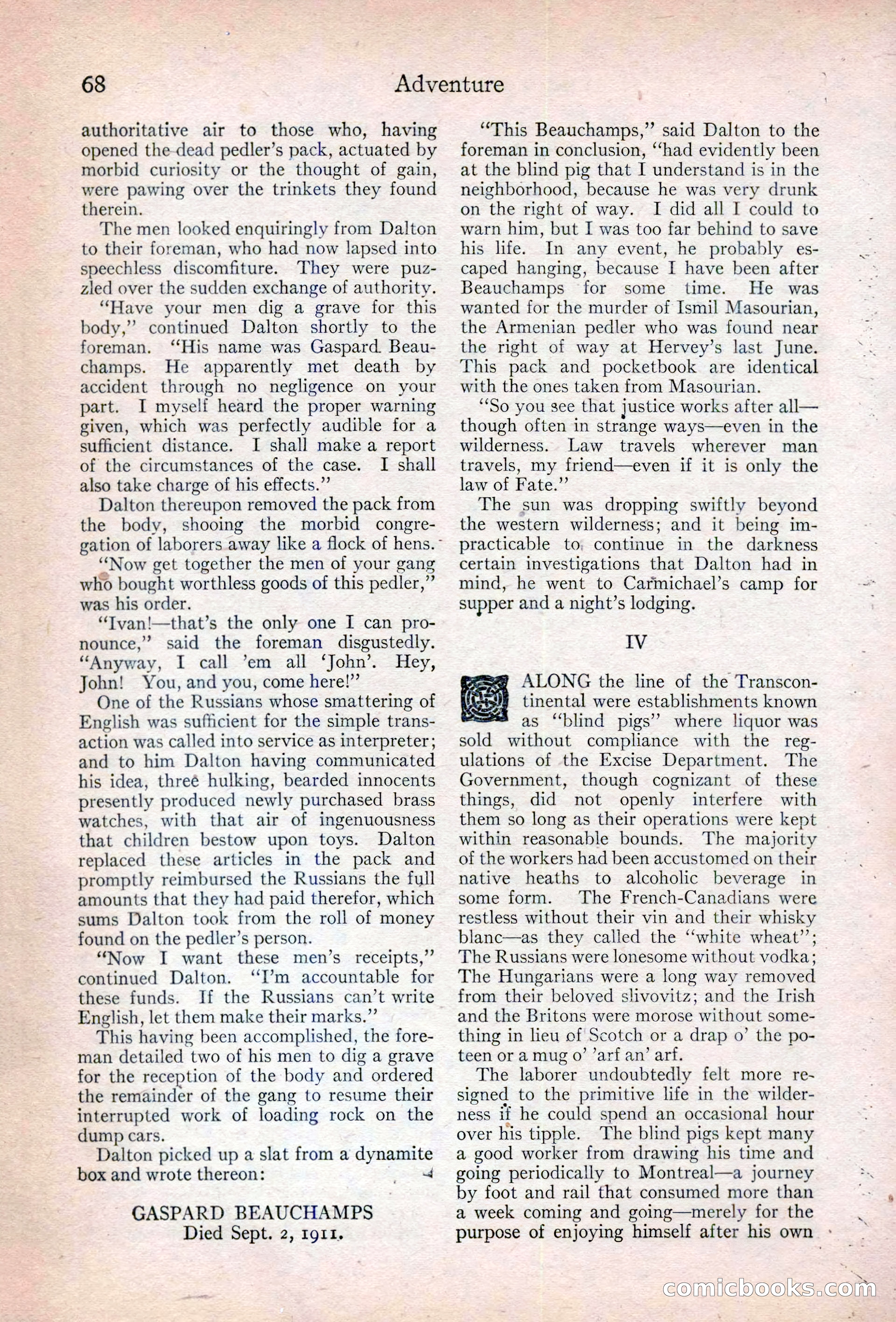
A restored page from Pulp Fiction, 1921. Page through the whole issue in the reader above.
📄 Transcribed text from this page (OCR, searchable)
Machine-transcribed from the original scan — historical spelling and the odd misread are preserved.
68 authoritative air to those who, having opened the-dead pedler’s pack, actuated by morbid curiosity or the thought of gain, were pawing over the trinkets they found therein. The men looked enquiringly from Dalton to their foreman, who had now lapsed into speechless discomfiture. They were puz- zled over the sudden exchange of authority. “Have your men dig a grave for this body,” continued Dalton shortly to the foreman. ‘‘His name was Gaspard. Beau- champs. He apparently met death by accident through no negligence on your part. I myself heard the proper warning given, which was perfectly audible for a sufficient distance. I shall make a report of the circumstances of the case. I shall also take charge of his effects.” Dalton thereupon removed the pack from the body, shooing the morbid congre- gation of laborers away like a flock of hens.~ ‘“‘Now get together the men of your gang who bought worthless goods of this pedler,” was his order. “Tvan!—that’s the only one I can pro- nounce,”’ said the foreman disgustedly. “Anyway, I call ’em all ‘John’. Hey, John! You, and you, come here!’’ One of the Russians whose smattering of English was sufficient for the simple trans- action was called into service as interpreter; and to him Dalton having communicated his idea, threé hulking, bearded innocents presently produced newly purchased brass watches, with that air of ingenuousness that children bestow upon toys. Dalton replaced these articles in the pack and promptly reimbursed the Russians the full amounts that they had paid therefor, which sums Dalton took from the roll of money found on the pedler’s person. “Now I want these men’s receipts,” continued Dalton. ‘I’m accountable for these funds. If the Russians can’t write English, let them make their marks.” This having been accomplished, the fore- man detailed two of his men to dig a grave for the reception of the body and ordered the remainder of the gang to resume their interrupted work of loading rock on the dump cars. Dalton picked up a slat from a dynamite box and wrote thereon: od GASPARD BEAUCHAMPS Died Sept. 2, 1911. Adventure “This Beauchamps,” said Dalton to the foreman in conclusion, ‘‘had evidently been at the blind pig that I understand is in the neighborhood, because he was very drunk on the right of way. I did all I could to warn him, but I was too far behind to save his life. In any event, he probably es- caped hanging, because I have been after Beauchamps for some time. He was wanted for the murder of Ismil Masourian, the Armenian pedler who was found near the right of way at Hervey’s last June. This pack and pocketbook are identical with the ones taken from Masourian. ‘‘So you see that justice works after all— though often in strange ways—even in the wilderness. Law travels wherever man travels, my friend—even if it is only the law of Fate.” The sun was dropping swiftly beyond the western wilderness; and it being im- practicable to, continue in the darkness certain investigations that Dalton had in mind, he went to Carmichael’s camp for supper and a night’s lodging. IV ALONG the line of the Transcon- tinental were establishments known as “blind pigs’ where liquor was sold without compliance with the reg- ulations of the Excise Department. The Government, though cognizant of these things, did not openly interfere with them so long as their operations were kept within reasonable bounds. The majority of the workers had been accustomed on their native heaths to alcoholic beverage in some form. The French-Canadians were restless without their vin and their whisky blanc—as they called the ‘“‘white wheat’; The Russians were lonesome without vodka; The Hungarians were a long way removed from their beloved slivovitz; and the Irish and the Britons were morose without some- thing in lieu of Scotch or a drap o’ the po- teen or a mug 0’ ’arf an’ arf. The laborer undoubtedly felt more re- signed to the primitive life in the wilder- ness if he could spend an occasional hour over his tipple. The blind pigs kept many a good worker from drawing his time and going periodically to Montreal—a journey by foot and rail that consumed more than a week coming and going—merely for the purpose of enjoying himself after his own COMMICLOOOkKS con