
Pulp Fiction, 1921 · page 62 of 200
Adventure Magazine Cover — page 62: what you’re looking at
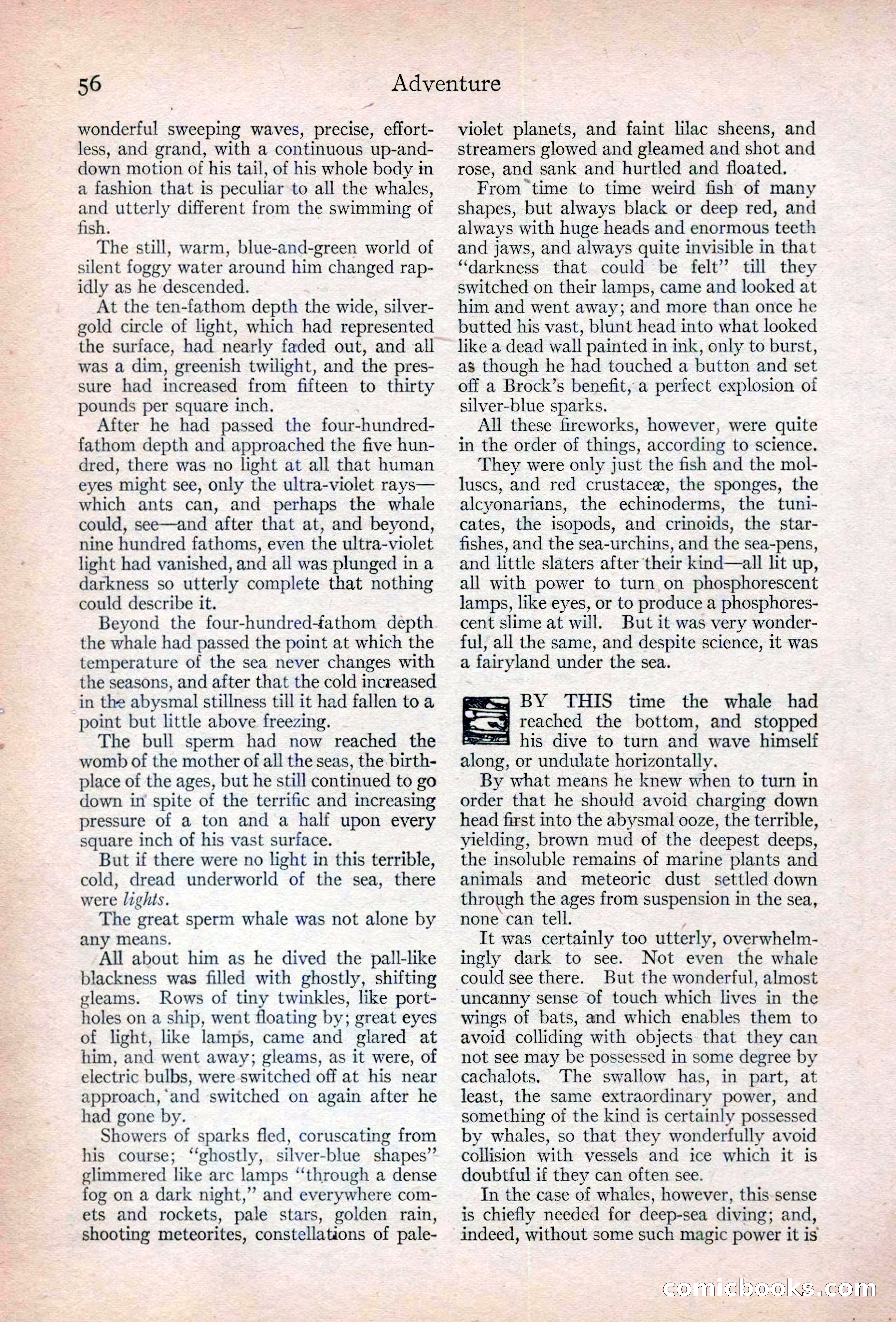
A restored page from Pulp Fiction, 1921. Page through the whole issue in the reader above.
📄 Transcribed text from this page (OCR, searchable)
Machine-transcribed from the original scan — historical spelling and the odd misread are preserved.
56 wonderful sweeping waves, precise, effort- less, and grand, with a continuous up-and- down motion of his tail, of his whole body tn a fashion that is peculiar to all the whales, and utterly different from the swimming of fish. The still, warm, blue-and-green world of silent foggy water around him changed rap- idly as he descended. At the ten-fathom depth the wide, silver- gold circle of light, which had represented the surface, had nearly faded out, and all was a dim, greenish twilight, and the pres- sure had increased from fifteen to thirty pounds per square inch. After he had passed the four-hundred- fathom depth and approached the five hun- dred, there was no light at all that human eyes might see, only the ultra-violet rays— which ants can, and perhaps the whale could, see—and after that at, and beyond, nine hundred fathoms, even the ultra-violet light had vanished, and all was plunged in a darkness so utterly complete that nothing could describe it. Beyond the four-hundred-fathom depth the whale had passed the point at which the temperature of the sea never changes with the seasons, and after that the cold increased in the abysmal stillness till it had fallen to a point but little above freezing. The bull sperm had now reached the womb of the mother of all the seas, the birth- place of the ages, but he still continued to go down in spite of the terrific and increasing pressure of a ton and a half upon every square inch of his vast surface. But if there were no light in this terrible, cold, dread underworld of the sea, there were lights. The great sperm whale was not alone by any means. All about him as he dived the pall-like blackness was filled with ghostly, shifting gleams. Rows of tiny twinkles, like port- holes on a ship, went floating by; great eyes of light, like lamps, came and glared at him, and went away; gleams, as it were, of electric bulbs, were switched off at his near approach, and switched on again after he had gone by. Showers of sparks fled, coruscating from his course; “ghostly, silver-blue shapes” glimmered like arc lamps “through a dense fog on a dark night,” and everywhere com- ets and rockets, pale stars, golden rain, shooting meteorites, constellations of pale- Adventure violet planets, and faint lilac sheens, and streamers glowed and gleamed and shot and rose, and sank and hurtled and floated. From time to time weird fish of many shapes, but always black or deep red, and always with huge heads and enormous teeth and jaws, and always quite invisible in that “darkness that could be felt” till they switched on their lamps, came and looked at him and went away; and more than once he butted his vast, blunt head into what looked like a dead wall painted in ink, only to burst, as though he had touched a button and set off a Brock’s benefit, a perfect explosion oi silver-blue sparks. All these fireworks, however, were quite in the order of things, according to science. They were only just the fish and the mol- luscs, and red crustacee, the sponges, the alcyonarians, the echinoderms, the tuni- cates, the isopods, and crinoids, the star- fishes, and the sea-urchins, and the sea-pens, and little slaters after their kind—all lit up, all with power to turn on phosphorescent lamps, like eyes, or to produce a phosphores- cent slime at will. But it was very wonder- ful, all the same, and despite science, it was a fairyland under the sea. gees BY THIS time the whale had Rw reached the bottom, and stopped a=2rd his dive to turn and wave himself along, or undulate horizontally. By what means he knew when to turn in order that he should avoid charging down head first into the abysmal ooze, the terrible, yielding, brown mud of the deepest deeps, the insoluble remains of marine plants and animals and meteoric dust settled down through the ages from suspension in the sea, none can tell. It was certainly too utterly, overwhelm- ingly dark to see. Not even the whale could see there. But the wonderful, almost uncanny sense of touch which lives in the wings of bats, and which enables them to avoid colliding with objects that they can not see may be possessed in some degree by cachalots. The swallow has, in part, at least, the same extraordinary power, and something of the kind is certainly possessed by whales, so that they wonderfully avoid collision with vessels and ice which it is doubtful if they can often see. In the case of whales, however, this sense is chiefly needed for deep-sea diving; and, indeed, without some such magic power it is (O) NOOLKS ANC (C@