
Pulp Fiction, 1921 · page 50 of 200
Adventure Magazine Cover — page 50: what you’re looking at
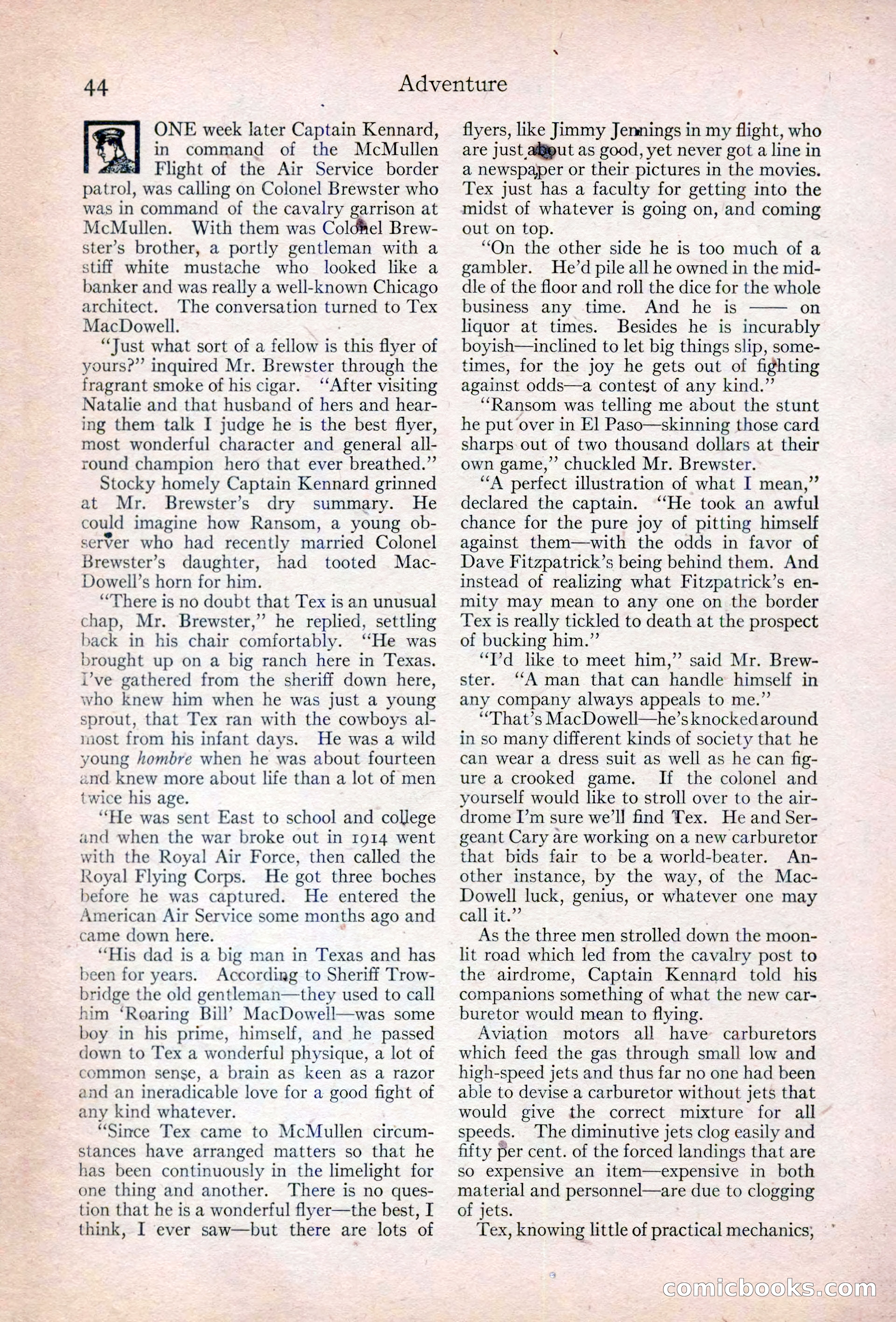
A restored page from Pulp Fiction, 1921. Page through the whole issue in the reader above.
📄 Transcribed text from this page (OCR, searchable)
Machine-transcribed from the original scan — historical spelling and the odd misread are preserved.
44 ONE week later Captain Kennard, in command of the McMullen Flight of the Air Service border patrol, was calling on Colonel Brewster who was in command of the cavalry garrison at McMullen. With them was Coldfel Brew- ster’s brother, a portly gentleman with a stiff white mustache who looked like a banker and was really a well-known Chicago architect. The conversation turned to Tex MacDowell. “Just what sort of a fellow is ice flyer of yours?” inquired Mr. Brewster through the fragrant smoke of his cigar. ‘‘After visiting Natalie and that husband of hers and hear- ing them talk I judge he is the best flyer, most wonderful character and general all- round champion hero that ever breathed.” Stocky homely Captain Kennard grinned at Mr. Brewster’s dry summary. He could imagine how Ransom, a young ob- server who had recently married Colonel Brewster’s daughter, had tooted Mac- Dowell’s horn for him. ‘There is no doubt that Tex is an unusual chap, Mr. Brewster,’ he replied, settling back in his chair comfortably. “He was brought up on a big ranch here in Texas. i’ve gathered from the sheriff down here, who knew him when he was just a young sprout, that Tex ran with the cowboys al- most from his infant days. He was a wild young kombre when he was about fourteen and knew more about life than a lot of men twice his age. ‘““He was sent East to school and college and when the war broke out in 1914 went with the Royal Air Force, then called the Royal Flying Corps. He got three boches before he was captured. He entered the American Air Service some months ago and came down here. “His dad is a big man in Texas and has been for years. According to Sheriff Trow- bridge the old gentleman—they used to call him ‘Rearing Bill’ MacDowell—was some boy in his prime, himself, and he passed down to Tex a wonderful physique, a lot of common sense, a brain as keen as a razor and an ineradicable love for a good fight of any kind whatever. “Since Tex came to McMullen circum- stances have arranged matters so that he has been continuously in the limelight for one thing and another. There is no ques- tion that he is a wonderful flyer—the best, I think, I ever saw—but there are lots of Adventure flyers, like Jimmy Jennings in my flight, who are just ai§put as good, yet never got a line in a newspaper or their pictures in the movies. Tex just has a faculty for getting into the midst of whatever is going on, and coming out on top. “On the other side he is too much of a gambler. He’d pile all he owned in the mid- dle of the floor and roll the dice for the whole business any time. And he is on liquor at times. Besides he is incurably boyish—inclined to let big things slip, some- times, for the joy he gets out of fighting against odds—a contest of any kind.” ‘Ransom was telling me about the stunt he put over in E] Paso—skinning those card sharps out of two thousand dollars at their own game,” chuckled Mr. Brewster. ‘““A perfect illustration of what I mean,” declared the captain. “He took an awful chance for the pure joy of pitting himself against them—with the odds in favor of Dave Fitzpatrick’s being behind them. And instead of realizing what Fitzpatrick’s en- mity may mean to any one on the border Tex is really tickled to death at the prospect of bucking him.” “T’d like to meet him,” said Mr. Brew- ster. “‘A man that can handle himself in any company always appeals to me.” ‘““That’s MacDowell—he’s knocked around in so many different kinds of society that he can wear a dress suit as well as he can fig- ure a crooked game. If the colonel and yourself would like to stroll over to the air- drome I’m sure we'll find Tex. He and Ser- geant Cary are working on a new carburetor that bids fair to be a world-beater. An- other instance, by the way, of the Mac- Dowell luck, genius, or whatever one may call it.” : As the three men strolled down the moon- lit road which led from the cavalry post to the airdrome, Captain Kennard told his companions something of what the new car- buretor would mean to flying. Aviation motors all have carburetors which feed the gas through small low and high-speed jets and thus far no one had been able to devise a carburetor without jets that would give the correct mixture for all speeds. The diminutive jets clog easily and fifty per cent. of the forced landings that are sO expensive an item—expensive in both material and personnel—are due to clogging of jets. Tex, knowing little of practical mechanics, CORNICLOOOKS (C@