
Pulp Fiction, 1921 · page 116 of 200
Adventure Magazine Cover — page 116: what you’re looking at
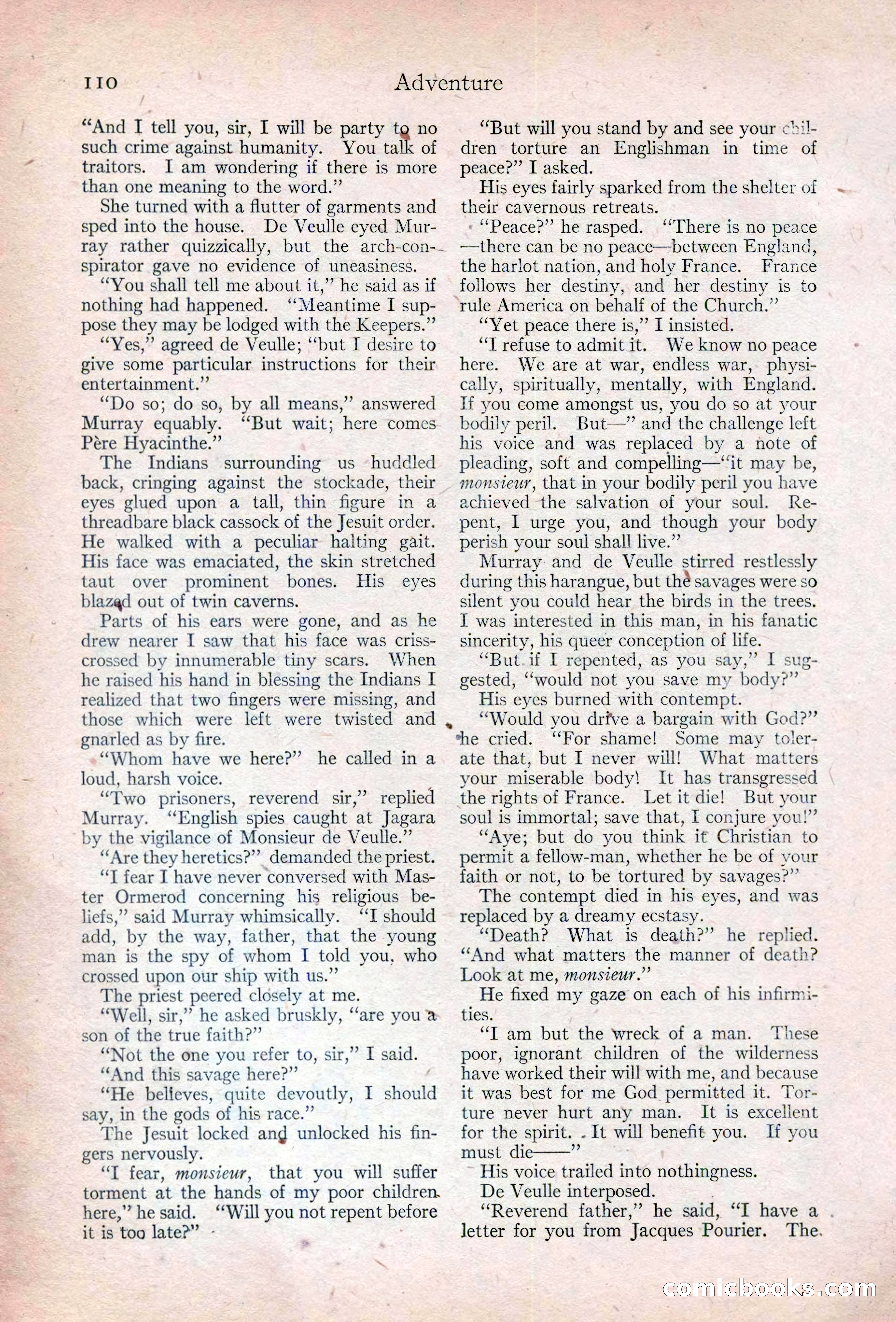
A restored page from Pulp Fiction, 1921. Page through the whole issue in the reader above.
📄 Transcribed text from this page (OCR, searchable)
Machine-transcribed from the original scan — historical spelling and the odd misread are preserved.
IIo “And I tell you, sir, I will be party tg no such crime against humanity. You talk of traitors. I am wondering if there is more than one meaning to the word.” She turned with a flutter of garments and sped into the house. De Veulle eyed Mur- ray rather quizzically, but the arch-con-— spirator gave no evidence of uneasiness. “You shall tell me about it,” he said as if nothing had happened. “Meantime I sup- pose they may be lodged with the Keepers.” “Ves,” agreed de Veulle; “but I desire to give some particular instructions for their entertainment.” “Do so; do so, by all means,” answered Murray equably. “But wait; here comes Pere Hyacinthe.” The Indians surrounding us huddled back, cringing against the stockade, their eyes glued upon a tall, thin figure in a threadbare black cassock of the Jesuit order. He walked with a peculiar halting gait. His face was emaciated, the skin stretched taut over prominent bones. His eyes blazad out of twin caverns. Parts of his ears were gone, and as he drew nearer I saw that his face was criss- crossed by innumerable tiny scars. When he raised his hand in blessing the Indians I realized that two fingers were missing, and i) those which were left were twisted and , gnarled as by fire. “Whom have we here?” loud, harsh voice. “Two prisoners, reverend sir,’ replied Murray. “English spies caught at Jagara by the vigilance of Monsieur de Veulle.”’ “Are they heretics?” demanded the priest. “T fear I have never conversed with Mas- ter Ormerod concerning his religious be- liefs,” said Murray whimsically. ‘T should add, by the way, father, that the young man is the spy of whom I told you, who crossed upon our ship with us.’ The priest peered closely at me. “Well, sir,’ he asked bruskly, “are you a son of the true faith?” “Not the one you refer to, sir,” I said. “And this savage here?” “He believes, quite devoutly, I should say, in the gods of his race.” The Jesuit locked ang unlocked his fin- gers nervously. “T fear, monsieur, that you will suffer torment at the hands of my poor children. here,” he said. ‘Will you not repent before it is too late?” - , he called in a Adventure “But will you stand by and see your chil- dren torture an Englishman in time of peace?” I asked. His eyes fairly sparked from the shelter of their cavernous retreats. * “Peace?” he rasped. ‘There is no peace —there can be no peace—between England, the harlot nation, and holy France. France follows her destiny, and her destiny is to rule America on behalf of the Church.” ‘Yet peace there is,” I insisted. “T refuse to admit it. We know no peace here. We are at war, endless war, physi- cally, spiritually, mentally, with England. If you come amongst us, you do so at your bodily peril. But—” and the challenge left his voice and was replaced by a hote of pleading, soft and compelling—‘it may be, monsteur, that in your bodily peril you have achieved the salvation of your soul. Re- pent, I urge you, and though your body perish your soul shall live.” Murray and de Veulle stirred restlessly during this harangue, but thé savages were so silent you could hear the birds in the trees. I was interested in this man, in his fanatic sincerity, his queer conception of life. ‘“But.if I repented, as you say,” I sug- gested, “would not you save my body?” His eyes burned with contempt. “Would you drive a bargain with God?” the cried. ‘‘For shame! Some may toler- ate that, but I never will! What matters your miserable body) It has transgressed the rights of France. Let it die! But your soul is immortal; save that, I conjure you!” “Aye; but do you think if Christian to permit a fellow-man, whether he be of your faith or not, to be tortured by savages?” The contempt died in his eyes, and was replaced by a dreamy ecstasy. “Death? What is death?” he replied. “And what matters the manner of death? Look at me, monsiteur.”’ He fixed my gaze on each of his infirmi- ties. “T am but the wreck of a man. These poor, ignorant children of the wilderness have worked their will with me, and because it was best for me God permitted it. Tor- ture never hurt any man. It is excellent for the spirit. - It will benefit you. If you must die——”’ His voice trailed into nothingness. De Veulle interposed. “Reverend father,” he said, Jetter for you from Jacques Pourier. EORIICLOO© C Ss “T have a. The. (C@