
Pulp Fiction, 1921 · page 113 of 200
Adventure Magazine Cover — page 113: what you’re looking at
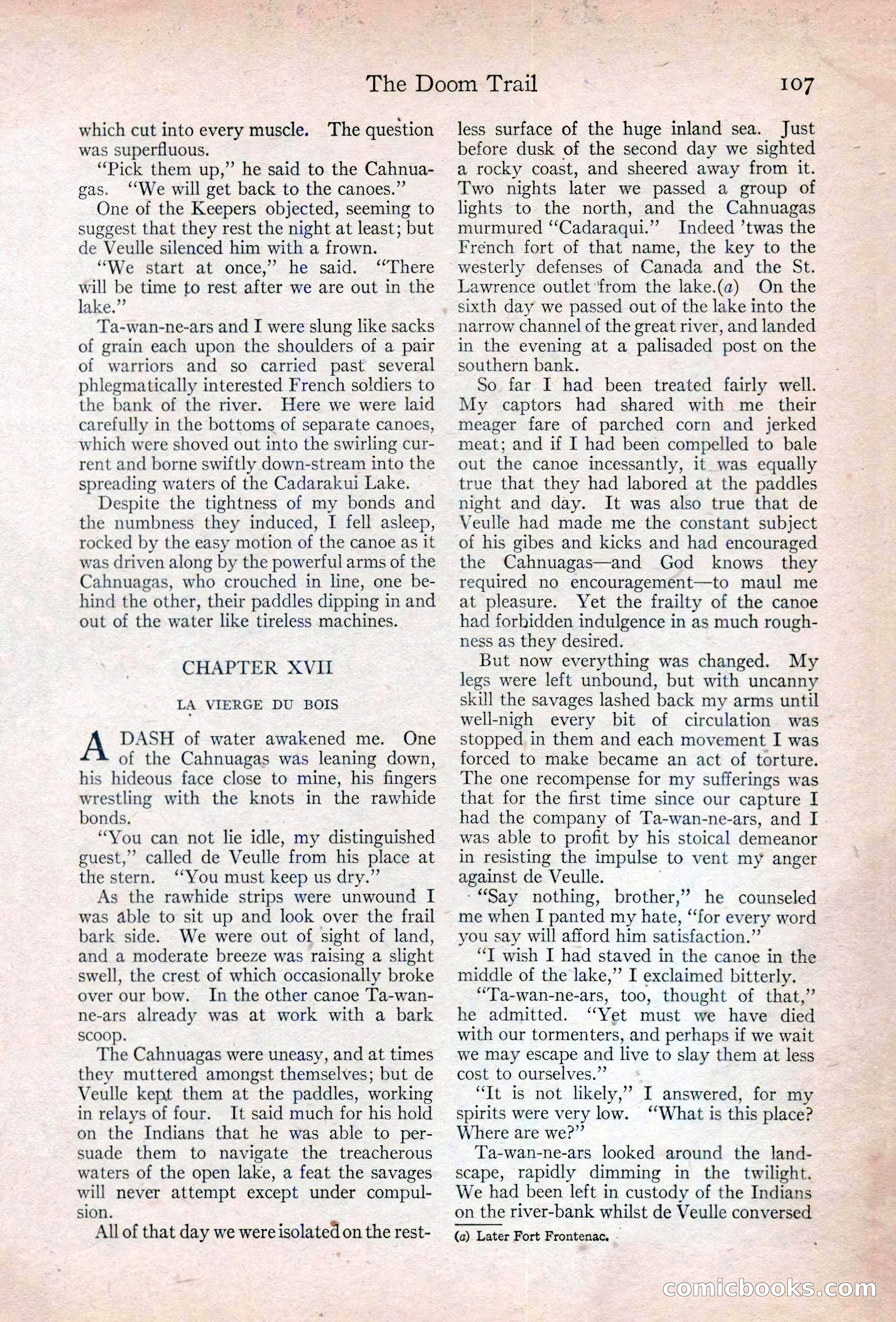
A restored page from Pulp Fiction, 1921. Page through the whole issue in the reader above.
📄 Transcribed text from this page (OCR, searchable)
Machine-transcribed from the original scan — historical spelling and the odd misread are preserved.
The Doom Trail which cut into every muscle. The question was superfluous. “Pick them up,” he said to the Cahnua- gas. ‘We will get back to the canoes.” One of the Keepers objected, seeming to suggest that they rest the night at least; but de Veulle silenced him with a frown. “We start at once,” he said. ‘There will be time to rest after we are out in the lake.” Ta-wan-ne-ars and I were slung like sacks of grain each upon the shoulders of a pair of warriors and so carried past several phlegmatically interested French soldiers to the bank of the river. Here we were laid carefully in the bottoms of separate canoes, which were shoved out into the swirling cur- rent and borne swiftly down-stream into the spreading waters of the Cadarakui Lake. Despite the tightness of my bonds and the numbness they induced, I fell asleep, rocked by the easy motion of the canoe as it was driven along by the powerful arms of the Cahnuagas, who crouched in line, one be- hind the other, their paddles dipping in and out of the water like tireless machines. CHAPTER XVII LA VIERGE DU BOIS DASH of water awakened me. One of the Cahnuagas was leaning down, his hideous face close to mine, his fingers wrestling with the knots in the rawhide bonds. “You can not lie idle, my distinguished guest,” called de Veulle from his place at the stern. ‘‘You must keep us dry.” As the rawhide strips were unwound I was able to sit up and look over the frail bark side. We were out of sight of land, and a moderate breeze was raising a slight swell, the crest of which occasionally broke over our bow. In the other canoe Ta-wan- ne-ars already was at work with a bark scoop. The Cahnuagas were uneasy, and at times they muttered amongst themselves; but de Veulle kept them at the paddles, working in relays of four. It said much for his hold on the Indians that he was able to per- suade them to navigate the treacherous waters of the open lake, a feat the savages will never attempt except under compul- sion. All of that day we were isolated on the rest- 107 less surface of the huge inland sea. Just before dusk of the second day we sighted a rocky coast, and sheered away from it. Two nights later we passed a group of lights to the north, and the Cahnuagas murmured “‘Cadaraqui.” Indeed ’twas the French fort of that name, the key to the westerly defenses of Canada and the St. Lawrence outlet from the lake.(a) On the sixth day we passed out of the lake into the narrow channel of the great river, and landed in the evening at a palisaded post on the southern bank. So far I had been treated fairly well. My captors had shared with me their meager fare of parched corn and jerked meat; and if I had been compelled to bale out the canoe incessantly, it was equally true that they had labored at the paddles night and day. It was also true that de Veulle had made me the constant subject of his gibes and kicks and had encouraged the Cahnuagas—and God knows they required no encouragement—to maul me at pleasure. Yet the frailty of the canoe had forhidden indulgence in as much rough- ness as they desired. But now everything was changed. My legs were left unbound, but with uncanny skill the savages lashed back my arms until well-nigh every bit of circulation was stopped in them and each movement I was forced to make became an act of torture. The one recompense for my sufferings was that for the first time since our capture I had the company of Ta-wan-ne-ars, and I was able to profit by his stoical demeanor in resisting the impulse to vent my anger against de Veulle. - “Say nothing, brother,’ he counseled me when I panted my hate, ‘for every word you say will afford him satisfaction.” “T wish I had staved in the canoe in the middle of the lake,” I exclaimed bitterly. ‘““Ta-wan-ne-ars, too, thought of that,” he admitted. “Yet must we have died with our tormenters, and perhaps if we wait we may escape and live to slay them at less cost to ourselves.” “It is not likely,” I answered, for my spirits were very low. ‘What is this place? Where are we?” Ta-wan-ne-ars looked around the land- scape, rapidly dimming in the twilight. We had been left in custody of the Indians on the river-bank whilst de Veulle conversed (a) Later Fort Frontenac, (EO) VOOKS (F@)