
Pulp Fiction, 1921 · page 106 of 200
Adventure Magazine Cover — page 106: what you’re looking at
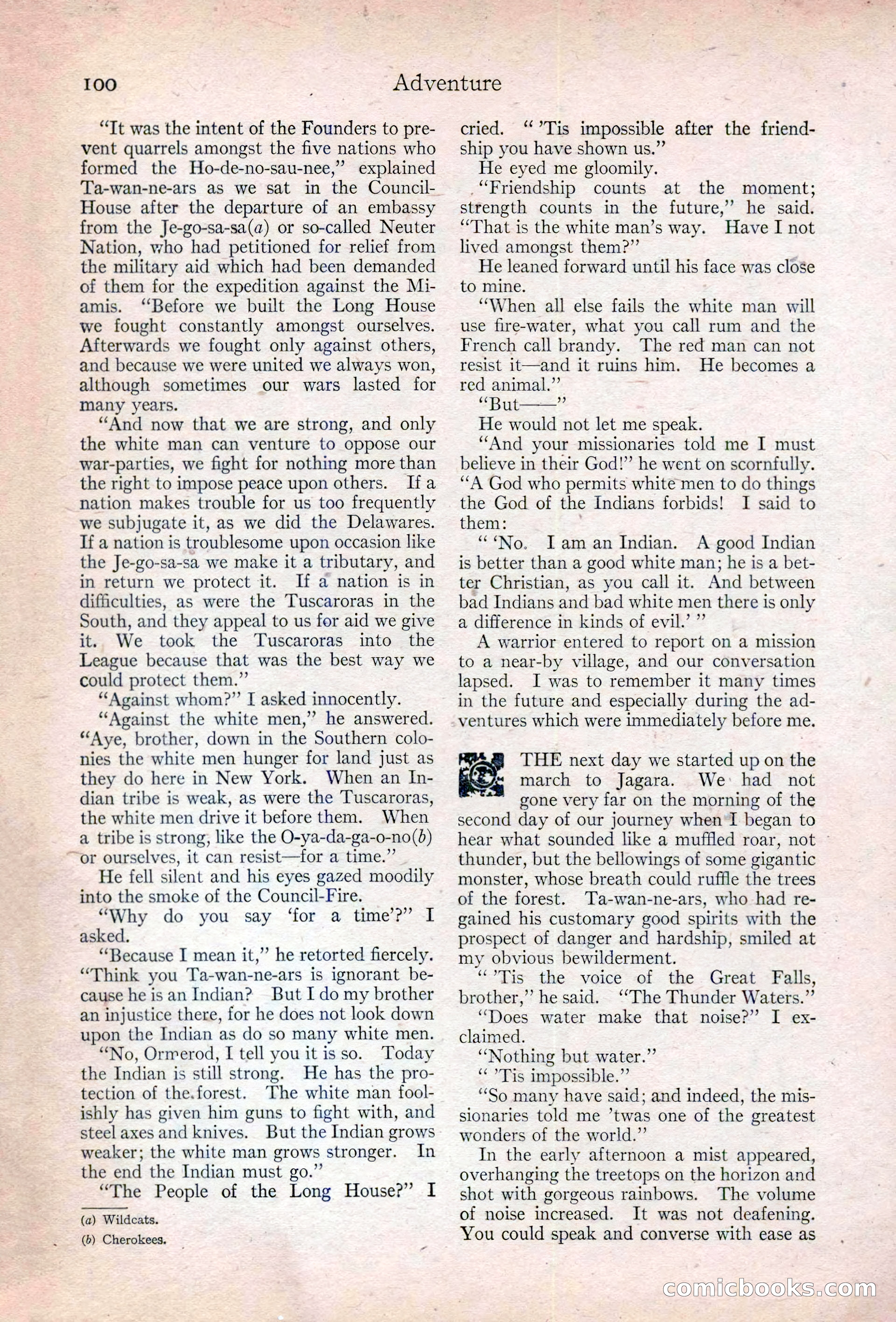
A restored page from Pulp Fiction, 1921. Page through the whole issue in the reader above.
📄 Transcribed text from this page (OCR, searchable)
Machine-transcribed from the original scan — historical spelling and the odd misread are preserved.
100 “Tt was the intent of the Founders to pre- vent quarrels amongst the five nations who formed the Ho-de-no-sau-nee,” explained Ta-wan-ne-ars as we sat in the Council- House after the departure of an embassy from the Je-go-sa-sa(a) or so-called Neuter Nation, who had petitioned for relief from the military aid which had been demanded of them for the expedition against the Mi- amis. ‘Before we built the Long House we fought constantly amongst ourselves. Afterwards we fought only against others, and because we were united we always won, although sometimes our wars lasted for many years. “And now that we are strong, and only the white man can venture to oppose our war-parties, we fight for nothing more than the right to impose peace upon others. Ifa nation makes trouble for us too frequently we subjugate it, as we did the Delawares. If a nation is troublesome upon occasion like the Je-go-sa-sa we make it a tributary, and in return we protect it. If a nation is in difficulties, as were the Tuscaroras in the South, and they appeal to us for aid we give it. We took the Tuscaroras into the League because that was the best way we could protect them.” “Against whom?” I asked innocently. “Against the white men,” he answered. *‘Aye, brother, down in the Southern colo- nies the white men hunger for land just as they do here in New York. When an In- dian tribe is weak, as were the Tuscaroras, the white men drive it before them. When a tribe is strong, like the O-ya-da-ga-o-no(d) ~or ourselves, it can resist—for a time.” He fell silent and his eyes gazed moodily into the smoke of the Council-Fire. “Why do you say ‘for a time’?”’ I asked. “Because I mean it,’ he retorted fiercely. “Think you Ta-wan-ne-ars is ignorant be- cause he is an Indian? But I do my brother an injustice there, for he does not look down upon the Indian as do so many white men. “No, Ormerod, I tell youitisso. Today the Indian is still strong. He has the pro- tection of the.forest. The white man fool- ishly has given him guns to fight with, and steel axes and knives. But the Indian grows weaker; the white man grows stronger. In the end the Indian must go.” “The People of the Long House?” I (a) Wildcats. (b) Cherokees. Adventure cried. “’Tis impossible after the friend- ship you have shown us.” He eyed me gloomily. “Friendship counts at the moment; strength counts in the future,” he said. ‘That is the white man’s way. Have I not lived amongst them?”’ He leaned forward until his face was close to mine. ‘When all else fails the white man will use fire-water, what you call rum and the French call brandy. The red man can not resist it—and it ruins him. He becomes a red animal.” “But 9) He would not let me speak. ‘And your missionaries told me I must believe in their God!” he went on scornfully. ‘‘A God who permits white men to do things the God of the Indians forbids! I said to them: 3 “ “No. Iam an Indian. A good Indian is better than a good white man; he is a bet- ter Christian, as you call it. And between bad Indians and bad white men there is only a difference in kinds of evil.’ ” A warrior entered to report on a mission to a near-by village, and our conversation lapsed. I was to remember it many times in the future and especially during the ad- ventures which were immediately before me. ARs Has march to Jagara. We: had not 3 gone very far on the morning of the second day of our journey when I began to THE next day we started up on the hear what sounded like a muffled roar, not © thunder, but the bellowings of some gigantic monster, whose breath could ruffle the trees of the forest. Ta-wan-ne-ars, who had re- gained his customary good spirits with the prospect of danger and hardship, smiled at my obvious bewilderment. “°Tis the voice of the Great Falls, brother,’ he said. ‘“The Thunder Waters.” “Does water make that noise?” I ex- claimed. “Nothing but water.”’ ‘Tis impossible.”’ “So many have said; and indeed, the mis- sionaries told me ’twas one of the greatest wonders of the world.”’ In the early afternoon a mist appeared, overhanging the treetops on the horizon and shot with gorgeous rainbows. The volume of noise increased. It was not deafening. You could speak and converse with ease as CORNICGLOO© S (C@