
Pulp Fiction, 1921 · page 101 of 200
Adventure Magazine Cover — page 101: what you’re looking at
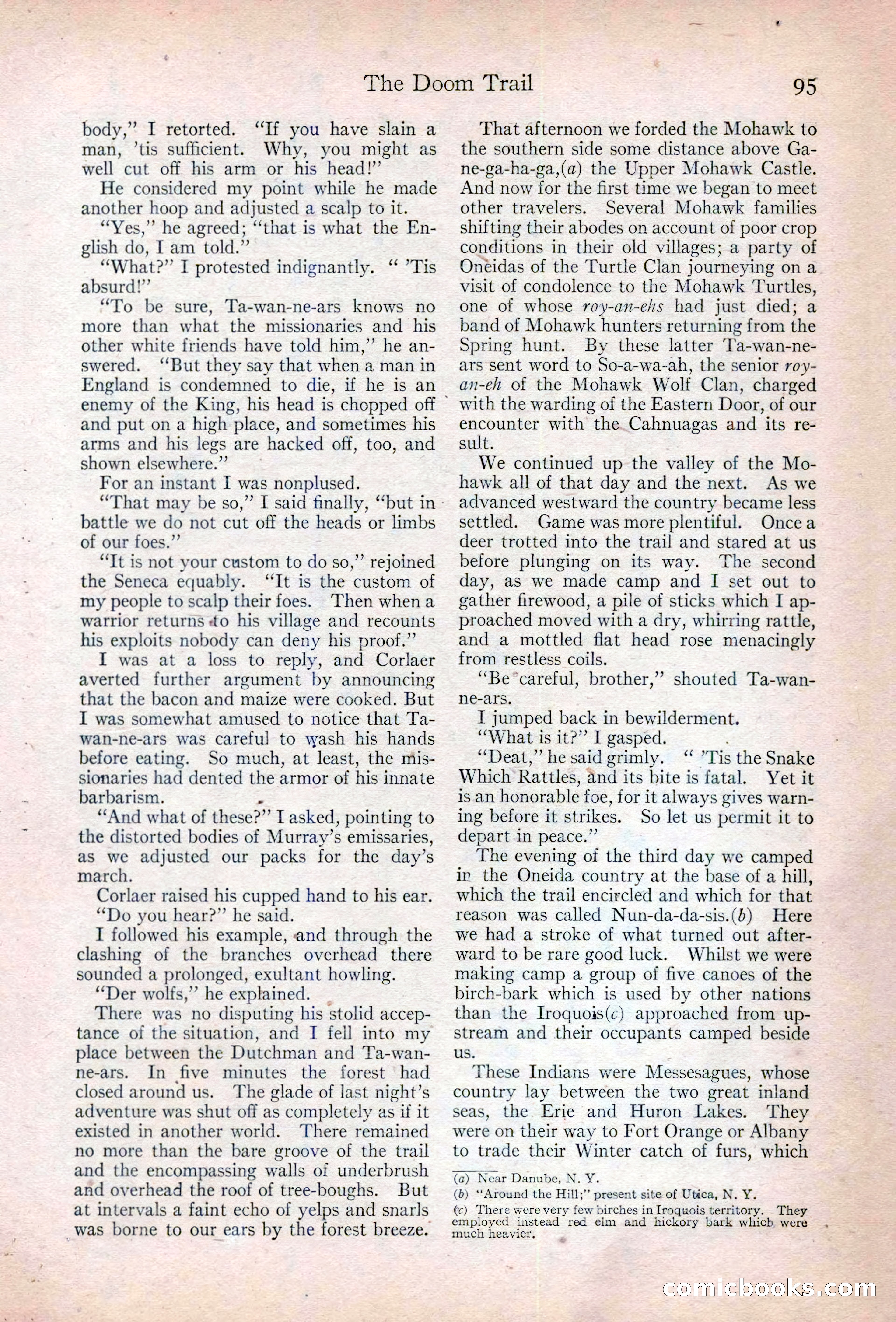
A restored page from Pulp Fiction, 1921. Page through the whole issue in the reader above.
📄 Transcribed text from this page (OCR, searchable)
Machine-transcribed from the original scan — historical spelling and the odd misread are preserved.
The Doom Trail body,” I retorted. “If you have slain a man, ‘tis sufficient. Why, you might as well cut off his arm or his head!’ He considered my point while he made another hoop and adjusted a scalp to it. “Ves,” he agreed; “that is what the En- glish do, I am told.” “What?” I protested indignantly. “ ’Tis absurd!” “To be sure, Ta-wan-ne-ars knows no more than what the missionaries and his other white friends have told him,” he an- swered. “But they say that when a man in England is condemned to die, if he is an enemy of the King, his head is chopped off and put on a high place, and sometimes his arms and his legs are hacked off, too, and shown elsewhere.” For an instant I was nonplused. “That may be so,” I said finally, “but in - battle we do not cut off the heads or limbs of our foes.” “Tt is not your custom to do so,”’ rejoined the Seneca equably. “It is the custom of my people to scalp their foes. Then whena warrior returns eo his village and recounts his exploits nobody can deny his proof.”’ I was at a loss to reply, and Corlaer averted further argument by announcing that the bacon and maize were cooked. But I was somewhat amused to notice that Ta- wan-ne-ars was careful to wash his hands before eating. So much, at least, the mis- sionaries had dented the armor of his innate barbarism. z “‘And what of these?” I asked, pointing to the distorted bodies of Murray’s emissaries, as we adjusted our packs for the day’s march. Corlaer raised his cupped hand to his ear. “Do you hear?” he said. I followed his example, and through the clashing of the branches overhead there sounded a prolonged, exultant howling. “Der wolfs,” he explained. _ There was no disputing his stolid accep- tance of the situation, and I fell into my place between the Dutchman and Ta-wan- ne-ars. In five minutes the forest had closed around us. ‘The glade of last night’s adventure was shut off as completely as if it existed in another world. There remained no more than the bare groove of the trail and the encompassing walls of underbrush and overhead the roof of tree-boughs. But at intervals a faint echo of yelps and snarls was borne to our ears by the forest breeze. 93 That afternoon we forded the Mohawk to the southern side some distance above Ga- ne-ga-ha-ga,(a) the Upper Mohawk Castle. And now for the first time we began to meet other travelers. Several Mohawk families shifting their abodes on account of poor crop conditions in their old villages; a party of Oneidas of the Turtle Clan journeying on a visit of condolence to the Mohawk Turtles, one of whose roy-an-ehs had just died; a band of Mohawk hunters returning from the Spring hunt. By these latter Ta-wan-ne- ars sent word to So-a-wa-ah, the senior roy- an-eh of the Mohawk Wolf Clan, charged ~ with the warding of the Eastern Door, of our encounter with the Cahnuagas and its re- sult. We continued up the valley of the Mo- hawk all of that day and the next. As we advanced westward the country became less settled. Game was more plentiful. Oncea deer trotted into the trail and stared at us before plunging on its way. The second day, as we made camp and [I set out to gather firewood, a pile of sticks which I ap- proached moved with a dry, whirring rattle, and a mottled flat head rose menacingly from restless coils. “Be careful, brother,’ ne-ars. T jumped back in bewilderment. “What is it?” I gasped. “Deat,” he said grimly. “ ’Tis the Snake Which Rattles, and its bite is fatal. Yet it is an honorable foe, for it always gives warn- ing before it strikes. So let us permit it to depart in peace.” The evening of the third day we camped in the Oneida country at the base of a hill, which the trail encircled and which for that reason was called Nun-da-da-sis.(b) Here ) shouted Ta-wan- we had a stroke of what turned out after- — ward to be rare good luck. Whilst we were making camp a group of five canoes of the birch-bark which is used by other nations than the Iroquois(c) approached from up- stream and their occupants camped beside us. These Indians were Messesagues, whose country lay between the two great inland seas, the Erie and Huron Lakes. They were on their way to Fort Orange or Albany to trade their Winter catch of furs, which (a) Near Danube, N. Y. (6) ‘‘Around the Hill;” present site of Utaca, N. Y. (c) There were very few birches in Iroquois territory. They employed instead red elm and hickory bark which were much heavier, CORMICOOOKS (©)