
Pulp Fiction, 1921 · page 10 of 200
Adventure Magazine Cover — page 10: what you’re looking at
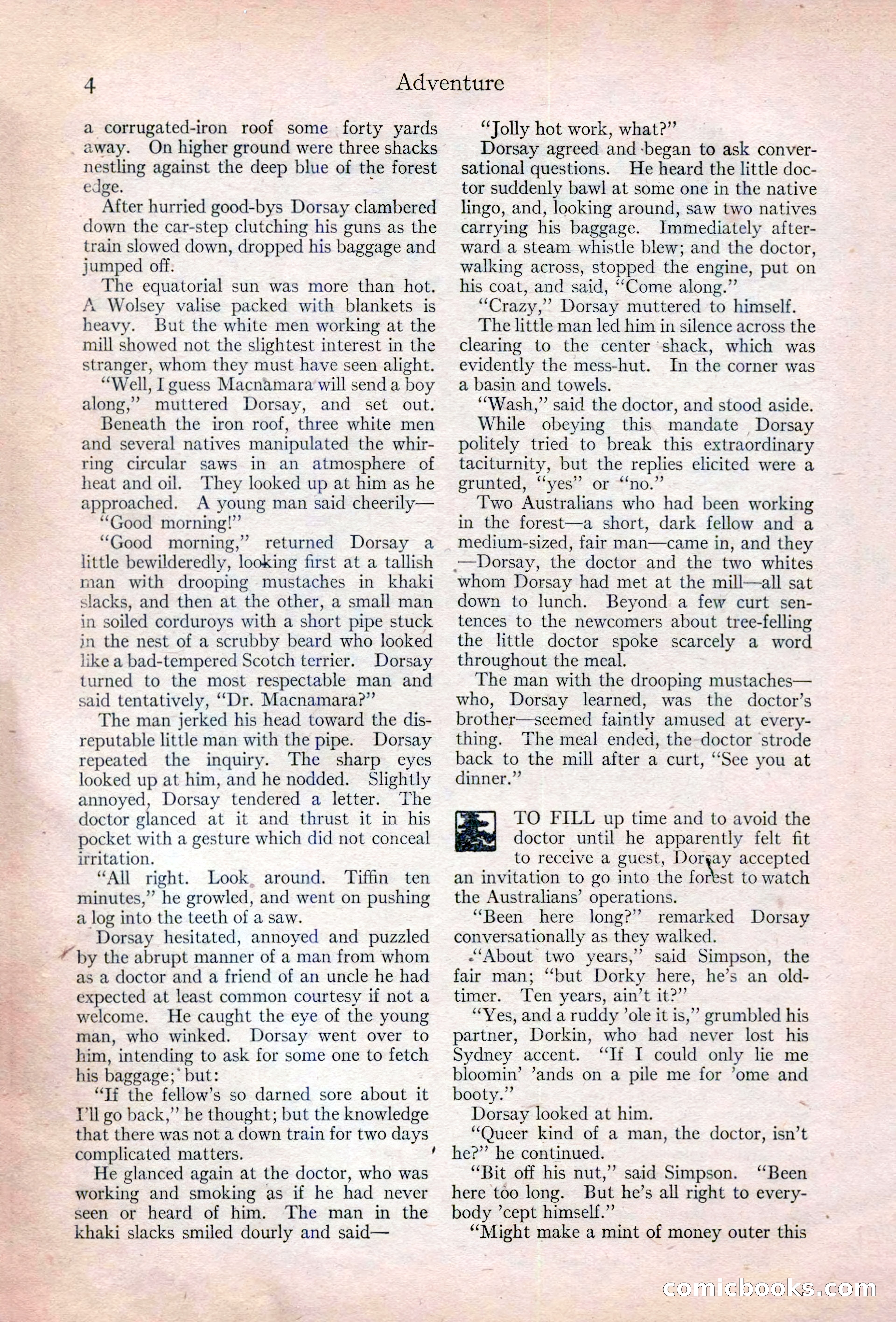
A restored page from Pulp Fiction, 1921. Page through the whole issue in the reader above.
📄 Transcribed text from this page (OCR, searchable)
Machine-transcribed from the original scan — historical spelling and the odd misread are preserved.
4 Adventure a corrugated-iron roof some forty yards away. On higher ground were three shacks nestling against the deep blue of the forest edge. After hurried good-bys Dorsay clambered down the car-step clutching his guns as the train slowed down, dropped his baggage and jumped off. The equatorial sun was more than hot. A. Wolsey valise packed with blankets is heavy. But the white men working at the mill showed not the slightest interest in the stranger, whom they must have seen alight. “Well, I guess Macnamara will send a boy along,” muttered Dorsay, and set out. Beneath the iron roof, three white men and several natives manipulated the whir- ring circular saws in an atmosphere of heat and oil. They looked up at him as he approached. A young man said cheerily— “Good morning!” “Good morning,” returned Dorsay a little bewilderedly, looking first at a tallish man with drooping mustaches in khaki slacks, and then at the other, a small man in soiled corduroys with a short pipe stuck in the nest of a scrubby beard who looked like a bad-tempered Scotch terrier. Dorsay turned to the most respectable man and said tentatively, “Dr. Macnamara?” The man jerked his head toward the dis- reputable little man with the pipe. Dorsay repeated the inquiry. The sharp eyes looked up at him, and he nodded. Slightly annoyed, Dorsay tendered a letter. The doctor glanced at it and thrust it in his pocket with a gesture which did not conceal irritation. “All right. Look, around. Tiffin ten minutes,” he growled, and went on pushing a log into the teeth of a saw. Dorsay hesitated, annoyed and puzzled * by the abrupt manner of a man from whom as a doctor and a friend of an uncle he had expected at least common courtesy if not a welcome. He caught the eye of the young man, who winked. Dorsay went over to him, intending to ask for some one to fetch his baggage; but: “Tf the fellow’s so darned sore about it Vl go back,” he thought; but the knowledge that there was not a down train for two days complicated matters. He glanced again at the doctor, who was working and smoking as if he had never seen or heard of him. The man in the khaki slacks smiled dourly and said— ; “Jolly hot work, what?” Dorsay agreed and -began to ask conver- sational questions. He heard the little doc- tor suddenly bawl at some one in the native lingo, and, looking around, saw two natives carrying his baggage. Immediately after- ward a steam whistle blew; and the doctor, walking across, stopped the engine, put on his coat, and said, ““Come along.” “Crazy,” Dorsay muttered to himself. The little man led him in silence across the clearing to the center shack, which was evidently the mess-hut. In the corner was a basin and towels. “Wash,” said the doctor, and stood aside. While obeying this mandate Dorsay politely tried to break this extraordinary taciturnity, but the replies elicited were a grunted, “yes” or ‘‘no.” Two Australians who had been working in the forest—a short, dark fellow and a medium-sized, fair man—came in, and they —Dorsay, the doctor and the two whites whom Dorsay had met at the mill—all sat down to lunch. Beyond a few curt sen- tences to the newcomers about tree-felling the little doctor spoke scarcely a word throughout the meal. The man with the drooping mustaches— who, Dorsay learned, was the doctor’s brother—seemed faintly amused at every- thing. The meal ended, the-doctor strode back to the mill after a curt, “See you at dinner.” a | TO FILL up time and to avoid the fo doctor until he apparently felt fit to receive a guest, Dorgay accepted an invitation to go into the robe to watch the Australians’ operations. “Been here long?” remarked Dorsay conversationally as they walked. -‘About two years,” said Simpson, the fair man; “but Dorky here, he’s an old- timer. ‘Ten years, ain’t it?” “Yes, and a ruddy ’ole it is,” grumbled his partner, Dorkin, who had never lost his Sydney accent. “If I could only lie me bloomin’ ’ands on a pile me for ’ome and booty.” Dorsay looked at him. “Queer kind of a man, the doctor, isn’t he?” he continued. “Bit off his nut,” said Simpson. “Been here too long. But he’s all right to every- body ’cept himself.” “Might make a mint of money outer this NOOLKS COLMUC (E@)