
Pulp Fiction, 1921 · page 79 of 200
Adventure Magazine Cover, August 18, 1921 — page 79: what you’re looking at
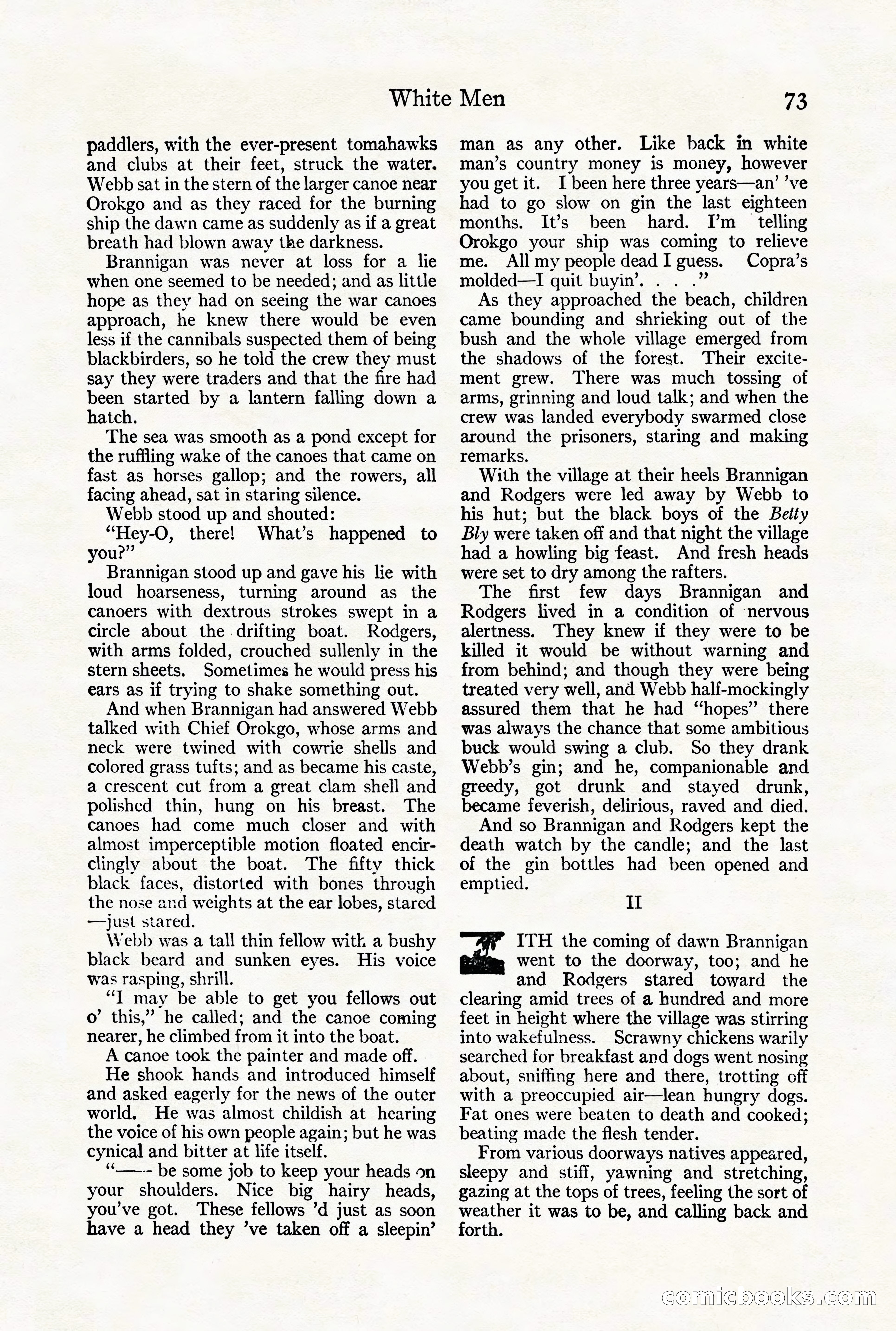
A restored page from Pulp Fiction, 1921. Page through the whole issue in the reader above.
📄 Transcribed text from this page (OCR, searchable)
Machine-transcribed from the original scan — historical spelling and the odd misread are preserved.
White Men paddlers, with the ever-present tomahawks and clubs at their feet, struck the water. Webb sat in the stern of the larger canoe near Orokgo and as they raced for the burning ship the dawn came as suddenly as if a great breath had blown away the darkness. Brannigan was never at loss for a lie when one seemed to be needed; and as little hope as they had on seeing the war canoes approach, he knew there would be even less if the cannibals suspected them of being blackbirders, so he told the crew they must say they were traders and that the fire had been started by a lantern falling down a hatch. The sea was smooth as a pond except for the ruffling wake of the canoes that came on fast as horses gallop; and the rowers, all facing ahead, sat in staring silence. Webb stood up and shouted: ““Hey-O, there! What’s happened to you?” Brannigan stood up and gave his lie with loud hoarseness, turning around as the canoers with dextrous strokes swept in a circle about the drifting boat. Rodgers, with arms folded, crouched sullenly in the stern sheets. Sometimes he would press his ears as if trying to shake something out. And when Brannigan had answered Webb talked with Chief Orokgo, whose arms and neck were twined with cowrie shells and colored grass tufts; and as became his caste, a crescent cut from a great clam shell and polished thin, hung on his breast. The canoes had come much closer and with almost imperceptible motion floated encir- clingly about the boat. The fifty thick black faces, distorted with bones through the nose and weights at the ear lobes, stared —just stared. Webb was a tall thin fellow with a bushy black beard and sunken eyes. His voice was rasping, shrill. “TY may be able to get you fellows out o’ this,” he called; and the canoe coming nearer, he climbed from it into the boat. A canoe took the painter and made off. He shook hands and introduced himself and asked eagerly for the news of the outer world. He was almost childish at hearing the voice of his own people again; but he was cynical and bitter at life itself. ‘——.- he some job to keep your heads on your shoulders. Nice big hairy heads, you've got. These fellows ’d just as soon have a head they ’ve taken off a sleepin’ 73 man as any other. Like back in white man’s country money is money, however you get it. I been here three years—an’ ’ve had to go slow on gin the last eighteen months. It’s been hard. I’m telling Orokgo your ship was coming to relieve me. All my people dead I guess. Copra’s molded—I quit buyin’. . As they approached the beach, children came bounding and shrieking out of the bush and the whole village emerged from the shadows of the forest. Their excite- ment grew. There was much tossing of arms, grinning and loud talk; and when the crew was landed everybody swarmed close around the prisoners, staring and making remarks. With the village at their heels Brannigan and Rodgers were led away by Webb to his hut; but the black boys of the Beity Bly were taken off and that night the village had a howling big feast. And fresh heads were set to dry among the rafters. The first few days Brannigan and Rodgers lived in a condition of nervous alertness. They knew if they were to be killed it would be without warning and from behind; and though they were being treated very well, and Webb half-mockingly assured them that he had “hopes” there was always the chance that some ambitious buck would swing a club. So they drank Webb’s gin; and he, companionable and greedy, got drunk and stayed drunk, became feverish, delirious, raved and died. And so Brannigan and Rodgers kept the death watch by the candle; and the last of the gin bottles had been opened and emptied. tie went to the doorway, too; and he and Rodgers stared toward the clearing amid trees of a hundred and more feet in height where the village was stirring into wakefulness. Scrawny chickens warily searched for breakfast and dogs went nosing about, snifing here and there, trotting off with a preoccupied air—lean hungry dogs. Fat ones were beaten to death and cooked; beating made the flesh tender. From various doorways natives appeared, sleepy and stiff, yawning and stretching, gazing at the tops of trees, feeling the sort of lee it was to be, and calling back and ort II ITH the coming of dawn Brannigan COmiclbook C©