
Pulp Fiction, 1921 · page 76 of 200
Adventure Magazine Cover, August 18, 1921 — page 76: what you’re looking at
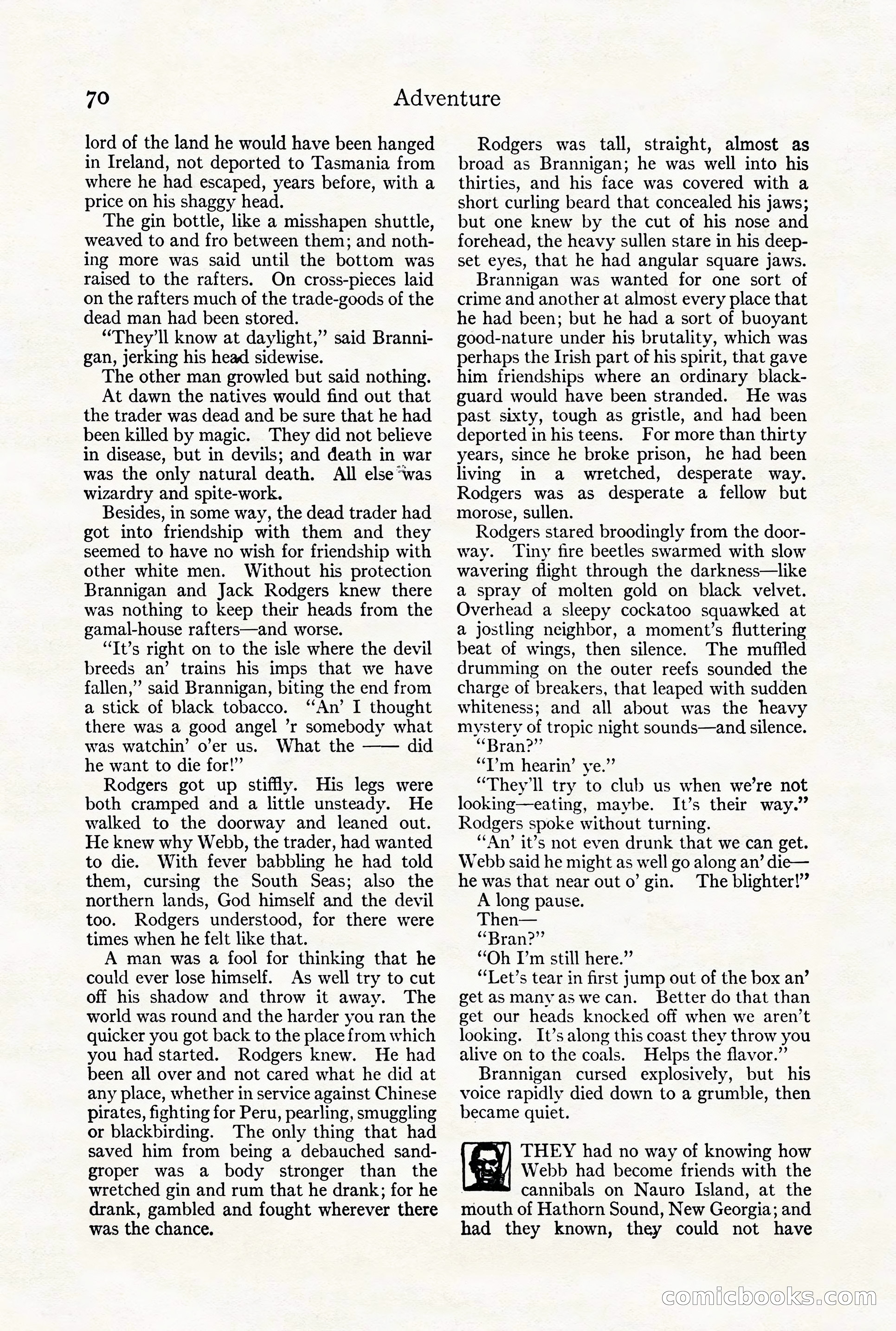
A restored page from Pulp Fiction, 1921. Page through the whole issue in the reader above.
📄 Transcribed text from this page (OCR, searchable)
Machine-transcribed from the original scan — historical spelling and the odd misread are preserved.
70 lord of the land he would have been hanged in Ireland, not deported to Tasmania from where he had escaped, years before, with a price on his shaggy head. The gin bottle, like a misshapen shuttle, weaved to and fro between them; and noth- ing more was said until the bottom was raised to the rafters. On cross-pieces laid on the rafters much of the trade-goods of the dead man had been stored. “They'll know at daylight,” said Branni- gan, jerking his head sidewise. The other man growled but said nothing. At dawn the natives would find out that the trader was dead and be sure that he had been killed by magic. They did not believe in disease, but in devils; and death in war was the only natural death. All else “was wizardry and spite-work. Besides, in some way, the dead trader had got into friendship with them and they seemed to have no wish for friendship with other white men. Without his protection Brannigan and Jack Rodgers knew there was nothing to keep their heads from the gamal-house rafters—and worse. “Tt’s right on to the isle where the devil breeds an’ trains his imps that we have fallen,” said Brannigan, biting the end from a stick of black tobacco. ‘‘An’ I thought there was a good angel ’r somebody what was watchin’ o’er us. What the —— did he want to die for!” Rodgers got up stiffly. His legs were both cramped and a little unsteady. He walked to the doorway and leaned out. He knew why Webb, the trader, had wanted to die. With fever babbling he had told them, cursing the South Seas; also the northern lands, God himself and the devil too. Rodgers understood, for there were times when he felt like that. A man was a fool for thinking that he could ever lose himself. As well try to cut off his shadow and throw it away. The world was round and the harder you ran the quicker you got back to the place from which you had started. Rodgers knew. He had been all over and not cared what he did at any place, whether in service against Chinese pirates, fighting for Peru, pearling, smuggling or blackbirding. The only thing that had saved him from being a debauched sand- groper was a body stronger than the wretched gin and rum that he drank; for he drank, gambled and fought wherever there was the chance. Adventure Rodgers was tall, straight, almost as broad as Brannigan; he was well into his thirties, and his face was covered with a short curling beard that concealed his jaws; but one knew by the cut of his nose and forehead, the heavy sullen stare in his deep- set eyes, that he had angular square jaws. Brannigan was wanted for one sort of crime and another at almost every place that he had been; but he had a sort of buoyant good-nature under his brutality, which was perhaps the Irish part of his spirit, that gave him friendships where an ordinary black- guard would have been stranded. He was past sixty, tough as gristle, and had been deported in his teens. For more than thirty years, since he broke prison, he had been living in a _ wretched, desperate way. Rodgers was as desperate a fellow but morose, sullen. Rodgers stared broodingly from the door- way. ‘Tiny fire beetles swarmed with slow wavering flight through the darkness—like a spray of molten gold on black velvet. Overhead a sleepy cockatoo squawked at a jostling neighbor, a moment’s fluttering beat of wings, then silence. The muffled drumming on the outer reefs sounded the charge of breakers, that leaped with sudden whiteness; and all about was the heavy mystery of tropic night sounds—and silence. “Bran?” ‘‘Y’m hearin’ ye.” “They'll try to club us when we’re not looking—eating, maybe. It’s their way.” Rodgers spoke without turning. ‘An’ it’s not even drunk that we can get. Webb said he might as well go along an’ die— he was that near out o’ gin. The blighter!”’ A long pause. Then— “Bran?” “Oh I’m still here.” “‘Let’s tear in first jump out of the box an’ getasmanyaswecan. Better do that than get our heads knocked off when we aren’t looking. It’s along this coast they throw you alive on to the coals. Helps the flavor.” Brannigan cursed explosively, but his voice rapidly died down to a grumble, then became quiet. THEY had no way of knowing how Webb had become friends with the cannibals on Nauro Island, at the mouth of Hathorn Sound, New Georgia; and had they known, they could not have COMmicloo S C©