
Pulp Fiction, 1921 · page 67 of 200
Adventure Magazine Cover, August 18, 1921 — page 67: what you’re looking at
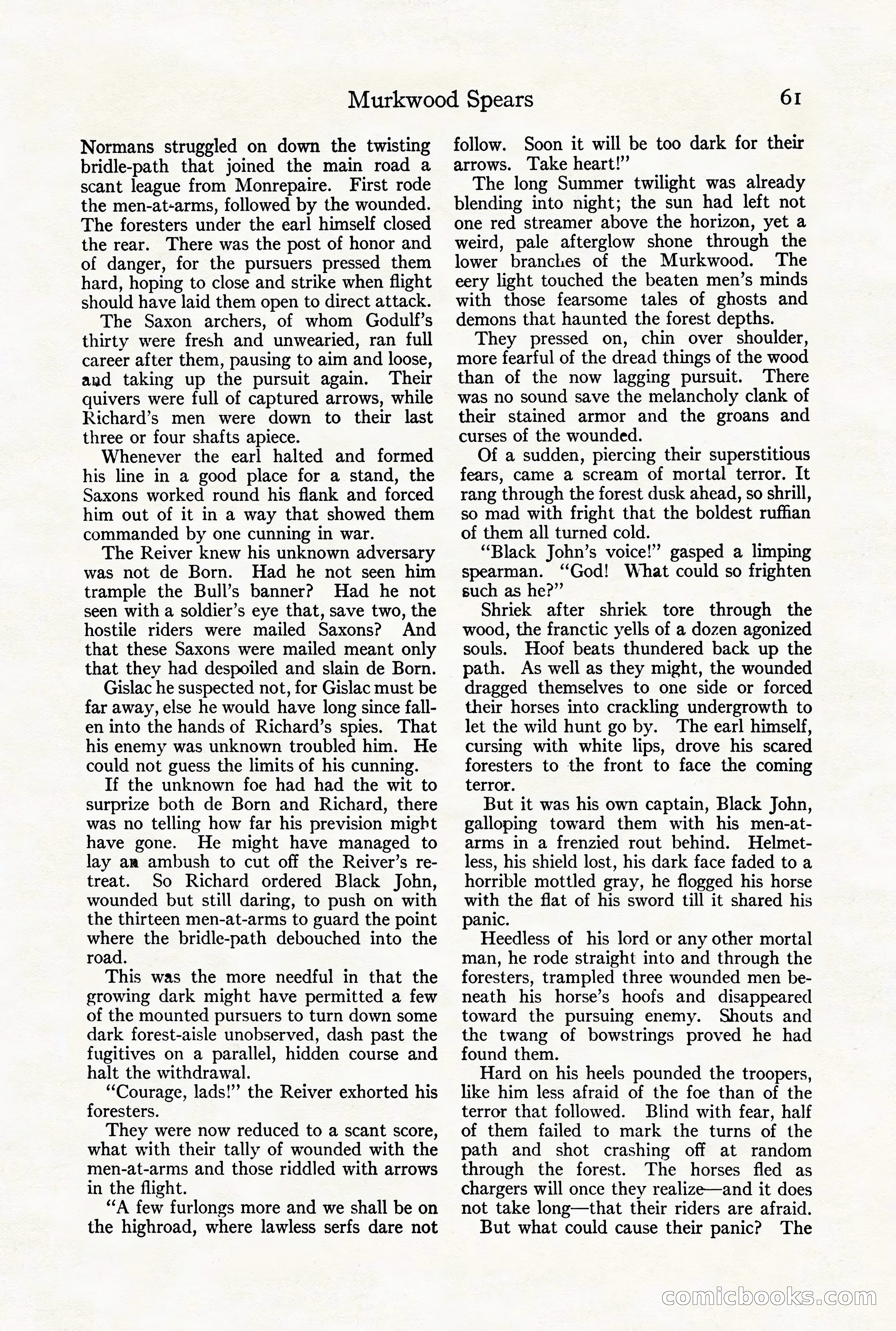
A restored page from Pulp Fiction, 1921. Page through the whole issue in the reader above.
📄 Transcribed text from this page (OCR, searchable)
Machine-transcribed from the original scan — historical spelling and the odd misread are preserved.
Murkwood Spears Normans struggled on down the twisting bridle-path that joined the main road a scant league from Monrepaire. First rode the men-at-arms, followed by the wounded. The foresters under the earl himself closed the rear. There was the post of honor and of danger, for the pursuers pressed them hard, hoping to close and strike when flight should have laid them open to direct attack. The Saxon archers, of whom Godulf’s thirty were fresh and unwearied, ran full career after them, pausing to aim and loose, aud taking up the pursuit again. Their quivers were full of captured arrows, while Richard’s men were down to their last three or four shafts apiece. Whenever the earl halted and formed his line in a good place for a stand, the Saxons worked round his flank and forced him out of it in a way that showed them commanded by one cunning in war. The Reiver knew his unknown adversary was not de Born. Had he not seen him trample the Bull’s banner? Had he not seen with a soldier’s eye that, save two, the hostile riders were mailed Saxons? And that these Saxons were mailed meant only that they had despoiled and slain de Born. Gislac he suspected not, for Gislac must be far away, else he would have long since fall- en into the hands of Richard’s spies. That his enemy was unknown troubled him. He could not guess the limits of his cunning. If the unknown foe had had the wit to surprize both de Born and Richard, there was no telling how far his prevision might have gone. He might have managed to lay an ambush to cut off the Reiver’s re- treat. So Richard ordered Black John, wounded but still daring, to push on with the thirteen men-at-arms to guard the point where the bridle-path debouched into the road. This was the more needful in that the growing dark might have permitted a few of the mounted pursuers to turn down some dark forest-aisle unobserved, dash past the fugitives on a parallel, hidden course and halt the withdrawal. “Courage, lads!” the Reiver exhorted his foresters. They were now reduced to a scant score, what with their tally of wounded with the men-at-arms and those riddled with arrows in the flight. *““A few furlongs more and we shall be on the highroad, where lawless serfs dare not 61 follow. Soon it will be too dark for their arrows. Take heart!’’ The long Summer twilight was already blending into night; the sun had left not one red streamer above the horizon, yet a weird, pale afterglow shone through the lower branches of the Murkwood. The eery light touched the beaten men’s minds with those fearsome tales of ghosts and demons that haunted the forest depths. They pressed on, chin over shoulder, more fearful of the dread things of the wood than of the now lagging pursuit. There was no sound save the melancholy clank of their stained armor and the groans and curses of the wounded. Of a sudden, piercing their superstitious fears, came a scream of mortal terror. It rang through the forest dusk ahead, so shrill, so mad with fright that the boldest rufhan of them all turned cold. “Black John’s voice!” gasped a limping spearman. “God! What could so frighten such as he?” Shriek after shriek tore through the wood, the franctic yells of a dozen agonized souls. Hoof beats thundered back up the path. As well as they might, the wounded dragged themselves to one side or forced their horses into crackling undergrowth to let the wild hunt go by. The earl himself, cursing with white lips, drove his scared foresters to the front to face the coming terror. But it was his own captain, Black John, galloping toward them with his men-at- arms in a frenzied rout behind. Helmet- less, his shield lost, his dark face faded to a horrible mottled gray, he flogged his horse with the flat of his sword till it shared his panic. Heedless of his lord or any other mortal man, he rode straight into and through the foresters, trampled three wounded men be- neath his horse’s hoofs and disappeared toward the pursuing enemy. Shouts and the twang of bowstrings proved he had found them. Hard on his heels pounded the troopers, like him less afraid of the foe than of the terror that followed. Blind with fear, half of them failed to mark the turns of the path and shot crashing off at random through the forest. The horses fled as chargers will once they realize—and it does not take long—that their riders are afraid. But what could cause their panic? The COmicloo S C©