
Pulp Fiction, 1921 · page 56 of 200
Adventure Magazine Cover, August 18, 1921 — page 56: what you’re looking at
A restored page from Pulp Fiction, 1921. Page through the whole issue in the reader above.
📄 Transcribed text from this page (OCR, searchable)
Machine-transcribed from the original scan — historical spelling and the odd misread are preserved.
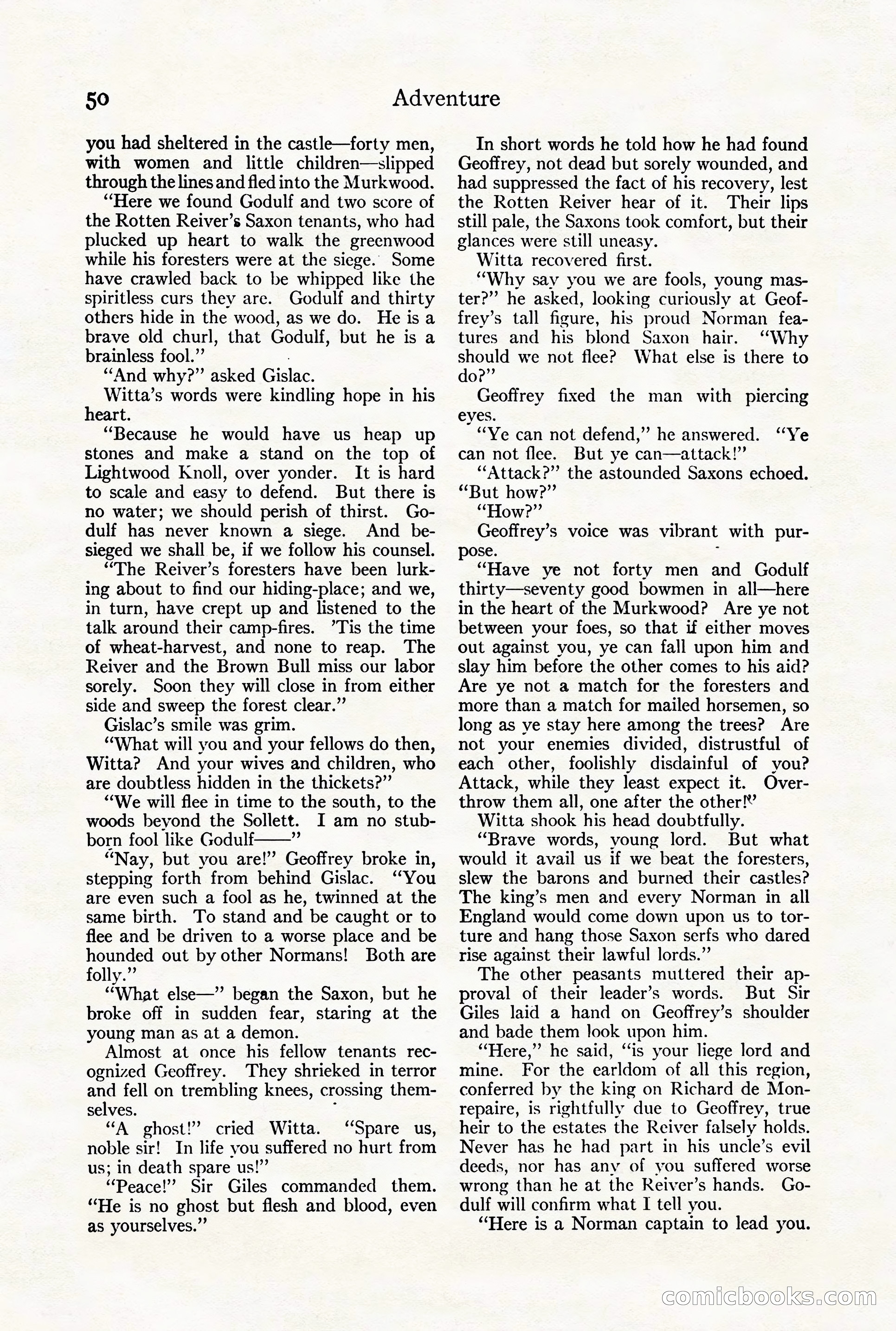
50 you had sheltered in the castle—forty men, with women and little children—slipped through the lines and fled into the Murkwood. “Here we found Godulf and two score of the Rotten Reiver’s Saxon tenants, who had plucked up heart to walk the greenwood while his foresters were at the siege. Some have crawled back to be whipped like the spiritless curs they are. Godulf and thirty others hide in the wood, as we do. He isa brave old churl, that Godulf, but he is a brainless fool.”’ , “And why?” asked Gislac. Witta’s words were kindling hope in his heart. “Because he would have us heap up stones and make a stand on the top of Lightwood Knoll, over yonder. It is hard to scale and easy to defend. But there is no water; we should perish of thirst. Go- dulf has never known a siege. And be- sieged we shall be, if we follow his counsel. “‘The Reiver’s foresters have been lurk- ing about to find our hiding-place; and we, in turn, have crept up and listened to the talk around their camp-fires. Tis the time of wheat-harvest, and none to reap. The Reiver and the Brown Bull miss our labor sorely. Soon they will close in from either side and sweep the forest clear.” Gislac’s smile was grim. “What will you and your fellows do then, Witta? And your wives and children, who are doubtless hidden in the thickets?” “‘We will flee in time to the south, to the woods beyond the Sollett. I am no stub- born fool like Godul és “Nay, but you are!” Geoffrey broke in, stepping forth from behind Gislac. “You are even such a fool as he, twinned at the same birth. To stand and be caught or to flee and be driven to a worse place and be hounded out by other Normans! Both are folly.” ‘“‘What else—” began the Saxon, but he broke off in sudden fear, staring at the young man as at a demon. Almost at once his fellow tenants rec- ognized Geoffrey. They shrieked in terror and fell on trembling knees, crossing them- selves. : “A ghost!” cried Witta. “Spare us, noble sir! In life you suffered no hurt from us; in death spare us!” “Peace!” Sir Giles commanded them. “He is no ghost but flesh and blood, even as yourselves.”’ Adventure In short words he told how he had found Geoffrey, not dead but sorely wounded, and had suppressed the fact of his recovery, lest the Rotten Reiver hear of it. Their lips still pale, the Saxons took comfort, but their glances were still uneasy. Witta recovered first. “Why say you we are fools, young mas- ter?” he asked, looking curiously at Geof- frey’s tall figure, his proud Norman fea- tures and his blond Saxon hair. ‘‘Why should we not flee? What else is there to do?” Geoffrey fixed the man with piercing eyes. “Ye can not defend,” he answered. can not flee. But ye can—attack!” “Attack?” the astounded Saxons echoed. “But how?” “How?” Geoffrey’s voice was vibrant with pur- pose. : “Have ye not forty men and Godulf thirty—seventy good bowmen in all—here in the heart of the Murkwood? Are ye not between your foes, so that if either moves out against vou, ye can fall upon him and slay him before the other comes to his aid? Are ye not a match for the foresters and more than a match for mailed horsemen, so long as ve stay here among the trees? Are not your enemies divided, distrustful of each other, foolishly disdainful of you? Attack, while they least expect it. Over- throw them all, one after the other!’ Witta shook his head doubtfully. “Brave words, voung lord. But what would it avail us if we beat the foresters, slew the barons and burned their castles? The king’s men and every Norman in all England would come down upon us to tor- ture and hang those Saxon serfs who dared rise against their lawful lords.” The other peasants muttered their ap- proval of their leader’s words. But Sir Giles laid a hand on Geoffrey’s shoulder and bade them look upon him. ‘‘Here,” he said, ‘‘is your liege lord and mine. For the earldom of all this region, conferred by the king on Richard de Mon- repaire, is rightfully due to Geoffrey, true heir to the estates the Reiver falsely holds. Never has he had part in his uncle’s evil deeds, nor has anv of you suffered worse wrong than he at the Reiver’s hands. Go- dulf will confirm what I tell you. “Here is a Norman captain to lead you. “Ve COmiclbook CO