
Pulp Fiction, 1921 · page 49 of 200
Adventure Magazine Cover, August 18, 1921 — page 49: what you’re looking at
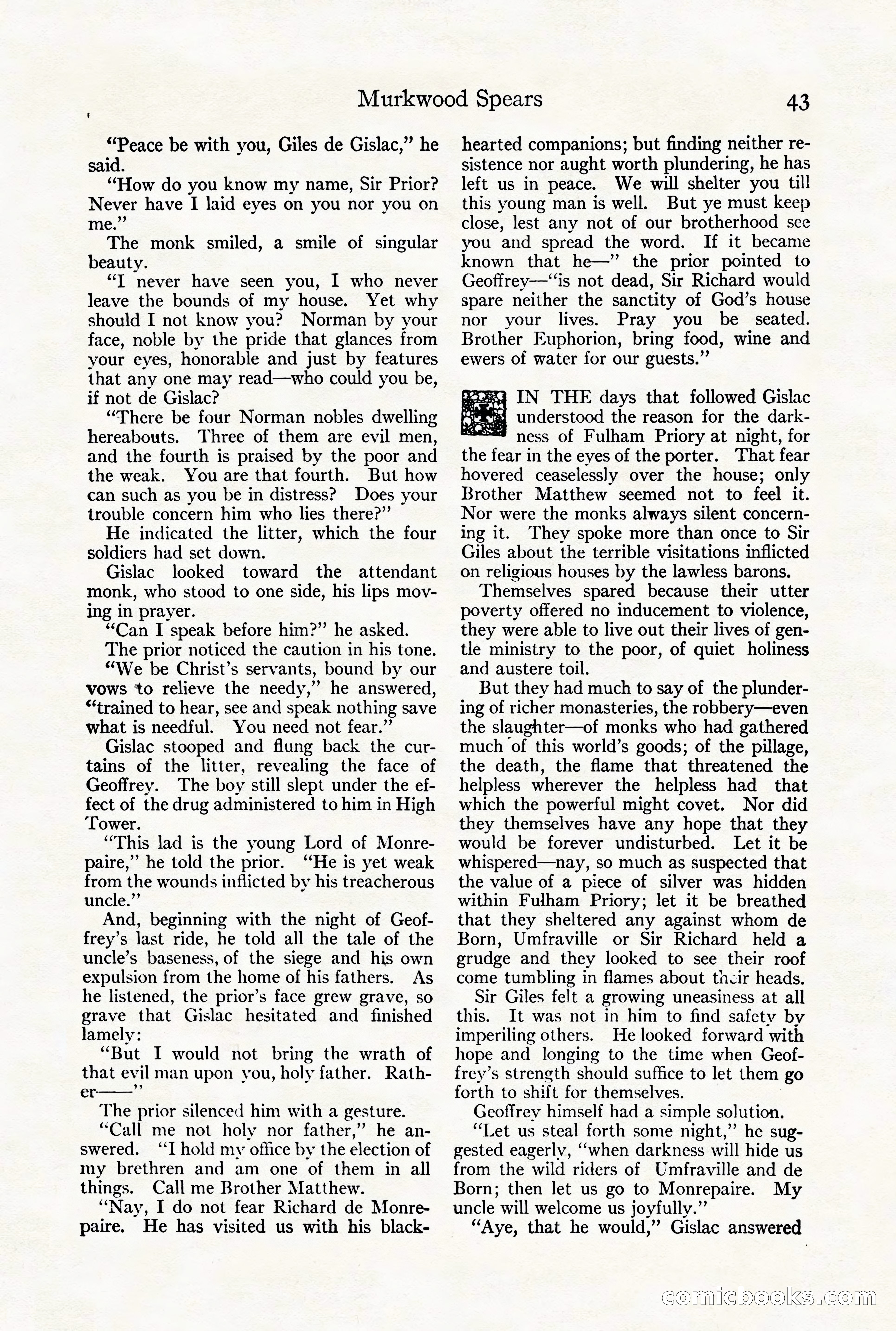
A restored page from Pulp Fiction, 1921. Page through the whole issue in the reader above.
📄 Transcribed text from this page (OCR, searchable)
Machine-transcribed from the original scan — historical spelling and the odd misread are preserved.
Murkwood Spears ‘Peace be with you, Giles de Gislac,” he said. “How do you know my name, Sir Prior? Never have I laid eyes on you nor you on me.”’ The monk smiled, a smile of singular beauty. “TI never have seen you, I who never leave the bounds of my house. Yet why should I not know you? Norman by your face, noble by the pride that glances from your eyes, honorable and just by features that any one may read—who could you be, if not de Gislac? “There be four Norman nobles dwelling hereabouts. Three of them are evil men, and the fourth is praised by the poor and the weak. You are that fourth. But how can such as you be in distress? Does your trouble concern him who lies there?” He indicated the litter, which the four soldiers had set down. Gislac looked toward the attendant monk, who stood to one side, his lips mov- ing in prayer. “Can I speak before him?” he asked. The prior noticed the caution in his tone. “We be Christ’s servants, bound by our vows ‘to relieve the needy,” he answered, “trained to hear, see and speak nothing save what is needful. You need not fear.” Gislac stooped and flung back the cur- tains of the litter, revealing the face of Geoffrey. The boy still slept under the ef- fect of the drug administered to him in High ‘Tower. “This lad is the young Lord of Monre- paire,” he told the prior. ‘‘He is yet weak from the wounds inflicted by his treacherous uncle.” And, beginning with the night of Geof- frey’s last ride, he told all the tale of the uncle’s baseness, of the siege and his own expulsion from the home of his fathers. As he listened, the prior’s face grew grave, so grave that Gislac hesitated and finished lamely: “But I would not bring the wrath of that evil man upon vou, holy father. Rath- er 9 The prior silenced him with a gesture. “Call me not holy nor father,” he an- swered. “I hold my office by the election of my brethren and am one of them in all things. Call me Brother Matthew. ‘Nay, I do not fear Richard de Monre- paire. He has visited us with his black- 43 hearted companions; but finding neither re- sistence nor aught worth plundering, he has left us in peace. We will shelter you till this young man is well. But ye must keep close, lest any not of our brotherhood sce you and spread the word. If it became known that he—” the prior pointed to Geofirey—‘‘is not dead, Sir Richard would spare neither the sanctity of God’s house nor your lives. Pray you be _ seated. Brother Euphorion, bring food, wine and ewers of water for our guests.” aq IN THE days that followed Gislac Pees) understood the reason for the dark- #083 ness of Fulham Priory at night, for the fear in the eyes of the porter. That fear hovered ceaselessly over the house; only Brother Matthew seemed not to feel it. Nor were the monks always silent concern- ing it. They spoke more than once to Sir Giles about the terrible visitations inflicted on religious houses by the lawless barons. Themselves spared because their utter poverty offered no inducement to violence, they were able to live out their lives of gen- tle ministry to the poor, of quiet holiness and austere toil. But they had much to say of the plunder- ing of richer monasteries, the robbery—even the slaughter—of monks who had gathered much ‘of this world’s goods; of the pillage, the death, the flame that threatened the helpless wherever the helpless had that which the powerful might covet. Nor did they themselves have any hope that they would be forever undisturbed. Let it be whispered—nay, so much as suspected that the value of a piece of silver was hidden within Fulham Priory; let it be breathed that they sheltered any against whom de Born, Umfraville or Sir Richard held a grudge and they looked to see their roof come tumbling in flames about tncir heads. Sir Giles felt a growing uneasiness at all this. It was not in him to find safety by imperiling others. He looked forward with hope and longing to the time when Geof- frey’s strength should suffice to let them ‘go forth to shift for themselves. Geoffrey himself had a simple solution. “Let us steal forth some night,” he sug- gested eagerlv, “when darkness will hide us from the wild riders of Umfraville and de Born; then let us go to Monrepaire. My uncle will welcome us joyfully.” “Aye, that he would,” Gislac answered CO COmiclbooks