
Pulp Fiction, 1921 · page 28 of 200
Adventure Magazine Cover, August 18, 1921 — page 28: what you’re looking at
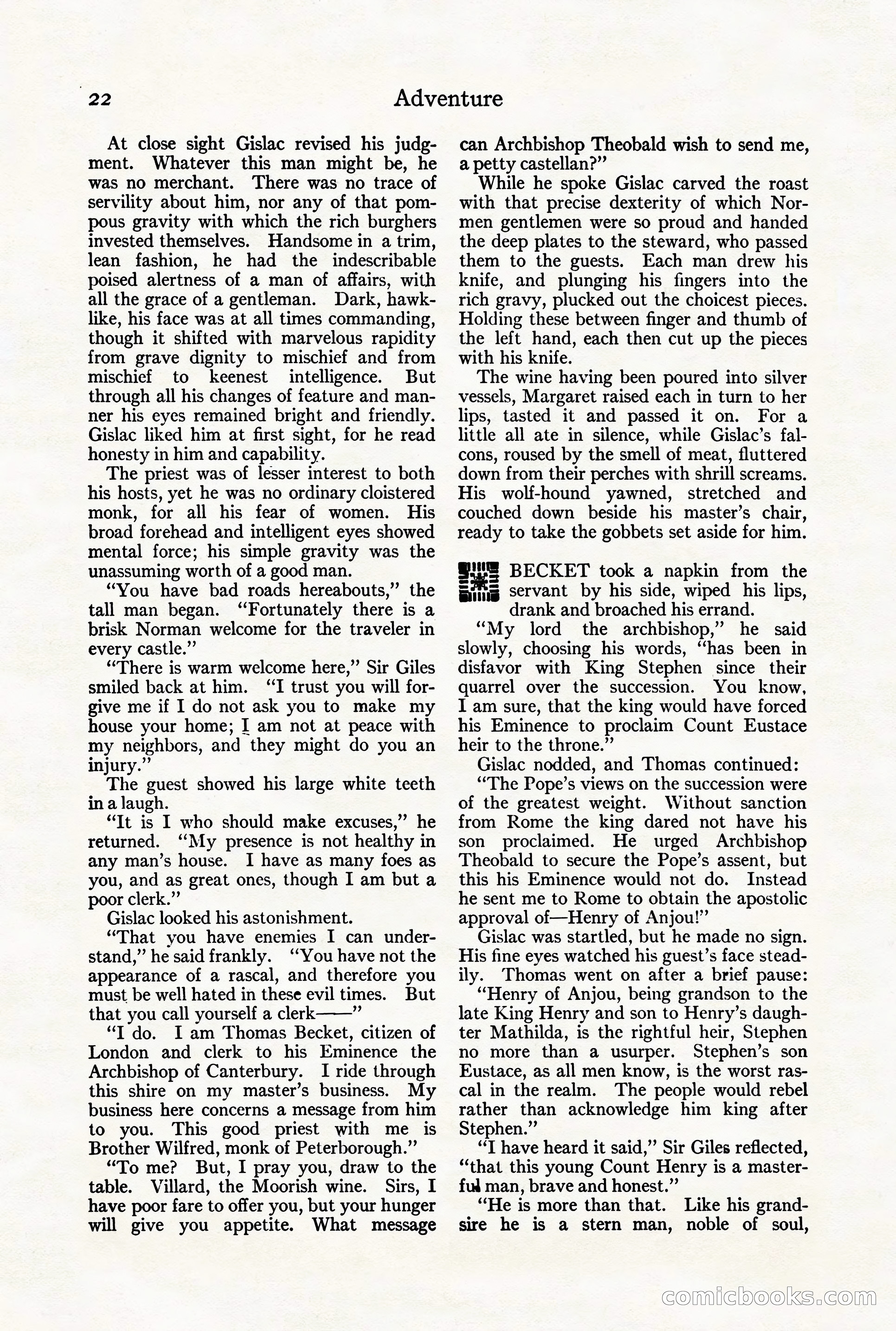
A restored page from Pulp Fiction, 1921. Page through the whole issue in the reader above.
📄 Transcribed text from this page (OCR, searchable)
Machine-transcribed from the original scan — historical spelling and the odd misread are preserved.
22 At close sight Gislac revised his judg- ment. Whatever this man might be, he was no merchant. There was no trace of servility about him, nor any of that pom- pous gravity with which the rich burghers invested themselves. Handsome in a trim, lean fashion, he had the indescribable poised alertness of a man of affairs, with all the grace of a gentleman. Dark, hawk- like, his face was at all times commanding, though it shifted with marvelous rapidity from grave dignity to mischief and from mischief to keenest intelligence. But through all his changes of feature and man- ner his eyes remained bright and friendly. Gislac liked him at first sight, for he read honesty in him and capability. The priest was of lesser interest to both his hosts, yet he was no ordinary cloistered monk, for all his fear of women. His broad forehead and intelligent eyes showed mental force; his simple gravity was the unassuming worth of a good man. “You have bad roads hereabouts,” the tall man began. “Fortunately there is a brisk Norman welcome for the traveler in every castle.” ‘There is warm welcome here,”’ Sir Giles smiled back at him. “TI trust you will for- give me if I do not ask you to make my house your home; I am not at peace with my neighbors, and they might do you an injury.” The guest showed his large white teeth in a laugh. “It is I who should make excuses,” he returned. ‘My presence is not healthy in any man’s house. I have as many foes as you, and as great ones, though I am but a poor clerk.” Gislac looked his astonishment. “That you have enemies I can under- stand,” he said frankly. ‘You have not the appearance of a rascal, and therefore you must be well hated in these evil times. But that you call yourself a clerk “TI do. I am Thomas Becket, citizen of London and clerk to his Eminence the Archbishop of Canterbury. I ride through this shire on my master’s business. My business here concerns a message from him to you. This good priest with me is Brother Wilfred, monk of Peterborough.” “To me? But, I pray you, draw to the table. Villard, the Moorish wine. Sirs, I have poor fare to offer you, but your hunger will give you appetite. What message Adventure can Archbishop Theobald wish to send me, a petty castellan?” While he spoke Gislac carved the roast with that precise dexterity of which Nor- men gentlemen were so proud and handed the deep plates to the steward, who passed them to the guests. Each man drew his knife, and plunging his fingers into the rich gravy, plucked out the choicest pieces. Holding these between finger and thumb of the left hand, each then cut up the pieces with his knife. The wine having been poured into silver vessels, Margaret raised each in turn to her lips, tasted it and passed it on. For a little all ate in silence, while Gislac’s fal- cons, roused by the smell of meat, fluttered down from their perches with shrill screams. His wolf-hound yawned, stretched and couched down beside his master’s chair, ready to take the gobbets set aside for him. git] BECKET took a napkin from the Big servant by his side, wiped his lips, drank and broached his errand. “My lord the archbishop,” he said slowly, choosing his words, “‘has been in disfavor with King Stephen since their quarrel over the succession. You know, I am sure, that the king would have forced his Eminence to proclaim Count Eustace heir to the throne.” Gislac nodded, and Thomas continued: ‘The Pope’s views on the succession were of the greatest weight. Without sanction from Rome the king dared not have his son proclaimed. He urged Archbishop Theobald to secure the Pope’s assent, but this his Eminence would not do. Instead he sent me to Rome to obtain the apostolic approval of—Henry of Anjou!” Gislac was startled, but he made no sign. His fine eyes watched his guest’s face stead- ily. Thomas went on after a brief pause: “Henry of Anjou, being grandson to the late King Henry and son to Henry’s daugh- ter Mathilda, is the rightful heir, Stephen no more than a usurper. Stephen’s son Eustace, as all men know, is the worst ras- cal in the realm. The people would rebel rather than acknowledge him king after Stephen.” “T have heard it said,” Sir Giles reflected, “that this young Count Henry is a master- ful man, brave and honest.” “He is more than that. Like his grand- sire he is a stern man, noble of soul, CoOMmicbook ©