
Pulp Fiction, 1921 · page 189 of 200
Adventure Magazine Cover, August 18, 1921 — page 189: what you’re looking at
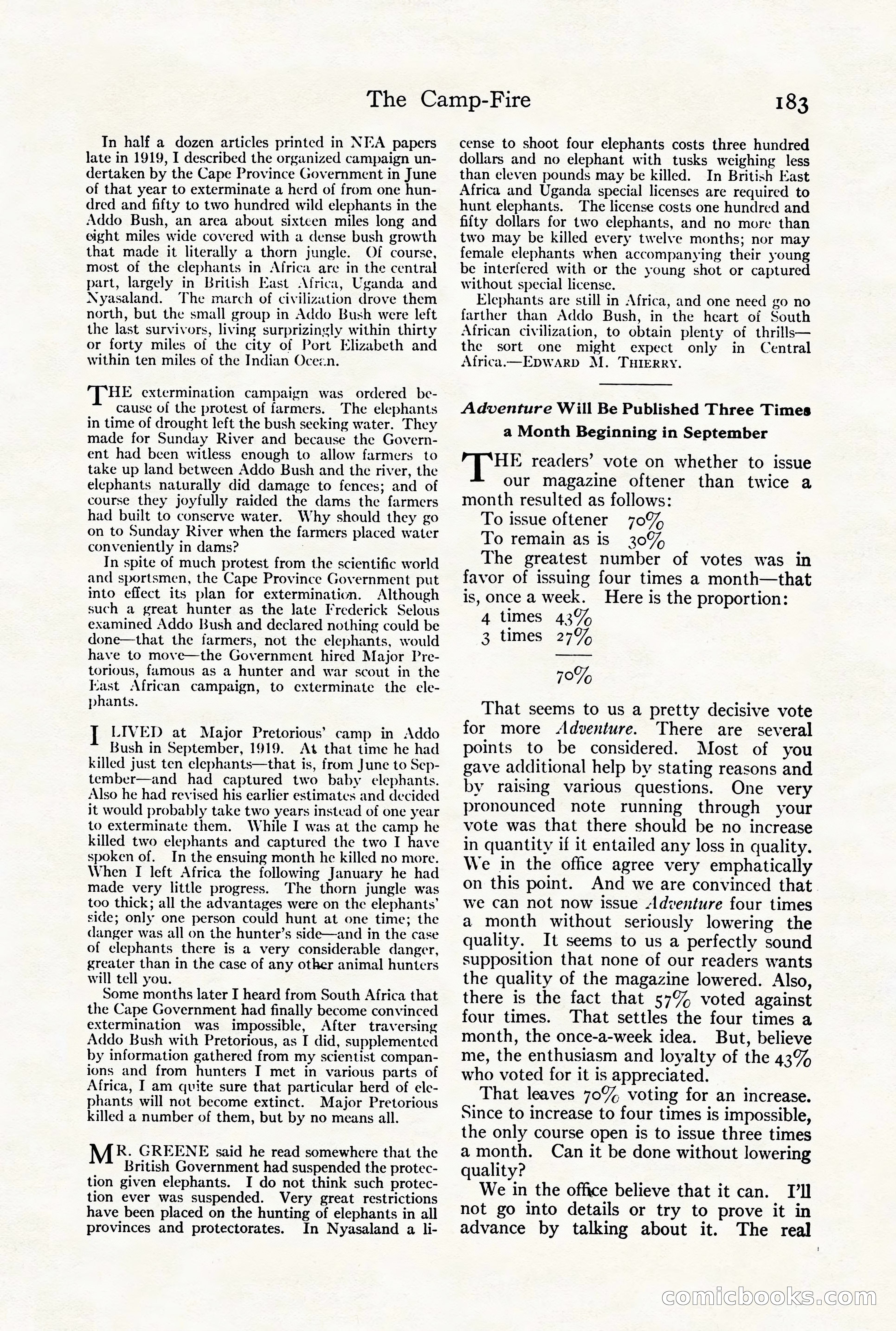
A restored page from Pulp Fiction, 1921. Page through the whole issue in the reader above.
📄 Transcribed text from this page (OCR, searchable)
Machine-transcribed from the original scan — historical spelling and the odd misread are preserved.
The Camp-Fire In half a dozen articles printed in NEA papers late in 1919, I described the organized campaign un- dertaken by the Cape Province Government in June of that year to exterminate a herd of from one hun- dred and fifty to two hundred wild elephants in the Addo Bush, an area about sixteen miles long and eight miles wide covered with a dense bush growth that made it literally a thorn jungle. Of course, most of the clephants in Africa are in the central part, largely in British East Africa, Uganda and Nyasaland. The march of civilization drove them north, but the small group in Addo Bush were left the last survivors, living surprizingly within thirty or forty miles of the city of Port Elizabeth and within ten miles of the Indian Ocecn. HE extermination campaign was ordered _ be- cause of the protest of farmers. The elephants in time of drought left the bush secking water. They made for Sunday River and because the Govern- ent had been witless enough to allow farmers to take up land between Addo Bush and the river, the elephants naturally did damage to fences; and of course they joyfully raided the dams the farmers had built to conserve water. Why should they go on to Sunday River when the farmers placed water conveniently in dams? In spite of much protest from the scientific world and sportsmen, the Cape Province Government put mto effect its plan for extermination. Although such a great hunter as the late Frederick Selous examined Addo Bush and declared nothing could be done—that the farmers, not the elephants, would have to move—the Government hired Major Pre- torious, famous as a hunter and war scout in the Kast African campaign, to exterminate the ele- phants. LIVED at Major Pretorious’ camp in Addo Bush in September, 1919. At that time he had killed just ten elephants—that is, from June to Sep- tember—and had captured two baby elephants. Also he had revised his earlier estimates and decided it would probably take two years instead of one year to exterminate them. While I was at the camp he killed two elephants and captured the two I have spoken of. In the ensuing month he killed no more. When I left Africa the following January he had made very little progress. The thorn jungle was too thick; all the advantages were on the elephants’ side; only one person could hunt at one time; the danger was all on the hunter’s side—and in the case of elephants there is a very considerable danger, greater than in the case of any other animal hunters will tell you. Some months later I heard from South Africa that the Cape Government had finally become convinced extermination was impossible, After traversing Addo Bush with Pretorious, as I did, supplemented by information gathered from my scientist compan- ions and from hunters IT met in various parts of Africa, I am quite sure that particular herd of ele- phants will not become extinct. Major Pretorious killed a number of them, but by no means all. ME. GREENE said he read somewhere that the British Government had suspended the protec- tion given elephants. I do not think such protec- tion ever was suspended. Very great restrictions have been placed on the hunting of elephants in all provinces and protectorates. In Nyasaland a li- 183 cense to shoot four elephants costs three hundred dollars and no elephant with tusks weighing less than eleven pounds may be killed. In British East Africa and Uganda special licenses are required to hunt elephants. The license costs one hundred and fifty dollars for two elephants, and no more than two may be killed every twelve months; nor may female elephants when accompanying their young be interfered with or the young shot or captured without special license. Elephants are still in Africa, and one need go no farther than Addo Bush, in the heart of South African civilization, to obtain plenty of thrills— the sort one might expect only in Central Africa.—EDWARD M. THIERRY. Adventure Will Be Published Three Times a Month Beginning in September HE readers’ vote on whether to issue our magazine oftener than twice a month resulted as follows: To issue oftener 70% To remain as is 30% The greatest number of votes was in favor of issuing four times a month—that is, once a week. Here is the proportion: 4 times 43% 3 times 27% 70% That seems to us a pretty decisive vote for more Adventure. There are several points to be considered. Most of you gave additional help by stating reasons and by raising various questions. One very pronounced note running through your vote was that there should be no increase in quantity if it entailed any loss in quality. We in the office agree very emphatically on this point. And we are convinced that we can not now issue Adventure four times a month without seriously lowering the quality. It seems to us a perfectly sound supposition that none of our readers wants the quality of the magazine lowered. Also, there is the fact that 57% voted against four times. That settles the four times a month, the once-a-week idea. But, believe me, the enthusiasm and loyalty of the 43% who voted for it is appreciated. That leaves 70% voting for an increase. Since to increase to four times is impossible, the only course open is to issue three times amonth. Can it be done without lowering quality? We in the office believe that it can. T’ll not go into details or try to prove it in advance by talking about it. The real Conn) EloOOkKS C© 5}