
Pulp Fiction, 1921 · page 185 of 200
Adventure Magazine Cover, August 18, 1921 — page 185: what you’re looking at
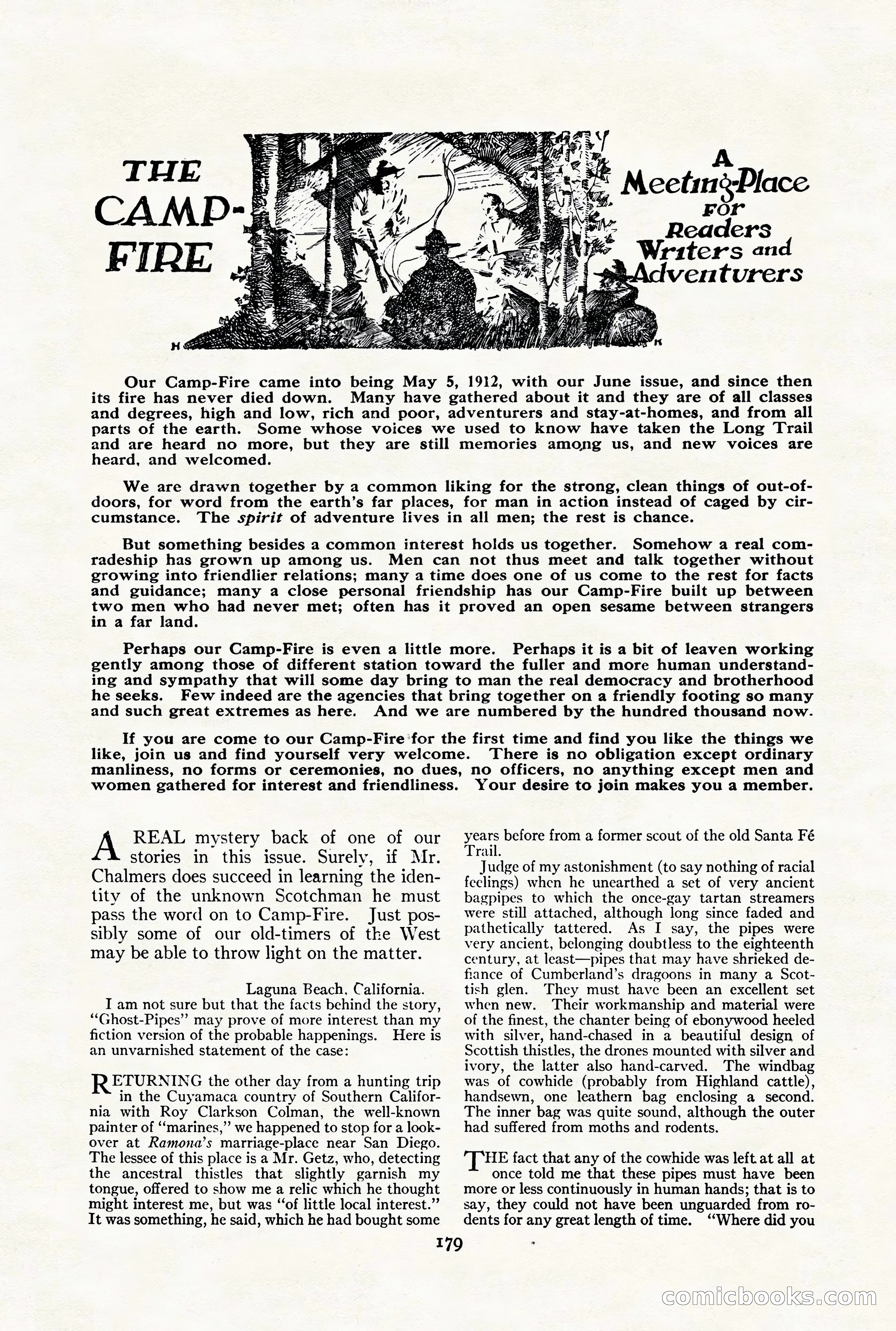
A restored page from Pulp Fiction, 1921. Page through the whole issue in the reader above.
📄 Transcribed text from this page (OCR, searchable)
Machine-transcribed from the original scan — historical spelling and the odd misread are preserved.
A MeetinPlace ty ae ¢ r Uy we fi Te : ‘ Ste rat GED) re =A < pn \ a Ts ee a a BS : st “ an y . > - <a ee, “ of x Pies . a 5 S f : Fa & 7 - , : * Sar iE ‘ / , ‘ yeh see ‘ a 7 > , 2 = ws ne Z : Ge : A : "3 ‘ 4 7 > ‘ A & ° y \ rs r wiBoaders 4 raters an FIRE veuturers Our Camp-Fire came into being May 5, 1912, with our June issue, and since then its fire has never died down. Many have gathered about it and they are of all classes and degrees, high and low, rich and poor, adventurers and stay-at-homes, and from all parts of the earth. Some whose voices we used to know have taken the Long Trail and are heard no more, but they are still memories among us, and new voices are heard, and welcomed. We are drawn together by a common liking for the strong, clean things of out-of- doors, for word from the earth’s far places, for man in action instead of caged by cir- cumstance. The spirit of adventure lives in all men; the rest is chance. But something besides a common interest holds us together. Somehow a real com- radeship has grown up among us. Men can not thus meet and talk together without growing into friendlier relations; many a time does one of us come to the rest for facts and guidance; many a close personal friendship has our Camp-Fire built up between two men who had never met; often has it proved an open sesame between strangers in a far land. Perhaps our Camp-Fire is even a little more. Perhaps it is a bit of leaven working gently among those of different station toward the fuller and more human understand- ing and sympathy that will some day bring to man the real democracy and brotherhood he seeks. and such great extremes as here. Few indeed are the agencies that bring together on a friendly footing so many And we are numbered by the hundred thousand now. If you are come to our Camp-Fire ‘for the first time and find you like the things we like, join us and find yourself very welcome. There is no obligation except ordinary manliness, no forms or ceremonies, no dues, no officers, no anything except men and women gathered for interest and friendliness. REAL mystery back of one of our stories in this issue. Surely, if Mr. Chalmers does succeed in learning the iden- tity of the unknown Scotchman he must pass the word on to Camp-Fire. Just pos- sibly some of our old-timers of the West may be able to throw light on the matter. Laguna Beach, California. I am not sure but that the facts behind the story, ““Ghost-Pipes” may prove of more interest than my fiction version of the probable happenings. Here is an unvarnished statement of the case: RETURNING the other day from a hunting trip in the Cuyamaca country of Southern Califor- nia with Roy Clarkson Colman, the well-known painter of ‘‘marines,”’ we happened to stop for a look- over at Ramona’s marriage-place near San Diego. The lessee of this place is a Mr. Getz, who, detecting the ancestral thistles that slightly garnish my tongue, offered to show me a relic which he thought might interest me, but was “‘of little local interest.” It was something, he said, which he had bought some 179 Your desire to join makes you a member. years before from a former scout of the old Santa Fé Trail. Judge of my astonishment (to say nothing of racial feelings) when he unearthed a set of very ancient bagpipes to which the once-gay tartan streamers were still attached, although long since faded and pathetically tattered. As I say, the pipes were very ancient, belonging doubtless to the eighteenth century, at least—pipes that may have shrieked de- fiance of Cumberland’s dragoons in many a Scot- tish glen. They must have been an excellent set when new. Their workmanship and material were of the finest, the chanter being of ebonywood heeled with silver, hand-chased in a beautiful design of Scottish thistles, the drones mounted with silver and ivory, the latter also hand-carved. The windbag was of cowhide (probably from Highland cattle), handsewn, one leathern bag enclosing a_ second. The inner bag was quite sound, although the outer had suffered from moths and rodents. ‘THE fact that any of the cowhide was left at all at once told me that these pipes must have been more or less continuously in human hands; that is to say, they could not have been unguarded from ro- dents for any great length of time. ‘Where did you COMICMOOoks. Conn