
Pulp Fiction, 1921 · page 175 of 200
Adventure Magazine Cover, August 18, 1921 — page 175: what you’re looking at
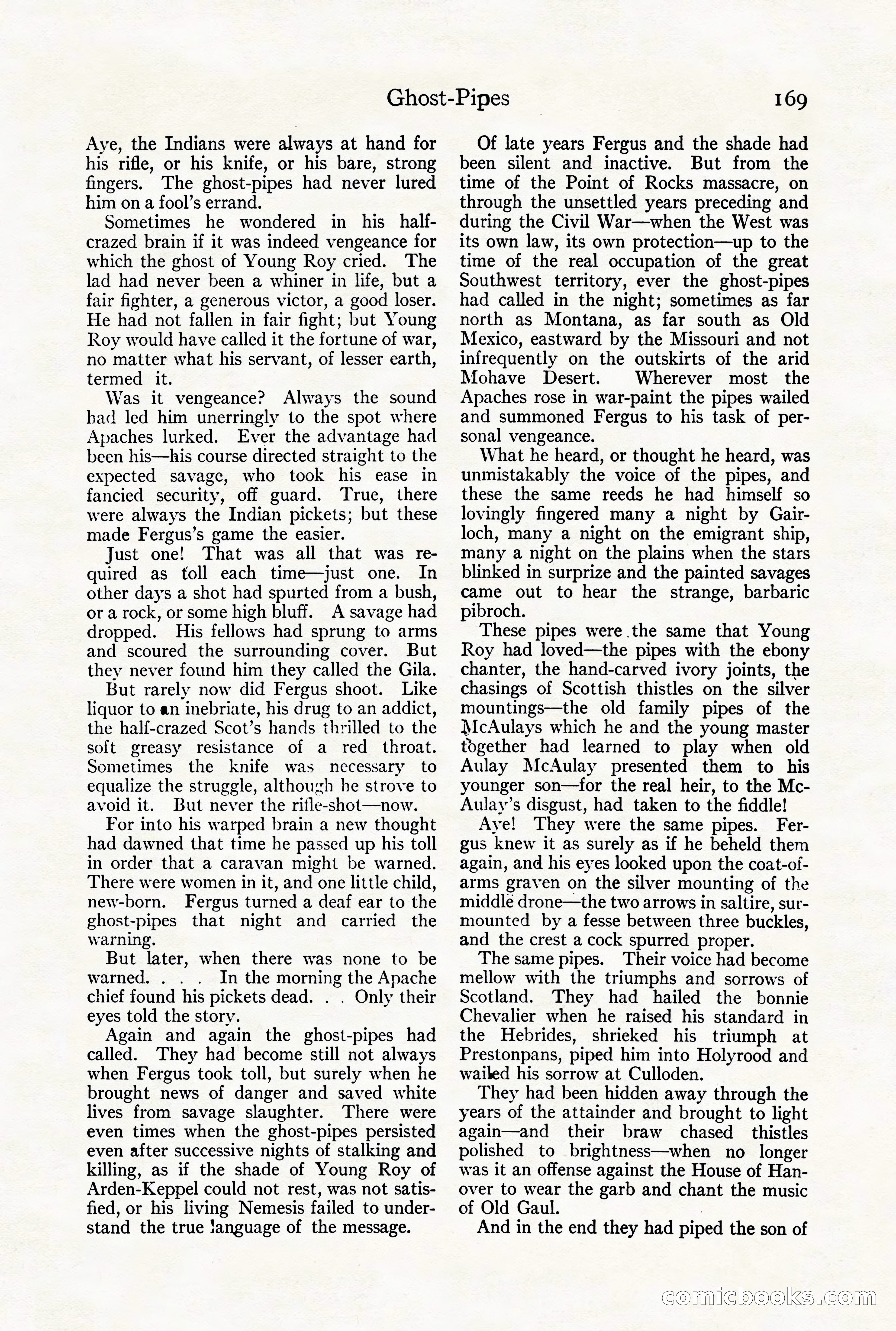
A restored page from Pulp Fiction, 1921. Page through the whole issue in the reader above.
📄 Transcribed text from this page (OCR, searchable)
Machine-transcribed from the original scan — historical spelling and the odd misread are preserved.
Ghost-Pipes Aye, the Indians were always at hand for his rifle, or his knife, or his bare, strong fingers. The ghost-pipes had never lured him on a fool’s errand. Sometimes he wondered in his _half- crazed brain if it was indeed vengeance for which the ghost of Young Roy cried. The lad had never been a whiner in life, but a fair fighter, a generous victor, a good loser. He had not fallen in fair fight; but Young Roy would have called it the fortune of war, no matter what his servant, of lesser earth, termed it. Was it vengeance? Always the sound bad led him unerringly to the spot where Apaches lurked. Ever the advantage had been his—his course directed straight to the expected savage, who took his ease in fancied security, off guard. True, there were always the Indian pickets; but these made Fergus’s game the easier. Just one! That was all that was re- quired as toll each time—just one. In other days a shot had spurted from a bush, or a rock, or some high bluff. A savage had dropped. His fellows had sprung to arms and scoured the surrounding cover. But thev never found him they called the Gila. But rarely now did Fergus shoot. Like liquor to an inebriate, his drug to an addict, the half-crazed Scot’s hands thrilled to the so{t greasy resistance of a red _ throat. Sometimes the knife was necessary to equalize the struggle, althouzh he strove to avoid it. But never the rifle-shot—now. For into his warped brain a new thought had dawned that time he passed up his toll in order that a caravan might be warned. There were women in it, and one little child, new-born. Fergus turned a deaf ear to the ghost-pipes that night and carried the warning. But later, when there was none to be warned. . . . In the morning the Apache chief found his pickets dead. . . Only their eyes told the story. Again and again the ghost-pipes had called. They had become still not always when Fergus took toll, but surely when he brought news of danger and saved white lives from savage slaughter. There were even times when the ghost-pipes persisted even after successive nights of stalking and killing, as if the shade of Young Roy of Arden-Keppel could not rest, was not satis- fied, or his living Nemesis failed to under- stand the true !anguage of the message. 169 Of late years Fergus and the shade had been silent and inactive. But from the time of the Point of Rocks massacre, on through the unsettled years preceding and during the Civil War—when the West was its own law, its own protection—up to the time of the real occupation of the great Southwest territory, ever the ghost-pipes had called in the night; sometimes as far north as Montana, as far south as Old Mexico, eastward by the Missouri and not infrequently on the outskirts of the arid Mohave Desert. | Wherever most the Apaches rose in war-paint the pipes wailed and summoned Fergus to his task of per- sonal vengeance. What he heard, or thought he heard, was unmistakably the voice of the pipes, and these the same reeds he had himself so lovingly fingered many a night by Gair- loch, many a night on the emigrant ship, many a night on the plains when the stars blinked in surprize and the painted savages came out to hear the strange, barbaric pibroch. These pipes were the same that Young Roy had loved—the pipes with the ebony chanter, the hand-carved ivory joints, the chasings of Scottish thistles on the silver mountings—the old family pipes of the McAulays which he and the young master together had learned to play when old Aulay McAulay presented them to his younger son—for the real heir, to the Mc- Aulay’s disgust, had taken to the fiddle! Aye! They were the same pipes. Fer- gus knew it as surely as if he beheld them again, and his eyes looked upon the coat-of- arms graven on the silver mounting of the middle drone—the two arrows in saltire, sur- mounted by a fesse between three buckles, and the crest a cock spurred proper. The same pipes. Their voice had become mellow with the triumphs and sorrows of Scotland. They had hailed the bonnie Chevalier when he raised his standard in the Hebrides, shrieked his triumph at Prestonpans, piped him into Holyrood and wailed his sorrow at Culloden. They had been hidden away through the years of the attainder and brought to light again—and their braw chased thistles polished to brightness—when no _ longer was it an offense against the House of Han- over to wear the garb and chant the music of Old Gaul. , And in the end they had piped the son of COmiclboolks ©