
Pulp Fiction, 1921 · page 171 of 200
Adventure Magazine Cover, August 18, 1921 — page 171: what you’re looking at
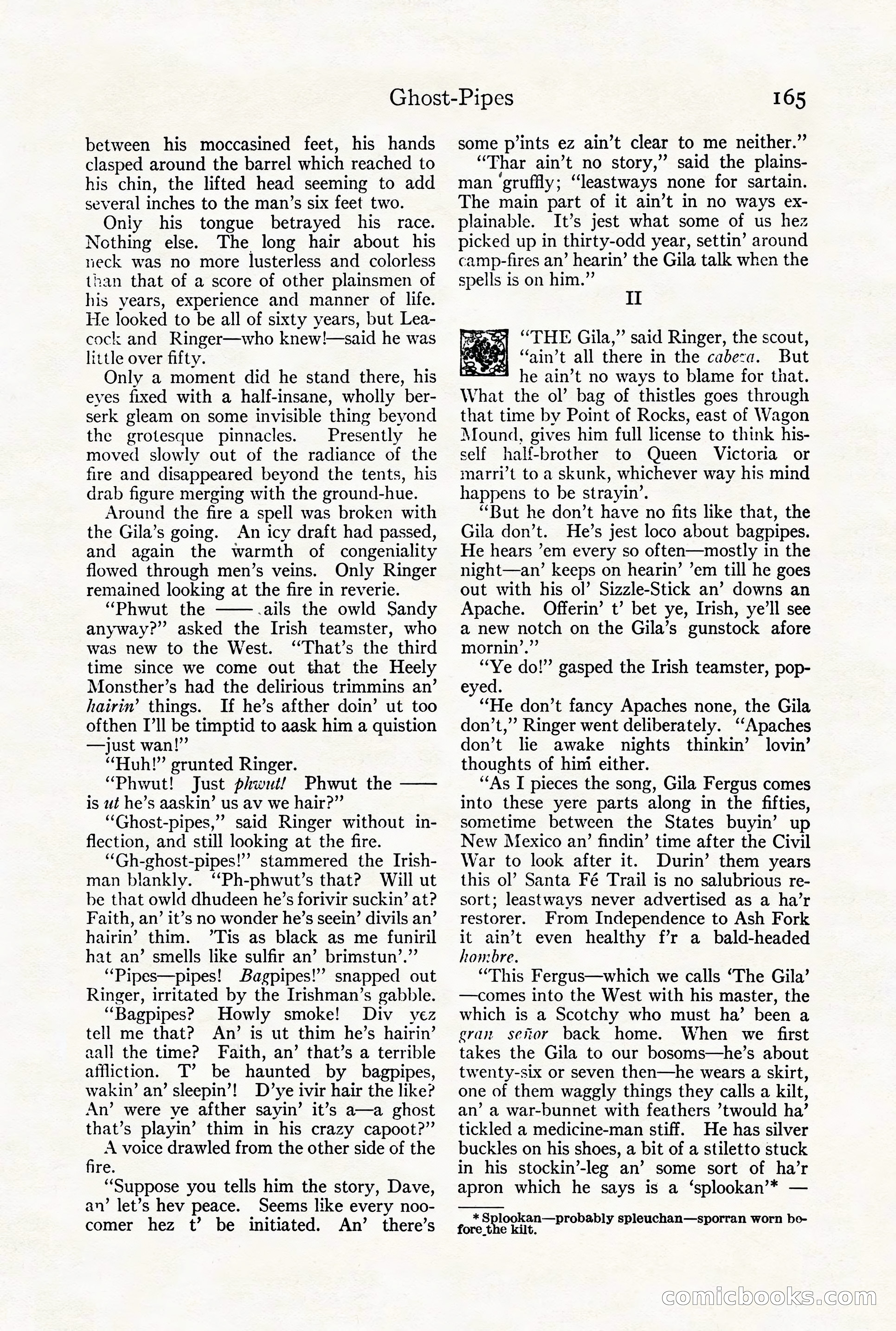
A restored page from Pulp Fiction, 1921. Page through the whole issue in the reader above.
📄 Transcribed text from this page (OCR, searchable)
Machine-transcribed from the original scan — historical spelling and the odd misread are preserved.
Ghost-Pipes between his moccasined feet, his hands clasped around the barrel which reached to his chin, the lifted head seeming to add several inches to the man’s six feet two. Oniy his tongue betrayed his race. Nothing else. The long hair about his neck was no more lusterless and colorless than that of a score of other plainsmen of his years, experience and manner of life. He looked to be all of sixty years, but Lea- cock and Ringer—who knew!—said he was little over fifty. Only a moment did he stand there, his eves fixed with a half-insane, wholly ber- serk gleam on some invisible thing beyond the grotesque pinnacles. Presently he moved slowly out of the radiance of the fire and disappeared beyond the tents, his drab figure merging with the ground-hue. Around the fire a spell was broken with the Gila’s going. An icy draft had passed, and again the warmth of congeniality flowed through men’s veins. Only Ringer remained looking at the fire in reverie. “Phwut the ails the owld Sandy anyway?” asked the Irish teamster, who was new to the West. ‘“That’s the third time since we come out that the Heely Monsther’s had the delirious trimmins an’ hairin’ things. If he’s afther doin’ ut too ofthen I’ll be timptid to aask him a quistion —just wan!” “Huh!” grunted Ringer. “Phwut! Just phwui! Phwut the —— is ut he’s aaskin’ us av we hair?” “‘Ghost-pipes,” said Ringer without in- flection, and still looking at the fire. ‘“‘Gh-ghost-pipes!”’ stammered the Irish- man blankly. ‘‘Ph-phwut’s that? Will ut be that owld dhudeen he’s forivir suckin’ at? Faith, an’ it’s no wonder he’s seein’ divils an’ hairin’ thim. ’Tis as black as me funiril hat an’ smells like sulfir an’ brimstun’.”’ ‘“Pipes—pipes! Bagpipes!” snapped out Ringer, irritated by the Irishman’s gabble. “Bagpipes? Howly smoke! Div_ yez tell me that? An’ is ut thim he’s hairin’ aall the time? Faith, an’ that’s a terrible affliction. T’ be haunted by bagpipes, wakin’ an’ sleepin’! Dye ivir hair the like? An’ were ve afther sayin’ it’s a—a ghost that’s playin’ thim in his crazy capoot?” A voice drawled from the other side of the fire. “Suppose you tells him the story, Dave, an’ let’s hev peace. Seems like every noo- comer hez t’ be initiated. An’ there’s 165 some p’ints ez ain’t clear to me neither.” “Thar ain’t no story,” said the plains- man ‘gruffly; “leastways none for sartain. The main part of it ain’t in no ways ex- plainable. It’s jest what some of us hez picked up in thirty-odd year, settin’ around camp-fires an’ hearin’ the Gila talk when the spells is on him.” II “THE Gila,” said Ringer, the scout, Messy) “‘ain’t all there in the cabeza. But me he ain’t no ways to blame for that. What the ol’ bag of thistles goes through that time by Point of Rocks, east of Wagon Mound, gives him full license to think his- self half-brother to Queen Victoria or marri’t to a skunk, whichever way his mind happens to be strayin’. “But he don’t have no fits like that, the Gila don’t. He’s jest loco about bagpipes. He hears ’em every so often—mostly in the night—an’ keeps on hearin’ ’em till he goes out with his ol’ Sizzle-Stick an’ downs an Apache. Offerin’ t’ bet ye, Irish, ye’ll see a new notch on the Gila’s gunstock afore mornin’.” “Ve do!” gasped the Irish teamster, pop- eyed. “He don’t fancy Apaches none, the Gila don’t,”’ Ringer went deliberately. ‘Apaches don’t lie awake nights thinkin’ lovin’ thoughts of him either. ‘As I pieces the song, Gila Fergus comes into these yere parts along in the fifties, sometime between the States buyin’ up New Mexico an’ findin’ time after the Civil War to look after it. Durin’ them years this ol’ Santa Fé Trail is no salubrious re- sort; leastways never advertised as a ha’r restorer. From Independence to Ash Fork it ain’t even healthy f’r a bald-headed hombre. “This Fergus—which we calls ‘The Gila’ —comes into the West with his master, the which is a Scotchy who must ha’ been a gran senor back home. When we first takes the Gila to our bosoms—he’s about twenty-six or seven then—he wears a skirt, one of them waggly things they calls a kilt, an’ a war-bunnet with feathers ’twould ha’ tickled a medicine-man stiff. He has silver buckles on his shoes, a bit of a stiletto stuck in his stockin’-leg an’ some sort of ha’r apron which he says is a ‘splookan’* — * Splookan—probably spleuchan—sporran worn be- fore the kilt. bd C© CloOOkKS CO