
Pulp Fiction, 1921 · page 165 of 200
Adventure Magazine Cover, August 18, 1921 — page 165: what you’re looking at
A restored page from Pulp Fiction, 1921. Page through the whole issue in the reader above.
📄 Transcribed text from this page (OCR, searchable)
Machine-transcribed from the original scan — historical spelling and the odd misread are preserved.
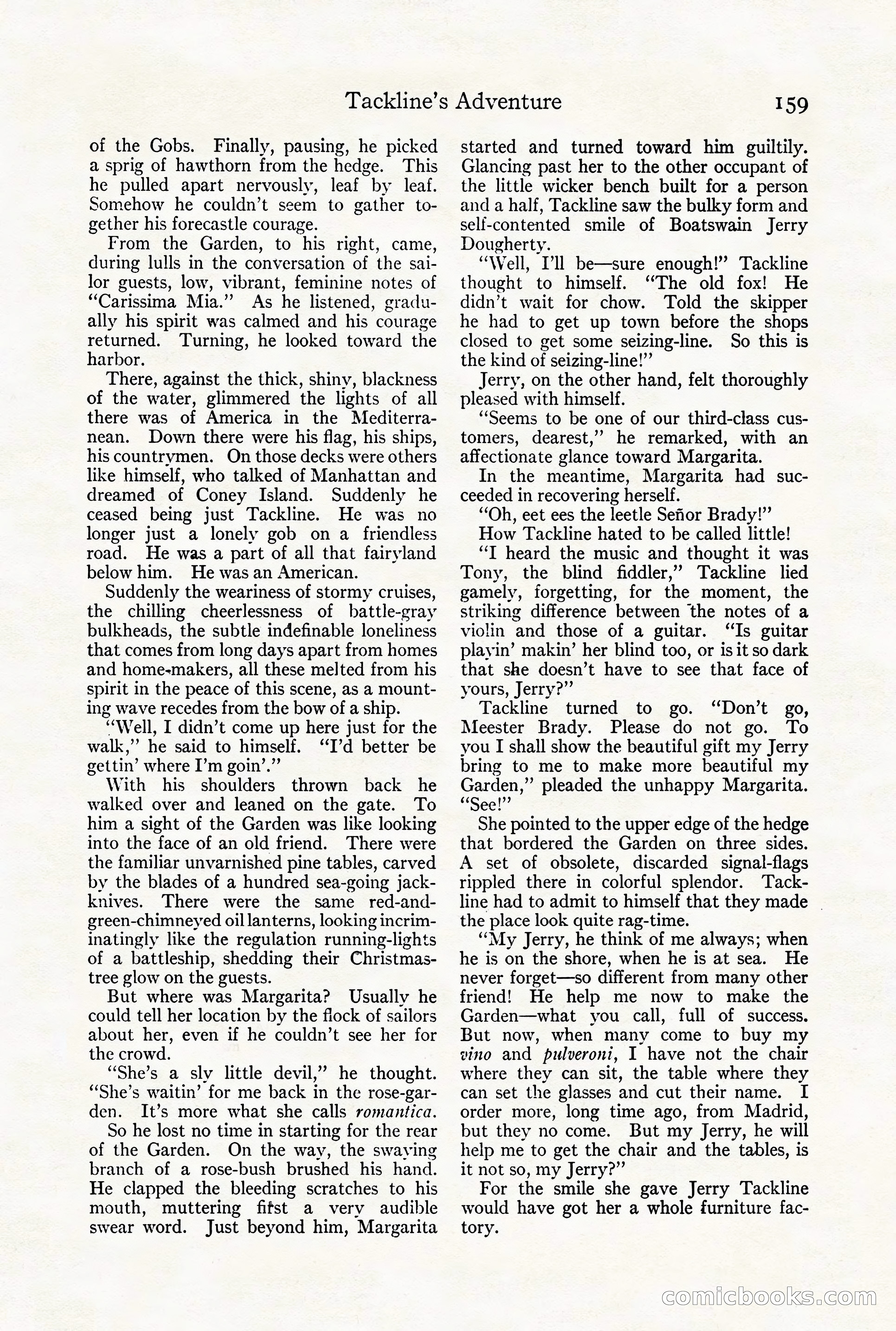
Tackline’s Adventure of the Gobs. Finally, pausing, he picked a sprig of hawthorn from the hedge. This he pulled apart nervously, leaf by leaf. Somehow he couldn’t seem to gather to- gether his forecastle courage. From the Garden, to his right, came, during lulls in the conversation of the sai- lor guests, low, vibrant, feminine notes of “Carissima Mia.” As he listened, gradu- ally his spirit was calmed and his courage returned. Turning, he looked toward the harbor. There, against the thick, shiny, blackness of the water, glimmered the lights of all there was of America in the Mediterra- nean. Down there were his flag, his ships, his countrymen. On those decks were others like himself, who talked of Manhattan and dreamed of Coney Island. Suddenly he ceased being just Tackline. He was no longer just a lonely gob on a friendless road. He was a part of all that fairyland below him. He was an American. Suddenly the weariness of stormy cruises, the chilling cheerlessness of battle-gray bulkheads, the subtle indefinable loneliness that comes from long days apart from homes and home-makers, all these melted from his spirit in the peace of this scene, as a mount- ing wave recedes from the bow of a ship. ‘Well, I didn’t come up here just for the walk,” he said to himself. ‘‘I’d better be gettin’ where I’m goin’.” With his shoulders thrown back he walked over and leaned on the gate. To him a sight of the Garden was like looking into the face of an old friend. There were the familiar unvarnished pine tables, carved by the blades of a hundred sea-going jack- knives. There were the same red-and- green-chimneyed oil lanterns, looking incrim- inatingly like the regulation running-lights of a battleship, shedding their Christmas- tree glow on the guests. But where was Margarita? Usuallv he could tell her location by the fiock of sailors about her, even if he couldn’t see her for the crowd. “She’s a slv little devil,” he thought. “She’s waitin’ for me back in the rose-gar- den. It’s more what she calls romantica. So he lost no time in starting for the rear of the Garden. On the way, the swaving branch of a rose-bush brushed his hand. He clapped the bleeding scratches to his mouth, muttering fifst a very audible swear word. Just beyond him, Margarita 159 started and turned toward him guiltily. Glancing past her to the other occupant of the little wicker bench built for a person and a half, Tackline saw the bulky form and self-contented smile of Boatswain Jerry Dougherty. “Well, I'll be—sure enough!” Tackline thought to himself. “The old fox! He didn’t wait for chow. Told the skipper he had to get up town before the shops closed to get some seizing-line. So this is the kind of seizing-line!”’ 3 Jerry, on the other hand, felt thoroughly pleased with himself. ‘Seems to be one of our third-class cus- tomers, dearest,” he remarked, with an affectionate glance toward Margarita. In the meantime, Margarita had suc- ceeded in recovering herself. “Oh, eet ees the leetle Sefior Brady!” How Tackline hated to be called little! “T heard the music and thought it was Tony, the blind fiddler,’ Tackline lied gamely, forgetting, for the moment, the striking difference between the notes of a violin and those of a guitar. “Is guitar playin’ makin’ her blind too, or is it so dark that she doesn’t have to see that face of yours, Jerry?” Tackline turned to go. ‘Don’t go, Meester Brady. Please do not go. To you I shall show the beautiful gift my Jerry bring to me to make more beautiful my Garden,” pleaded the unhappy Margarita. “See!” She pointed to the upper edge of the hedge that bordered the Garden on three sides. A set of obsolete, discarded signal-flags rippled there in colorful splendor. Tack- line had to admit to himself that they made | the place look quite rag-time. “My Jerry, he think of me always; when he is on the shore, when he is at sea. He never forget—so different from many other friend! He help me now to make the Garden—what you call, full of success. But now, when many come to buy my vino and pulveroni, I have not the chair where they can sit, the table where they can set the glasses and cut their name. I order more, long time ago, from Madrid, but they no come. But my Jerry, he will help me to get the chair and the tables, is it not so, my Jerry?” For the smile she gave Jerry Tackline would have got her a whole furniture fac- tory. COmiclbook ©