
Pulp Fiction, 1921 · page 15 of 200
Adventure Magazine Cover, August 18, 1921 — page 15: what you’re looking at
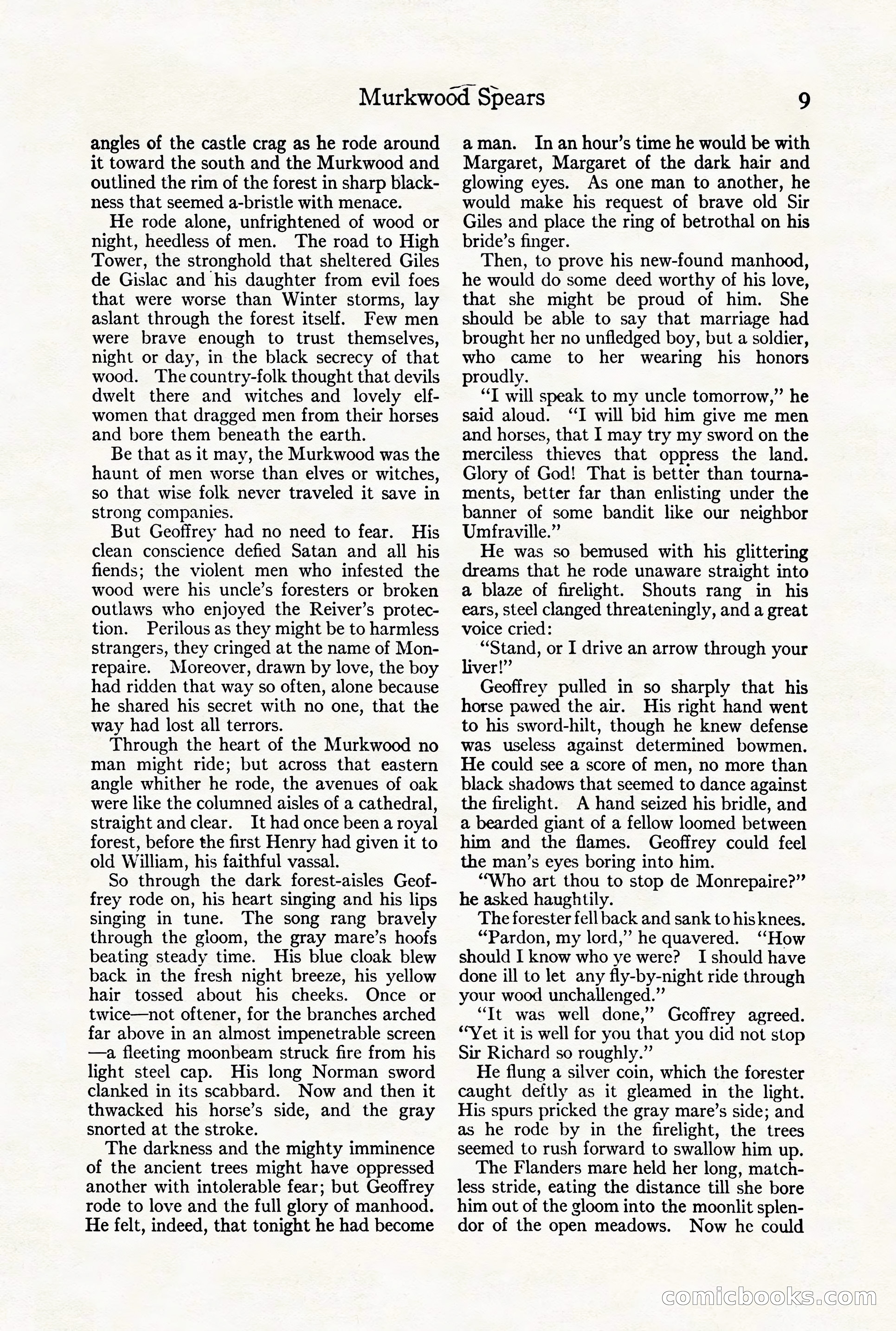
A restored page from Pulp Fiction, 1921. Page through the whole issue in the reader above.
📄 Transcribed text from this page (OCR, searchable)
Machine-transcribed from the original scan — historical spelling and the odd misread are preserved.
Murkwood Spears angles of the castle crag as he rode around it toward the south and the Murkwood and outlined the rim of the forest in sharp black- ness that seemed a-bristle with menace. He rode alone, unfrightened of wood or night, heedless of men. The road to High Tower, the stronghold that sheltered Giles de Gislac and his daughter from evil foes that were worse than Winter storms, lay aslant through the forest itself. Tew men were brave enough to trust themselves, night or day, in the black secrecy of that wood. The country-folk thought that devils dwelt there and witches and lovely elf- women that dragged men from their horses and bore them beneath the earth. Be that as it may, the Murkwood was the haunt of men worse than elves or witches, so that wise folk never traveled it save in strong companies. But Geoffrey had no need to fear. His clean conscience defied Satan and all his fiends; the violent men who infested the wood were his uncle’s foresters or broken outlaws who enjoyed the Reiver’s protec- tion. Perilous as they might be to harmless strangers, they cringed at the name of Mon- repaire. Moreover, drawn by love, the boy had ridden that way so often, alone because he shared his secret with no one, that the way had lost all terrors. Through the heart of the Murkwood no man might ride; but across that eastern angle whither he rode, the avenues of oak were like the columned aisles of a cathedral, straight and clear. It had once been a royal forest, before the first Henry had given it to old William, his faithful vassal. So through the dark forest-aisles Geof- frey rode on, his heart singing and his lips singing in tune. The song rang bravely through the gloom, the gray mare’s hoofs beating steady time. His blue cloak blew back in the fresh night breeze, his yellow hair tossed about his cheeks. Once or twice—not oftener, for the branches arched far above in an almost impenetrable screen —a fleeting moonbeam struck fire from his light steel cap. His long Norman sword clanked in its scabbard. Now and then it thwacked his horse’s side, and the gray snorted at the stroke. The darkness and the mighty imminence of the ancient trees might have oppressed another with intolerable fear; but Geoffrey rode to love and the full glory of manhood. He felt, indeed, that tonight he had become 9 aman. In an hour’s time he would be with Margaret, Margaret of the dark hair and glowing eyes. As one man to another, he would make his request of brave old Sir Giles and place the ring of betrothal on his bride’s finger. Then, to prove his new-found manhood, he would do some deed worthy of his love, that she might be proud of him. She should be able to say that marriage had brought her no unfledged boy, but a soldier, who came to her wearing his honors proudly. “T will speak to my uncle tomorrow,” he said aloud. “I will bid him give me men and horses, that 1 may try my sword on the merciless thieves that oppress the land. Glory of God! That is better than tourna- ments, better far than enlisting under the banner of some bandit like our neighbor Umfraville.” He was so bemused with his glittering dreams that he rode unaware straight into a blaze of firelight. Shouts rang in his ears, steel clanged threateningly, and a great voice cried: “Stand, or I drive an arrow through your liver!” Geoffrey pulled in so sharply that his horse pawed the air. His right hand went to his sword-hilt, though he knew defense was useless against determined bowmen. He could see a score of men, no more than black shadows that seemed to dance against the firelight. A hand seized his bridle, and a bearded giant of a fellow loomed between him and the flames. Geoffrey could feel the man’s eyes boring into him. “Who art thou to stop de Monrepaire?” he asked haughtily. The forester fell back and sank to his knees. “Pardon, my lord,” he quavered. “How should I know who ye were? I should have done ill to let any fly-by-night ride through your wood unchallenged.” “It was well done,” Geoffrey agreed. “Yet it is well for you that you did not stop Sir Richard so roughly.” He flung a silver coin, which the forester caught deftly as it gleamed in the light. His spurs pricked the gray mare’s side; and as he rode by in the firelight, the trees seemed to rush forward to swallow him up. The Flanders mare held her long, match- less stride, eating the distance till she bore him out of the gloom into the moonlit splen- dor of the open meadows. Now he could Comiclhook CO