
Pulp Fiction, 1921 · page 149 of 200
Adventure Magazine Cover, August 18, 1921 — page 149: what you’re looking at
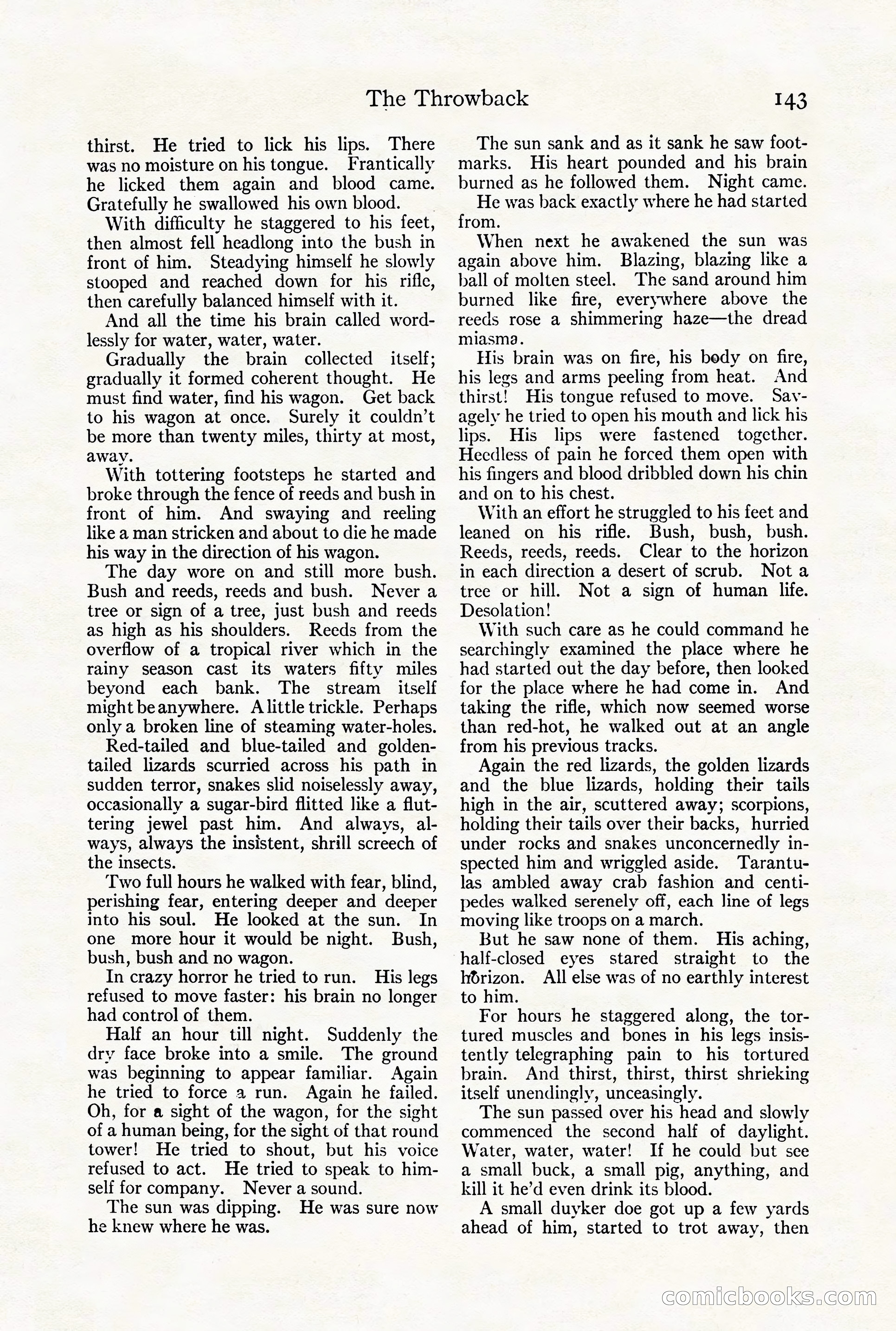
A restored page from Pulp Fiction, 1921. Page through the whole issue in the reader above.
📄 Transcribed text from this page (OCR, searchable)
Machine-transcribed from the original scan — historical spelling and the odd misread are preserved.
The Throwback thirst. He tried to lick his lips. There was no moisture on his tongue. Frantically he licked them again and blood came. Gratefully he swallowed his own blood. With difficulty he staggered to his feet, then almost fell headlong into the bush in front of him. Steadying himself he slowly stooped and reached down for his rifle, then carefully balanced himself with it. And all the time his brain called word- lessly for water, water, water. Gradually the brain collected itself; gradually it formed coherent thought. He must find water, find his wagon. Get back to his wagon at once. Surely it couldn’t be more than twenty miles, thirty at most, away. With tottering footsteps he started and broke through the fence of reeds and bush in front of him. And swaying and reeling like a man stricken and about to die he made his way in the direction of his wagon. The day wore on and still more bush. Bush and reeds, reeds and bush. Never a tree or sign of a tree, just bush and reeds as high as his shoulders. Reeds from the overflow of a tropical river which in the rainy season cast its waters fifty miles beyond each bank. The stream itself might beanywhere. A little trickle. Perhaps only a broken line of steaming water-holes. Red-tailed and blue-tailed and golden- tailed lizards scurried across his path in sudden terror, snakes slid noiselessly away, occasionally a sugar-bird flitted like a flut- tering jewel past him. And always, al- ways, always the insistent, shrill screech of the insects. Two full hours he walked with fear, blind, perishing fear, entering deeper and deeper into his soul. He looked at the sun. In one more hour it would be night. Bush, bush, bush and no wagon. In crazy horror he tried torun. His legs refused to move faster: his brain no longer had control of them. Half an hour till night. dry face broke into a smile. The ground was beginning to appear familiar. Again he tried to force a run. Again he failed. Oh, for a sight of the wagon, for the sight of a human being, for the sight of that round tower! He tried to shout, but his voice refused to act. He tried to speak to him- self for company. Never a sound. The sun was dipping. He was sure now he knew where he was. Suddenly the 143 The sun sank and as it sank he saw foot- marks. His heart pounded and his brain burned as he followed them. Night came. He was back exactly where he had started from. When next he awakened the sun was again above him. Blazing, blazing like a ball of molten steel. The sand around him burned like fire, everywhere above the reeds rose a shimmering haze—the dread miasma. His brain was on fire, his bedy on fire, his legs and arms peeling from heat. And thirst! His tongue refused to move. Sav- agely he tried to open his mouth and lick his lips. His lips were fastened together. Hecdless of pain he forced them open with his fingers and blood dribbled down his chin and on to his chest. With an effort he struggled to his feet and leaned on his rifle. Bush, bush, bush. Reeds, reeds, reeds. Clear to the horizon in each direction a desert of scrub. Nota tree or hill. Not a sign of human life. Desolation! With such care as he could command he searchingly examined the place where he had started out the day before, then looked for the place where he had come in. And taking the rifle, which now seemed worse than red-hot, he walked out at an angle from his previous tracks. Again the red lizards, the golden lizards and the blue lizards, holding their tails high in the air, scuttered away; scorpions, holding their tails over their backs, hurried under rocks and snakes unconcernedly in- spected him and wriggled aside. Tarantu- las ambled away crab fashion and centi- pedes walked serenely off, each line of legs moving like troops on a march. But he saw none of them. His aching, half-closed eyes stared straight to the hdrizon. All else was of no earthly interest to him. For hours he staggered along, the tor- tured muscles and bones in his legs insis- tently telegraphing pain to his tortured brain. And thirst, thirst, thirst shrieking itself unendingly, unceasingly. The sun passed over his head and slowly commenced the second half of daylight. Water, water, water! If he could but see a small buck, a small pig, anything, and kill it he’d even drink its blood. A small duyker doe got up a few yards ahead of him, started to trot away, then COMIC oo S ©