
Pulp Fiction, 1921 · page 129 of 200
Adventure Magazine Cover, August 18, 1921 — page 129: what you’re looking at
A restored page from Pulp Fiction, 1921. Page through the whole issue in the reader above.
📄 Transcribed text from this page (OCR, searchable)
Machine-transcribed from the original scan — historical spelling and the odd misread are preserved.
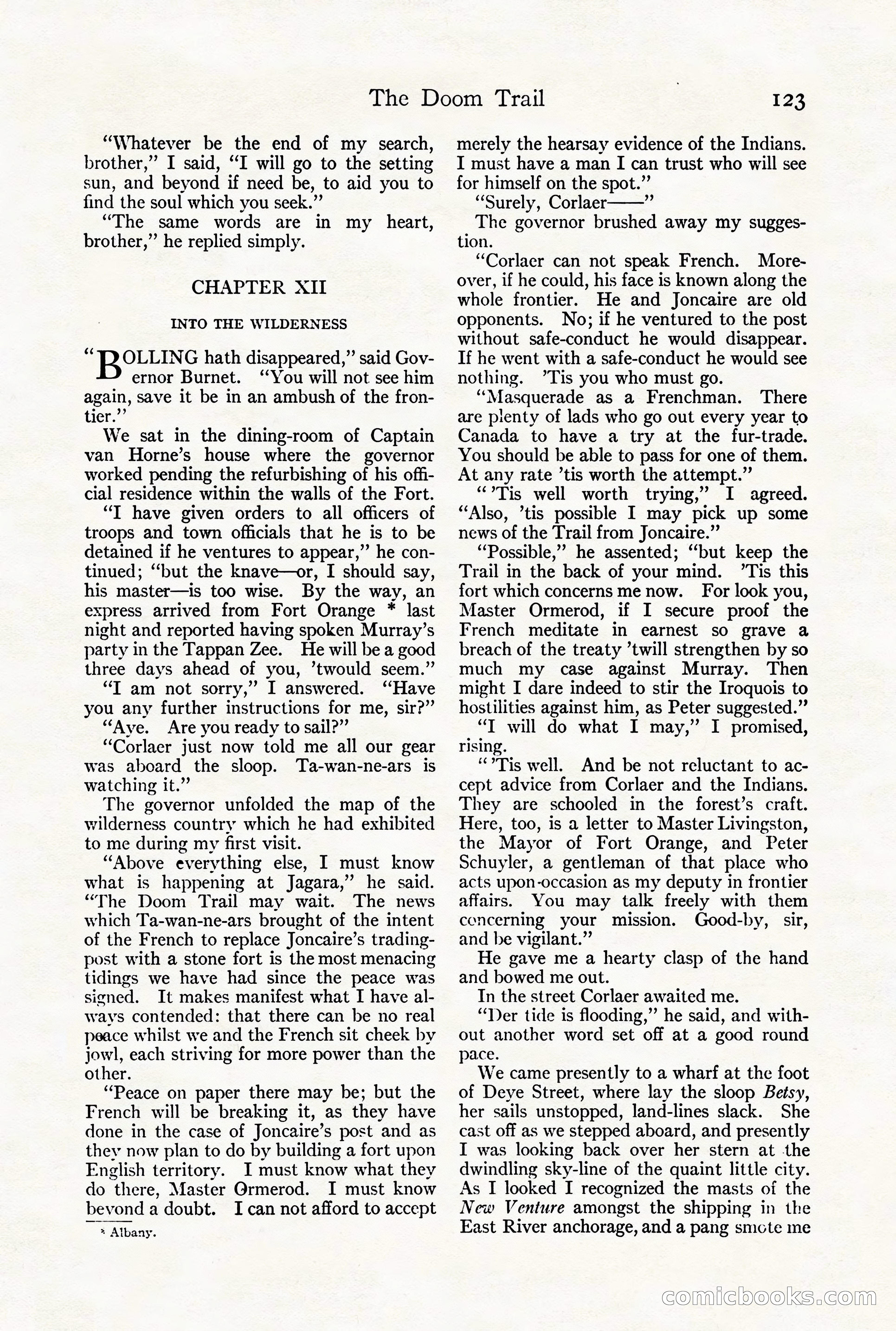
The Doom Trail “Whatever be the end of my search, brother,” I said, “I will go to the setting sun, and beyond if need be, to aid you to find the soul which you seek.”’ “The same words are in my heart, brother,” he replied simply. CHAPTER XII INTO THE WILDERNESS q BOLLING hath disappeared,” said Gov- ernor Burnet. ‘You will not see him again, save it be in an ambush of the fron- tier.”’ We sat in the dining-room of Captain van Horne’s house where the governor worked pending the refurbishing of his offi- cial residence within the walls of the Fort. “T have given orders to all officers of troops and town officials that he is to be detained if he ventures to appear,” he con- tinued; “but the knave—or, I should say, his master—is too wise. By the way, an express arrived from Fort Orange * last night and reported having spoken Murray’s party in the Tappan Zee. He will be a good three days ahead of you, ’twould seem.” “T am not sorry,” I answered. ‘‘Have you any further instructions for me, sir?” ‘“‘Ave. Are you ready to sail?” “Corlaer just now told me all our gear was aboard the sloop. Ta-wan-ne-ars is watching it.” The governor unfolded the map of the wilderness country which he had exhibited to me during my first visit. “Above everything else, I must know what is happening at Jagara,” he said. “The Doom Trail may wait. The news which Ta-wan-ne-ars brought of the intent of the French to replace Joncaire’s trading- post with a stone fort is the most menacing tidings we have had since the peace was signed. It makes manifest what I have al- ways contended: that there can be no real peace whilst we and the French sit cheek by jowl, each striving for more power than the other. ‘Peace on paper there may be; but the French will be breaking it, as they have done in the case of Joncaire’s post and as they now plan to do by building a fort upon English territory. I must know what they do there, Master Ormerod. I must know bevond a doubt. I can not afford to accept as Albany. 123 merely the hearsay evidence of the Indians. I must have a man I can trust who will see for himself on the spot.” “Surely, Corlaer——”’ The governor brushed away my sugges- tion. “Corlaer can not speak French. More- over, if he could, his face is known along the whole frontier. He and Joncaire are old opponents. No; if he ventured to the post without safe-conduct he would disappear. If he went with a safe-conduct he would see nothing. ’Tis you who must go. “Masquerade as a Frenchman. There are pienty of lads who go out every year to Canada to have a try at the fur-trade. You should be able to pass for one of them. At any rate ’tis worth the attempt.” “Tis well worth trying,’ I agreed. “Also, ’tis possible I may pick up some news of the Trail from Joncaire.”’ “Possible,” he assented; “‘but keep the Trail in the back of your mind. ’Tis this fort which concerns me now. For look you, Master Ormerod, if I secure proof the French meditate in earnest so grave a breach of the treaty ’twill strengthen by so much my case against Murray. Then might I dare indeed to stir the Iroquois to hostilities against him, as Peter suggested.” “YT will do what I may,’ I promised, rising. ‘°Tis well. And be not reluctant to ac- cept advice from Corlaer and the Indians. They are schooled in the forest’s craft. Here, too, is a letter to Master Livingston, the Mayor of Fort Orange, and Peter Schuyler, a gentleman of that place who acts upon-occasion as my deputy in frontier affairs. You may talk freely with them concerning your mission. Good-by, sir, and be vigilant.” He gave me a hearty clasp of the hand and bowed me out. In the street Corlaer awaited me. “Der tide is flooding,” he said, and with- out another word set off at a good round pace. We came presently to a wharf at the foot of Deye Street, where lay the sloop Betsy, her sails unstopped, land-lines slack. She cast off as we stepped aboard, and presently I was looking back over her stern at the dwindling sky-line of the quaint little city. As I looked I recognized the masts of the New Venture amongst the shipping in the East River anchorage, and a pang smote me C© MICLOOOKS CO