
Pulp Fiction, 1921 · page 10 of 200
Adventure Magazine Cover, August 18, 1921 — page 10: what you’re looking at
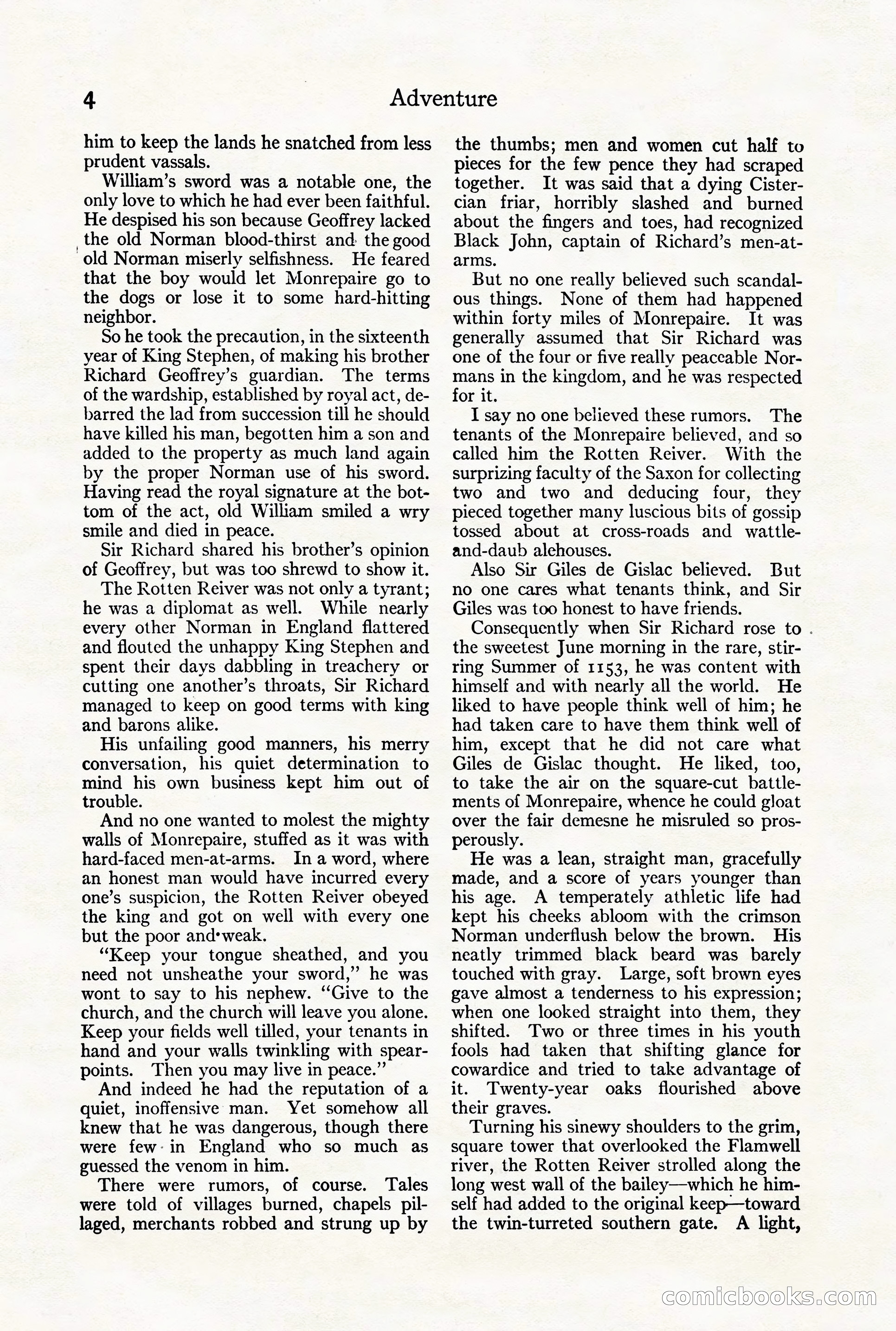
A restored page from Pulp Fiction, 1921. Page through the whole issue in the reader above.
📄 Transcribed text from this page (OCR, searchable)
Machine-transcribed from the original scan — historical spelling and the odd misread are preserved.
4 | Adventure him to keep the lands he snatched from less prudent vassals. William’s sword was a notable one, the only love to which he had ever been faithful. He despised his son because Geoffrey lacked the old Norman blood-thirst and: the good old Norman miserly selfishness. He feared that the boy would let Monrepaire go to the dogs or lose it to some hard-hitting neighbor. So he took the precaution, in the sixteenth year of King Stephen, of making his brother Richard Geoffrey’s guardian. The terms of the wardship, established by royal act, de- barred the lad from succession till he should have killed his man, begotten him a son and added to the property as much land again by the proper Norman use of his sword. Having read the royal signature at the bot- tom of the act, old William smiled a wry smile and died in peace. Sir Richard shared his brother’s opinion of Geoffrey, but was too shrewd to show it. The Rotten Reiver was not only a tyrant; he was a diplomat as well. While nearly every other Norman in England flattered and flouted the unhappy King Stephen and spent their days dabbling in treachery or cutting one another’s throats, Sir Richard managed to keep on good terms with king and barons alike. His unfailing good manners, his merry conversation, his quiet determination to mind his own business kept him out of trouble. And no one wanted to molest the mighty walls of Monrepaire, stuffed as it was with hard-faced men-at-arms. Ina word, where an honest man would have incurred every one’s suspicion, the Rotten Reiver obeyed the king and got on well with every one but the poor and*weak. “Keep your tongue sheathed, and you need not unsheathe your sword,” he was wont to say to his nephew. “Give to the church, and the church will leave you alone. Keep your fields well tilled, your tenants in hand and your walls twinkling with spear- points. Then you may live in peace.” And indeed he had the reputation of a quiet, inoffensive man. Yet somehow all knew that he was dangerous, though there were few: in England who so much as guessed the venom in him. There were rumors, of course. Tales were told of villages burned, chapels pil- laged, merchants robbed and strung up by the thumbs; men and women cut half to pieces for the few pence they had scraped together. It was said that a dying Cister- cian friar, horribly slashed and burned about the fingers and toes, had recognized Black John, captain of Richard’s men-at- arms. But no one really believed such scandal- ous things. None of them had happened within forty miles of Monrepaire. It was generally assumed that Sir Richard was one of the four or five really peaceable Nor- mans in the kingdom, and he was respected for it. I say no one believed these rumors. The tenants of the Monrepaire believed, and so called him the Rotten Reiver. With the surprizing faculty of the Saxon for collecting two and two and deducing four, they pieced together many luscious bits of gossip tossed about at cross-roads and wattle- and-daub alehouses. Also Sir Giles de Gislac believed. But no one cares what tenants think, and Sir Giles was too honest to have friends. Consequently when Sir Richard rose to . the sweetest June morning in the rare, stir- ring Summer of 1153, he was content with himself and with nearly all the world. He liked to have people think well of him; he had taken care to have them think well of him, except that he did not care what Giles de Gislac thought. He liked, too, to take the air on the square-cut battle- ments of Monrepaire, whence he could gloat over the fair demesne he misruled so pros- perously. He was a lean, straight man, gracefully made, and a score of years younger than his age. A temperately athletic life had kept his cheeks abloom with the crimson Norman underflush below the brown. His neatly trimmed black beard was barely touched with gray. Large, soft brown eyes gave almost a tenderness to his expression; when one looked straight into them, they shifted. Two or three times in his youth fools had taken that shifting glance for cowardice and tried to take advantage of it. Twenty-year oaks flourished above their graves. Turning his sinewy shoulders to the grim, square tower that overlooked the Flamwell river, the Rotten Reiver strolled along the long west wall of the bailey—which he him- self had added to the original keep—toward the twin-turreted southern gate. A light, COmiclbook C©