
Pulp Fiction, 1921 · page 85 of 204
Adventure Magazine Cover — page 85: what you’re looking at
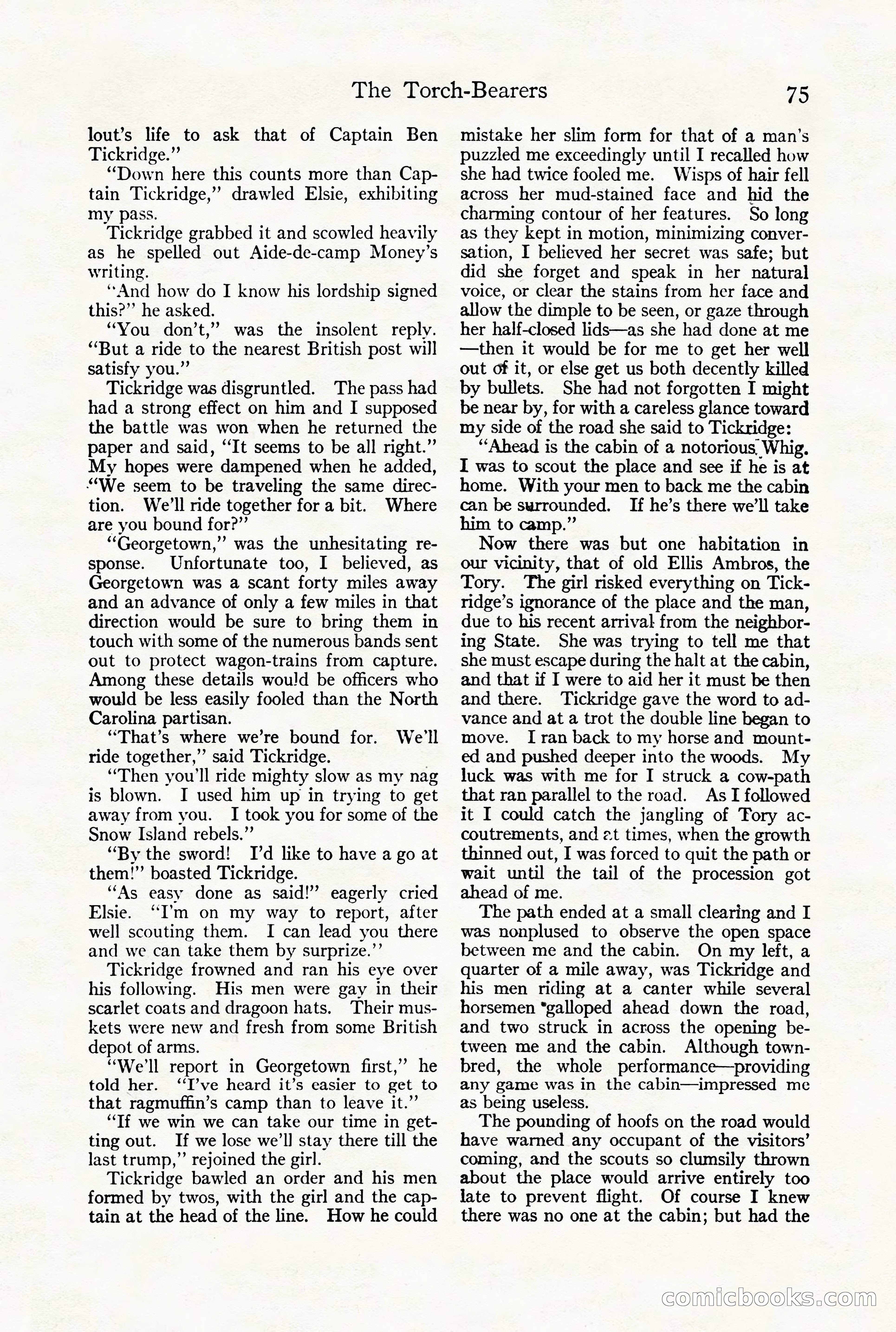
A restored page from Pulp Fiction, 1921. Page through the whole issue in the reader above.
📄 Transcribed text from this page (OCR, searchable)
Machine-transcribed from the original scan — historical spelling and the odd misread are preserved.
The Torch-Bearers lout’s life to ask that of Captain Ben Tickridge.” “Down here this counts more than Cap- tain Tickridge,” drawled Elsie, exhibiting my pass. Tickridge grabbed it and scowled heavily as he spelled out Aide-de-camp Money’s writing. ‘‘And how do I know his lordship signed this?” he asked. “You don’t,” was the insolent reply. “But a ride to the nearest British post will satisfy you.” Tickridge was disgruntled. The pass had had a strong effect on him and I supposed the battle was won when he returned the paper and said, “It seems to be all right.” My hopes were dampened when he added, “‘We seem to be traveling the same direc- tion. We'll ride together for a bit. Where are you bound for?”’ “‘“Georgetown,”’ was the unhesitating re- sponse. Unfortunate too, I believed, as Georgetown was a scant forty miles away and an advance of only a few miles in that direction would be sure to bring them in touch with some of the numerous bands sent out to protect wagon-trains from capture. Among these details would be officers who would be less easily fooled than the North Carolina partisan. “That’s where we’re bound for. ride together,” said Tickridge. 7 “Then you'll ride mighty slow as my nag is blown. I used him up in trying to get away from you. I took you for some of the Snow Island rebels.” “By the sword! Id like to have a go at them!” boasted Tickridge. ‘““As easy done as said!” eagerly cried Elsie. ‘I’m on my way to report, after well scouting them. I can lead you there and we can take them by surprize.’’ Tickridge frowned and ran his eye over his following. His men were gay in their scarlet coats and dragoon hats. Their mus- kets were new and fresh from some British depot of arms. “We'll report in Georgetown first,” he told her. ‘‘I’ve heard it’s easier to get to that ragmuffin’s camp than to leave it.”’ “If we win we can take our time in get- ting out. If we lose we’l] stay there till the last trump,” rejoined the girl. Tickridge bawled an order and his men formed by twos, with the girl and the cap- tain at the head of the line. How he could We'll 1)? 79 mistake her slim form for that of a man’s puzzled me exceedingly until I recalled how she had twice fooled me. Wisps of hair fell across her mud-stained face and hid the charming contour of her features. So long as they kept in motion, minimizing conver- sation, I believed her secret was safe; but did she forget and speak in her natural voice, or clear the stains from her face and allow the dimple to be seen, or gaze through her half-closed lids—as she had done at me —then it would be for me to get her well out of it, or else get us both decently killed by bullets. She had not forgotten I might be near by, for with a careless glance toward my side of the road she said to Tickridge: ‘‘Ahead is the cabin of a notorious, Whig. I was to scout the place and see if he is at home. With your men to back me the cabin can be surrounded. If he’s there we'll take him to camp.” Now there was but one habitation in our vicinity, that of old Ellis Ambros, the Tory. The girl risked everything on Tick- ridge’s ignorance of the place and the man, due to his recent arrival from the neighbor- ing State. She was trying to tell me that she must escape during the halt at the cabin, and that if I were to aid her it must be then and there. Tickridge gave the word to ad- vance and at a trot the double line began to move. [ran back to my horse and mount- ed and pushed deeper into the woods. My luck was with me for I struck a cow-path that ran parallel to the road. As I followed it I could catch the jangling of Tory ac- coutrements, and @t times, when the growth thinned out, I was forced to quit the path or wait until the tail of the procession got ahead of me. The path ended at a small clearing and I was nonplused to observe the open space between me and the cabin. On my left, a quarter of a mile away, was Tickridge and his men riding at a canter while several horsemen “galloped ahead down the road, and two struck in across the opening be- tween me and the cabin. Although town- bred, the whole performance—providing any game was in the cabin—impressed me as being useless. The pounding of hoofs on the road would have warned any occupant of the visitors’ coming, and the scouts so clumsily thrown about the place would arrive entirely too late to prevent flight. Of course I knew there was no one at the cabin; but had the Comicbhook ©