
Pulp Fiction, 1921 · page 69 of 204
Adventure Magazine Cover — page 69: what you’re looking at
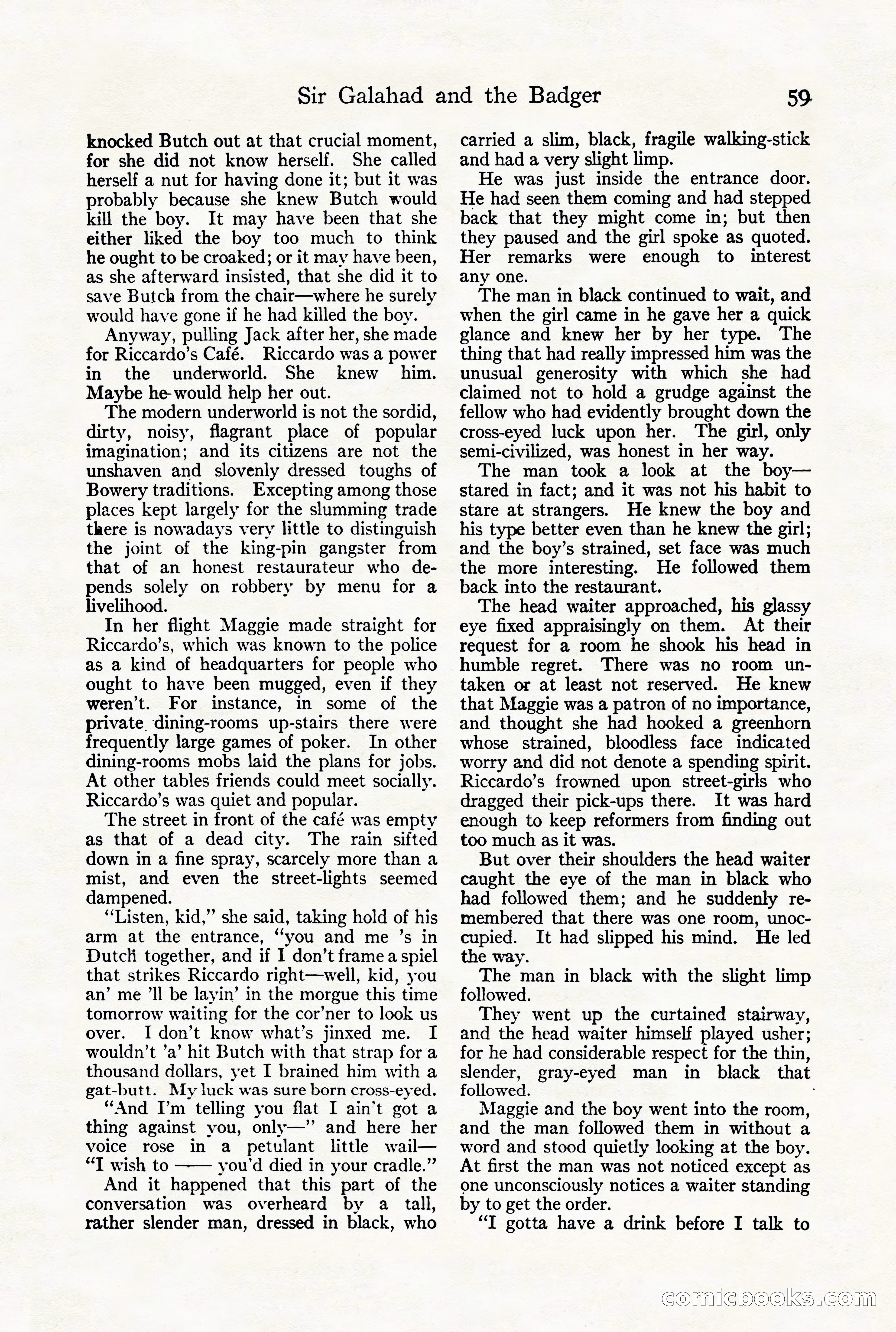
A restored page from Pulp Fiction, 1921. Page through the whole issue in the reader above.
📄 Transcribed text from this page (OCR, searchable)
Machine-transcribed from the original scan — historical spelling and the odd misread are preserved.
Sir Galahad and the Badger knocked Butch out at that crucial moment, for she did not know herself. She called herself a nut for having done it; but it was probably because she knew Butch would kill the boy. It may have been that she either liked the boy too much to think he ought to be croaked; or it may have been, as she afterward insisted, that she did it to save Butch from the chair—where he surely would have gone if he had killed the boy. Anyway, pulling Jack after her, she made for Riccardo’s Café. Riccardo was a power in the underworld. She knew him. Maybe he-would help her out. The modern underworld is not the sordid, dirty, noisy, flagrant place of popular imagination; and its citizens are not the unshaven and slovenly dressed toughs of Bowery traditions. Excepting among those places kept largely for the slumming trade there is nowadays very little to distinguish the joint of the king-pin gangster from that of an honest restaurateur who de- pends solely on robbery by menu for a livelihood. In her flight Maggie made straight for Riccardo’s, which was known to the police as a kind of headquarters for people who ought to have been mugged, even if they weren’t. For instance, in some of the private dining-rooms up-stairs there were frequently large games of poker. In other dining-rooms mobs laid the plans for jobs. At other tables friends could meet socially. Riccardo’s was quiet and popular. The street in front of the café was empty as that of a dead city. The rain sifted down in a fine spray, scarcely more than a mist, and even the street-lights seemed dampened. “Listen, kid,’’ she said, taking hold of his arm at the entrance, ‘‘you and me ’s in Dutch together, and if 1 don’t frame a spiel that strikes Riccardo right—well, kid, you an’ me ’ll be layin’ in the morgue this time tomorrow waiting for the cor’ner to look us over. I don’t know what’s jinxed me. I wouldn’t ’a’ hit Butch with that strap for a thousand dollars, yet I brained him with a gat-butt. My luck was sure born cross-eyed. “And I’m telling you flat I ain’t got a thing against you, only—” and here her voice rose in a petulant little w ail— “T wish to —— you'd died in your cradle.” And it happened that this part of the conversation was overheard by a tall, rather slender man, dressed in black, who 59. carried a slim, black, fragile walking-stick and had a very slight limp. He was just inside the entrance door. He had seen them coming and had stepped back that they might come in; but then they paused and the girl spoke as quoted. Her remarks were enough to interest any one. The man in black continued to wait, and when the girl came in he gave her a quick glance and knew her by her type. The thing that had really impressed him was the unusual generosity with which she had claimed not to hold a grudge against the fellow who had evidently brought down the cross-eyed luck upon her. The girl, only semi-civilized, was honest in her way. The man took a look at the boy— stared in fact; and it was not his habit to stare at strangers. He knew the boy and his type better even than he knew the girl; and the boy’s strained, set face was much the more interesting. He followed them back into the restaurant. The head waiter approached, his glassy eye fixed appraisingly on them. At their request for a room he shook his head in humble regret. There was no room un- taken or at least not reserved. He knew that Maggie was a patron of no importance, and thought she had hooked a greenhorn whose strained, bloodless face indicated worry and did not denote a spending spirit. Riccardo’s frowned upon street-girls who dragged their pick-ups there. It was hard enough to keep reformers from finding out too much as it was. But over their shoulders the head waiter caught the eye of the man in black who had followed them; and he suddenly re- membered that there was one room, unoc- cupied. It had slipped his mind. He led the way. The man in black with the slight limp followed. They went up the curtained stairway, and the head waiter himself played usher; for he had considerable respect for the thin, slender, followed. Maggie and the boy went into the room, and the man followed them in without a word and stood quietly looking at the boy. At first the man was not noticed except as one unconsciously notices a waiter standing by to get the order. “I gotta have a drink before I talk to CoMmicbhook gray-eyed man in black that C©