
Pulp Fiction, 1921 · page 58 of 204
Adventure Magazine Cover — page 58: what you’re looking at
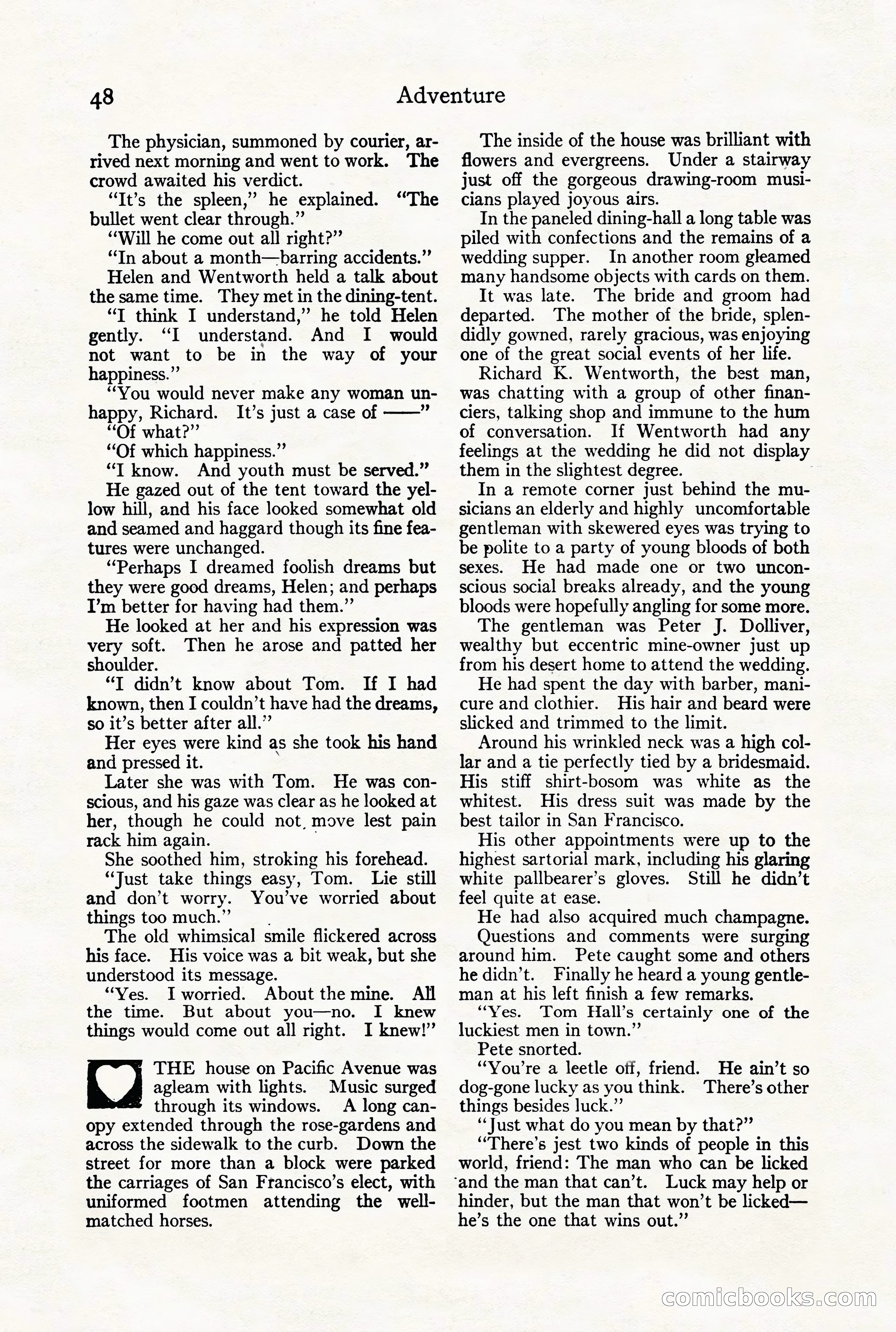
A restored page from Pulp Fiction, 1921. Page through the whole issue in the reader above.
📄 Transcribed text from this page (OCR, searchable)
Machine-transcribed from the original scan — historical spelling and the odd misread are preserved.
48 The physician, summoned by courier, ar- rived next morning and went to work. The crowd awaited his verdict. “Tt’s the spleen,” he explained. “The bullet went clear through.” “‘Will he come out all right?” “Tn about a month—barring accidents.”’ Helen and Wentworth held a talk about the same time. They met in the dining-tent. “T think I understand,” he told Helen gently. “I understand. And I would not want to be in the way of your happiness.” “You would never make any woman un- happy, Richard. It’s just a case of ——” “Of what?” “Of which happiness.” “T know. And youth must be served.” He gazed out of the tent toward the yel- low hill, and his face looked somewhat old and seamed and haggard though its fine fea- tures were unchanged. “Perhaps I dreamed foolish dreams but they were good dreams, Helen; and perhaps I’m better for having had them.”’ He looked at her and his expression was very soft. Then he arose and patted her shoulder. “T didn’t know about Tom. If I had known, then I couldn’t have had the dreams, so it’s better after all.” Her eyes were kind as she took his hand and pressed it. Later she was with Tom. He was con- scious, and his gaze was clear as he looked at her, though he could not, move lest pain rack him again. She soothed him, stroking his forehead. “Just take things easy, Tom. Lie still and don’t worry. You’ve worried about things too much.”’ ; The old whimsical smile flickered across his face. His voice was a bit weak, but she understood its message. “Ves. Iworried. About the mine. All the time. But about you—no. I knew things would come out all right. I knew!” THE house on Pacific Avenue was C agleam with lights. Music surged through its windows. A long can- opy extended through the rose-gardens and across the sidewalk to the curb. Down the street for more than a block were parked the carriages of San Francisco’s elect, with uniformed footmen attending the well- matched horses. ‘and the man that can’t. Adventure The inside of the house was brilliant with flowers and evergreens. Under a stairway just off the gorgeous drawing-room musi- cians played joyous airs. In the paneled dining-hall a long table was piled with confections and the remains of a wedding supper. In another room gleamed many handsome objects with cards on them. It was late. The bride and groom had departed. The mother of the bride, splen- didly gowned, rarely gracious, was enjoying one of the great social events of her life. Richard K. Wentworth, the best man, was chatting with a group of other finan- ciers, talking shop and immune to the hum of conversation. If Wentworth had any feelings at the wedding he did not display them in the slightest degree. In a remote corner just behind the mu- sicians an elderly and highly uncomfortable gentleman with skewered eyes was trying to be polite to a party of young bloods of both sexes. He had made one or two uncon- scious social breaks already, and the young bloods were hopefully angling for some more. The gentleman was Peter J. Dolliver, wealthy but eccentric mine-owner just up from his desert home to attend the wedding. He had spent the day with barber, mani- cure and clothier. His hair and beard were slicked and trimmed to the limit. Around his wrinkled neck was a high col- lar and a tie perfectly tied by a bridesmaid. His stiff shirt-bosom was white as the whitest. His dress suit was made by the best tailor in San Francisco. His other appointments were up to the highest sartorial mark, including his glaring white pallbearer’s gloves. Still he didn’t feel quite at ease. He had also acquired much champagne. Questions and comments were surging around him. Pete caught some and others he didn’t. Finally he heard a young gentle- man at his left finish a few remarks. “Yes. Tom Hall’s certainly one of the luckiest men in town.” Pete snorted. “You're a leetle off, friend. He ain’t so dog-gone lucky as you think. There’s other things besides luck.”’ ‘Just what do you mean by that?” “‘There’s jest two kinds of people in this world, friend: The man who can be licked Luck may help or hinder, but the man that won’t be licked— he’s the one that wins out.” COmiclbook CO