
Pulp Fiction, 1921 · page 187 of 204
Adventure Magazine Cover — page 187: what you’re looking at
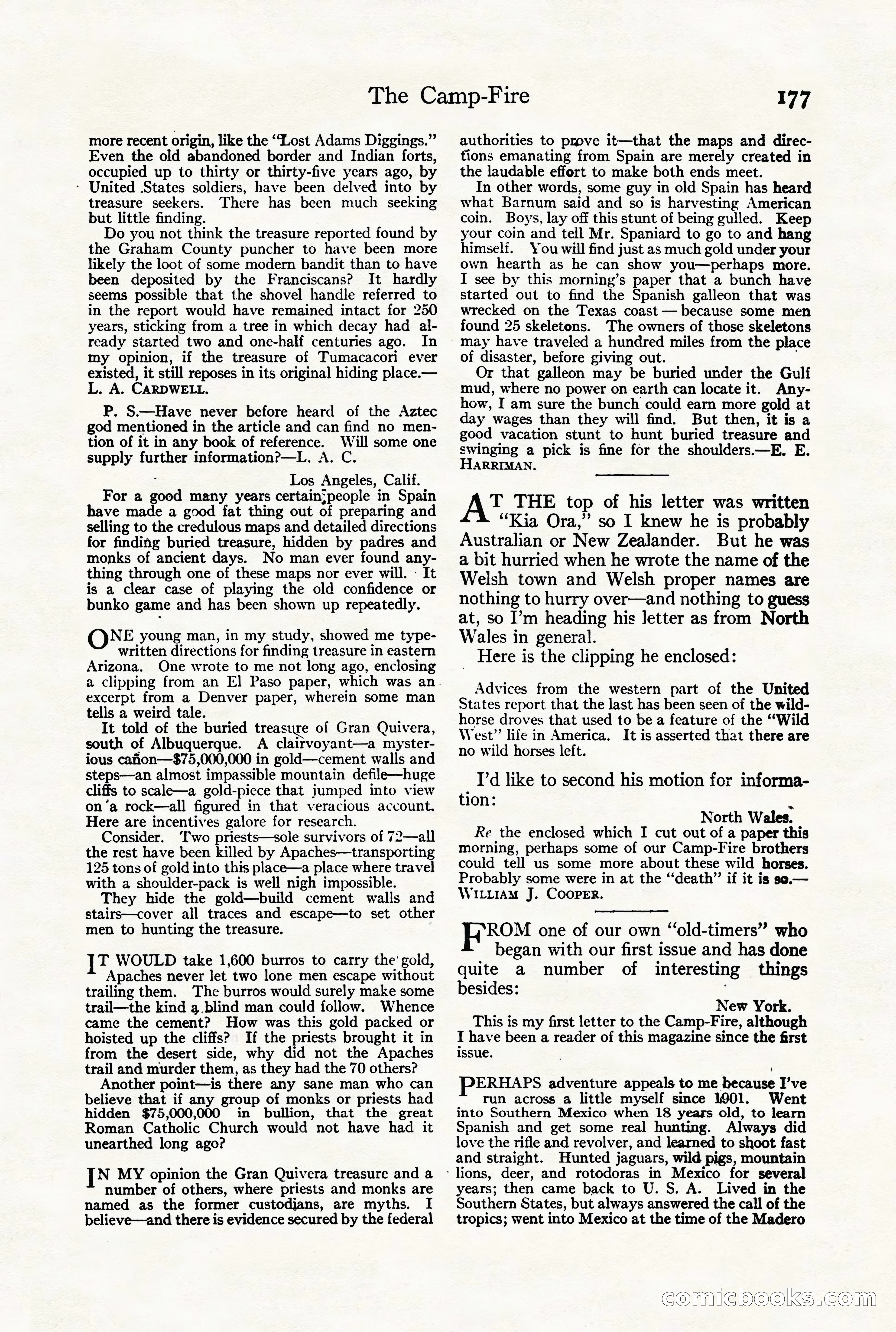
A restored page from Pulp Fiction, 1921. Page through the whole issue in the reader above.
📄 Transcribed text from this page (OCR, searchable)
Machine-transcribed from the original scan — historical spelling and the odd misread are preserved.
The Camp-Fire more recent origin, like the ‘Lost Adams Diggings.”’ Even the old abandoned border and Indian forts, occupied up to thirty or thirty-five years ago, by - United States soldiers, have been delved into by treasure seekers. There has been much seeking but little finding. Do you not think the treasure reported found by the Graham County puncher to have been more likely the loot of some modern bandit than to have been deposited by the Franciscans? It hardly seems possible that the shovel handle referred to in the report would have remained intact for 250 years, sticking from a tree in which decay had al- ready started two and one-half centuries ago. In my opinion, if the treasure of Tumacacori ever existed, it still reposes in its original hiding place.— L. A. CARDWELL. P. S.—Have never before heard of the Aztec god mentioned in the article and can find no men- tion of it in any book of reference. Will some one supply further information?P—L. A. C. Los Angeles, Calif. For a good many years certain;people in Spain have made a good fat thing out of preparing and selling to the credulous maps and detailed directions for finding buried treasure, hidden by padres and monks of ancient days. No man ever found any- thing through one of these maps nor ever will. - It is a clear case of playing the old confidence or bunko game and has been shown up repeatedly. ON E young man, in my study, showed me type- written directions for finding treasure in eastern Arizona. One wrote to me not long ago, enclosing a clipping from an El] Paso paper, which was an. excerpt from a Denver paper, wherein some man tells a weird tale. It told of the buried treasure of Gran Quivera, south of Albuquerque. A clairvoyant—a myster- ious cahon—$75,000,000 in gold—cement walls and steps—an almost impassible mountain defile—huge cliffs to scale—a gold-piece that jumped into view on’a rock—all figured in that veracious account. Here are incentives galore for research. Consider. ‘Two priests—sole survivors of 72—all the rest have been killed by Apaches—transporting 125 tons of gold into this place—a place where travel with a shoulder-pack is well nigh impossible. They hide the gold—build cement walls and stairs—cover all traces and escape—to set other men to hunting the treasure. : jt WOULD take 1,600 burros to carry the’ gold, Apaches never let two lone men escape without trailing them. The burros would surely make some trail—the kind 3.blind man could follow. Whence came the cement? How was this gold packed or hoisted up the cliffs? If the priests brought it in from the desert side, why did not the Apaches trail and murder them, as they had the 70 others? Another point—is there any sane man who can believe that if any group of monks or priests had hidden $75,000,000 in bullion, that the great Roman Catholic Church would not have had it unearthed long ago? N MY opinion the Gran Quivera treasure and a number of others, where priests and monks are named as the former custodjans, are myths. I believe—and there is evidence secured by the federal 177 authorities to prove it—that the maps and direc- tions emanating from Spain are merely created in the laudable effort to make both ends meet. In other words, some guy in old Spain has heard what Barnum said and so is harvesting American coin. Boys, lay off this stunt of being gulled. Keep your coin and tell Mr. Spaniard to go to and hang himself. You will find just as much gold under your own hearth as he can show you—perhaps more. I see by this morning’s paper that a bunch have started out to find the Spanish galleon that was wrecked on the Texas coast — because some men found 25 skeletons. The owners of those skeletons may have traveled a hundred miles from the place of disaster, before giving out. : Or that galleon may be buried under the Gulf mud, where no power on earth can locate it. Any- how, I am sure the bunch could earn more gold at day wages than they will find. But then, it is a good vacation stunt to hunt buried treasure and swinging a pick is fine for the shoulders.—E. E. HARRIMAN. Ae THE top of his letter was written “Kia Ora,” so I knew he is probably Australian or New Zealander. But he was a bit hurried when he wrote the name of the Welsh town and Welsh proper names are nothing to hurry over—and nothing to guess at, so I’m heading his letter as from North Wales in general. Here is the clipping he enclosed: Advices from the western part of the United States report that the last has been seen of the wild- horse droves that used to be a feature of the “Wild West” life in America. It is asserted that there are no wild horses left. I'd like to second his motion for informa- tion: Z North Wales. Re the enclosed which I cut out of a paper this morning, perhaps some of our Camp-Fire brothers could tell us some more about these wild horses. Probably some were in at the ‘“‘death”’ if it is se.— WILLIAM J. COOPER. ROM one of our own ‘‘old-timers” who began with our first issue and has done quite a number of interesting things besides: : New York. This is my first letter to the Camp-Fire, although I have been a reader of this magazine since the first issue. ERHAPS adventure appeals to me because I’ve run across a little myself since 1901. Went into Southern Mexico when 18 yeags old, to learn Spanish and get some real hunting. Always did love the rifle and revolver, and learned to shoot fast and straight. Hunted jaguars, wild pigs, mountain ‘lions, deer, and rotodoras in Mexico for several years; then came back to U. S. A. Lived in the Southern States, but always answered the call of the tropics; went into Mexico at the time of the Madero cCOmiclboolks