
Pulp Fiction, 1921 · page 171 of 204
Adventure Magazine Cover — page 171: what you’re looking at
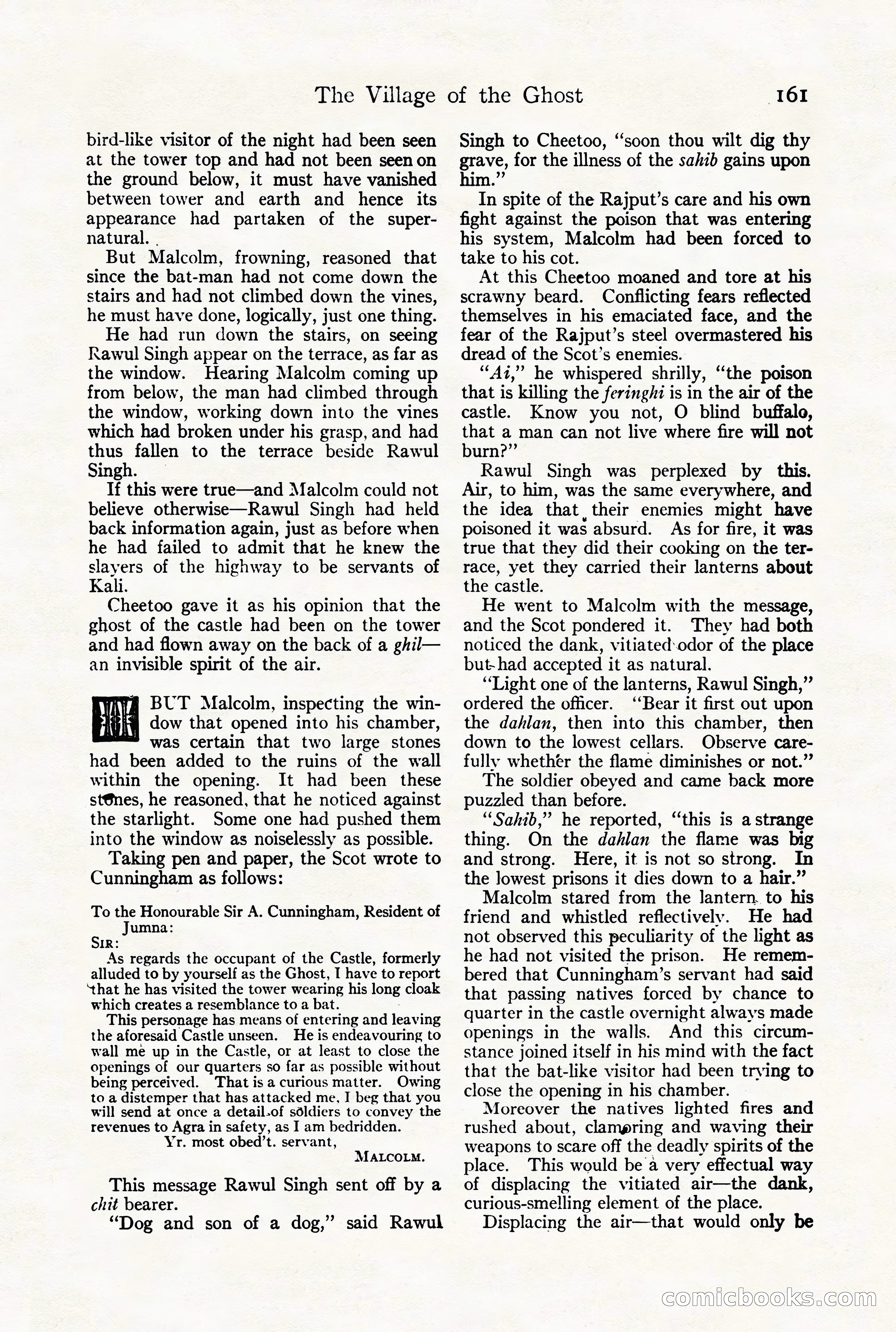
A restored page from Pulp Fiction, 1921. Page through the whole issue in the reader above.
📄 Transcribed text from this page (OCR, searchable)
Machine-transcribed from the original scan — historical spelling and the odd misread are preserved.
The Village of the Ghost bird-like visitor of the night had been seen at the tower top and had not been seen on the ground below, it must have vanished between tower and earth and hence its appearance had partaken of the super- natural. . But Malcolm, frowning, reasoned that since the bat-man had not come down the stairs and had not climbed down the vines, he must have done, logically, just one thing. He had run down the stairs, on seeing Rawul Singh appear on the terrace, as far as the window. Hearing Malcolm coming up from below, the man had climbed through the window, working down into the vines which had broken under his grasp, and had thus fallen to the terrace beside Rawul Singh. If this were true—and Malcolm could not believe otherwise—Rawul Singh had held back information again, just as before when he had failed to admit that he knew the slayers of the highway to be servants of Kali. Cheetoo gave it as his opinion that the ghost of the castle had been on the tower and had flown away on the back of a ghil— an invisible spirit of the air. Nd BUT Malcolm, inspecting the win- : dow that opened into his chamber, was certain that two large stones had been added to the ruins of the wall within the opening. It had been these st@nes, he reasoned, that he noticed against the starlight. Some one had pushed them into the window as noiselessly as possible. Taking pen and paper, the Scot wrote to Cunningham as follows: To the Honourable Sir A. Cunningham, Resident of Jumna: SIR: As regards the occupant of the Castle, formerly alluded to by yourself as the Ghost, I have to report ‘that he has visited the tower wearing his long cloak which creates a resemblance to a bat. This personage has means of entering and leaving the aforesaid Castle unseen. He is endeavouring to wall me up in the Castle, or at least to close the openings of our quarters so far as possible without being perceived. That isacurious matter. Owing to a distemper that has attacked me, I beg that you will send at once a detail.of sdldiers to convey the revenues to Agra in safety, as I am bedridden. Yr. most obed’t. servant, MALCOLM. This message Rawul Singh sent off by a chit bearer. “Dog and son of a dog,” said Rawul I61 Singh to Cheetoo, “soon thou wilt dig thy grave, for the illness of the sahzb gains upon him.”’ In spite of the Rajput’s care and his own fight against the poison that was entering his system, Malcolm had been forced to take to his cot. At this Cheetoo moaned and tore at his scrawny beard. Conflicting fears reflected themselves in his emaciated face, and the fear of the Rajput’s steel overmastered his dread of the Scot’s enemies. ‘‘At,” he whispered shrilly, “the poison that is killing the feringhz is in the air of the castle. Know you not, O blind buffalo, that a man can not live where fire will not burn?” Rawul Singh was perplexed by this. Air, to him, was the same everywhere, and the idea that. their enemies might have poisoned it was absurd. As for fire, it was true that they did their cooking on the ter- race, yet they carried their lanterns about the castle. He went to Malcolm with the message, and the Scot pondered it. They had both noticed the dank, vitiated-odor of the place but-had accepted it as natural. “Light one of the lanterns, Rawul Singh,” ordered the officer. ‘‘Bear it first out upon the dahlan, then into this chamber, then down to the lowest cellars. Observe care- fully whether the flame diminishes or not.” The soldier obeyed and came back more puzzled than before. “Sahib,” he reported, “this is a strange thing. On the dahlan the flame was big and strong. Here, it is not so strong. In the lowest prisons it dies down to a hair.” Malcolm stared from the lantern. to his friend and whistled reflectively. He had not observed this peculiarity of the light as he had not visited the prison. He remem- bered that Cunningham’s servant had said that passing natives forced by chance to quarter in the castle overnight always made openings in the walls. And this circum- stance joined itself in his mind with the fact that the bat-like visitor had been trving to close the opening in his chamber. Moreover the natives lighted fires and rushed about, clamgring and waving their weapons to scare off the deadly spirits of the place. This would be a very effectual way of displacing the vitiated air—the dank, curious-smelling element of the place. Displacing the air—that would only be cComicloooks ©