
Pulp Fiction, 1921 · page 164 of 204
Adventure Magazine Cover — page 164: what you’re looking at
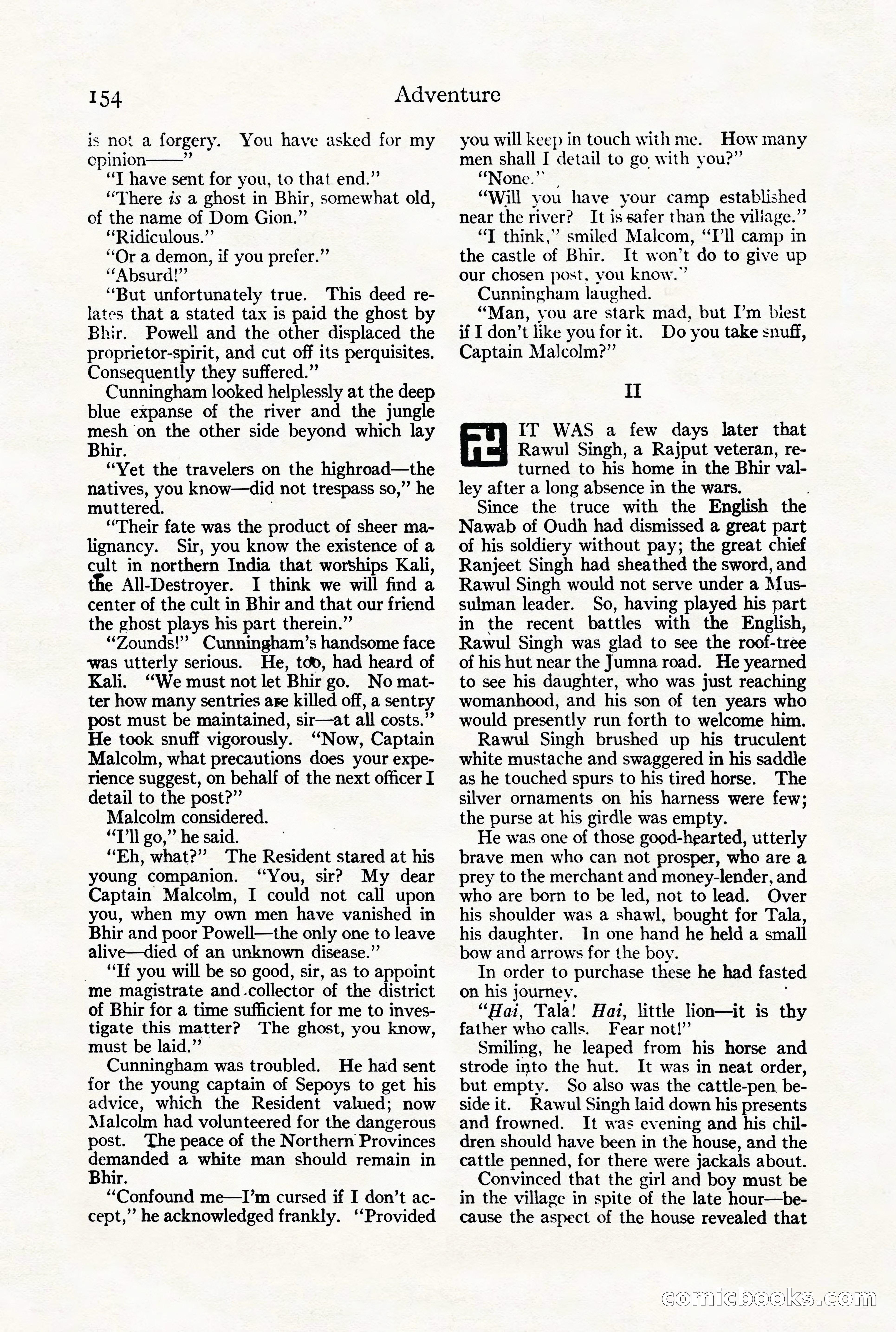
A restored page from Pulp Fiction, 1921. Page through the whole issue in the reader above.
📄 Transcribed text from this page (OCR, searchable)
Machine-transcribed from the original scan — historical spelling and the odd misread are preserved.
154 is not a forgery. You have asked for my opinion # “T have sent for you, to that end.” “There is a ghost in Bhir, somewhat old, of the name of Dom Gion.”’ “Ridiculous.” “Or a demon, if you prefer.”’ “Absurd!” “But unfortunately true. This deed re- lates that a stated tax is paid the ghost by Bhir. Powell and the other displaced the proprietor-spirit, and cut off its perquisites. Consequently they suffered.” Cunningham looked helplessly at the deep blue expanse of the river and the jungle mesh on the other side beyond which lay Bhir. “Vet the travelers on the highroad—the natives, you know—did not trespass so,” he muttered. “Their fate was the product of sheer ma- lignancy. Sir, you know the existence of a cult in northern India that worships Kali, the All-Destroyer. I think we will find a center of the cult in Bhir and that our friend the ghost plays his part therein.” “Zounds!” Cunningham’s handsome face ‘was utterly serious. He, tov, had heard of Kali. ‘We must not let Bhir go. No mat- ter how many sentries are killed off, a sentry post must be maintained, sir—at all costs.” He took snuff vigorously. ‘Now, Captain Malcolm, what precautions does your expe- rience suggest, on behalf of the next officer I detail to the post?” Malcolm considered. “T’ll go,” he said. “Eh, what?” The Resident stared at his young companion. ‘You, sir? My dear Captain Malcolm, I could not call upon you, when my own men have vanished in Bhir and poor Powell—the only one to leave alive—died of an unknown disease.” _ “Tf you will be so good, sir, as to appoint me magistrate and.collector of the district of Bhir for a time sufficient for me to inves- tigate this matter? The ghost, you know, must be laid.” Cunningham was troubled. He had sent for the young captain of Sepoys to get his advice, which the Resident valued; now Malcolm had volunteered for the dangerous post. The peace of the Northern Provinces demanded a white man should remain in Bhir. “‘Confound me—I’m cursed if I don’t ac- cept,” he acknowledged frankly. ‘‘Provided Adventure you will keep in touch with me. How many men shall J detail to go with you?” “None.” “Will you have your camp established near the river? It is safer than the village.” “T think,” smiled Malcom, “I'll camp in the castle of Bhir. It won't do to give up our chosen post, you know.” Cunningham laughed. “Man, you are stark mad, but I’m biest if I don’t like you for it. Do you take snuff, Captain Malcolm?” Rawul Singh, a Rajput veteran, re- turned to his home in the Bhir val- ley after a long absence in the wars. Since the truce with the English the Nawab of Oudh had dismissed a great part of his soldiery without pay; the great chief Ranjeet Singh had sheathed the sword, and Rawul Singh would not serve under a Mus- sulman leader. So, having played his part in the recent battles with the English, Rawul Singh was glad to see the roof-tree of his hut near the Jumna road. He yearned to see his daughter, who was just reaching womanhood, and his son of ten years who would presently run forth to welcome him. Rawul Singh brushed up his truculent white mustache and swaggered in his saddle as he touched spurs to his tired horse. The silver ornaments on his harness were few; the purse at his girdle was empty. He was one of those good-hearted, utterly brave men who can not prosper, who are a prey to the merchant and money-lender, and who are born to be led, not to lead. Over his shoulder was a shawl, bought for Tala, his daughter. In one hand he held a small bow and arrows for the boy. In order to purchase these he had fasted on his j journey. “Hai, Tala! Hai, little lion—it is thy father who calls. Fear not!” Smiling, he leaped from his horse and strode into the hut. It was in neat order, but empty. So also was the cattle-pen. be- side it. Rawul Singh laid down his presents and frowned. It was evening and his chil- dren should have been in the house, and the cattle penned, for there were jackals about. Convinced that the girl and boy must be in the village in spite of the late hour—be- cause the aspect of the house revealed that II IT WAS a few days later that COmiclbook CO