
Pulp Fiction, 1921 · page 155 of 204
Adventure Magazine Cover — page 155: what you’re looking at
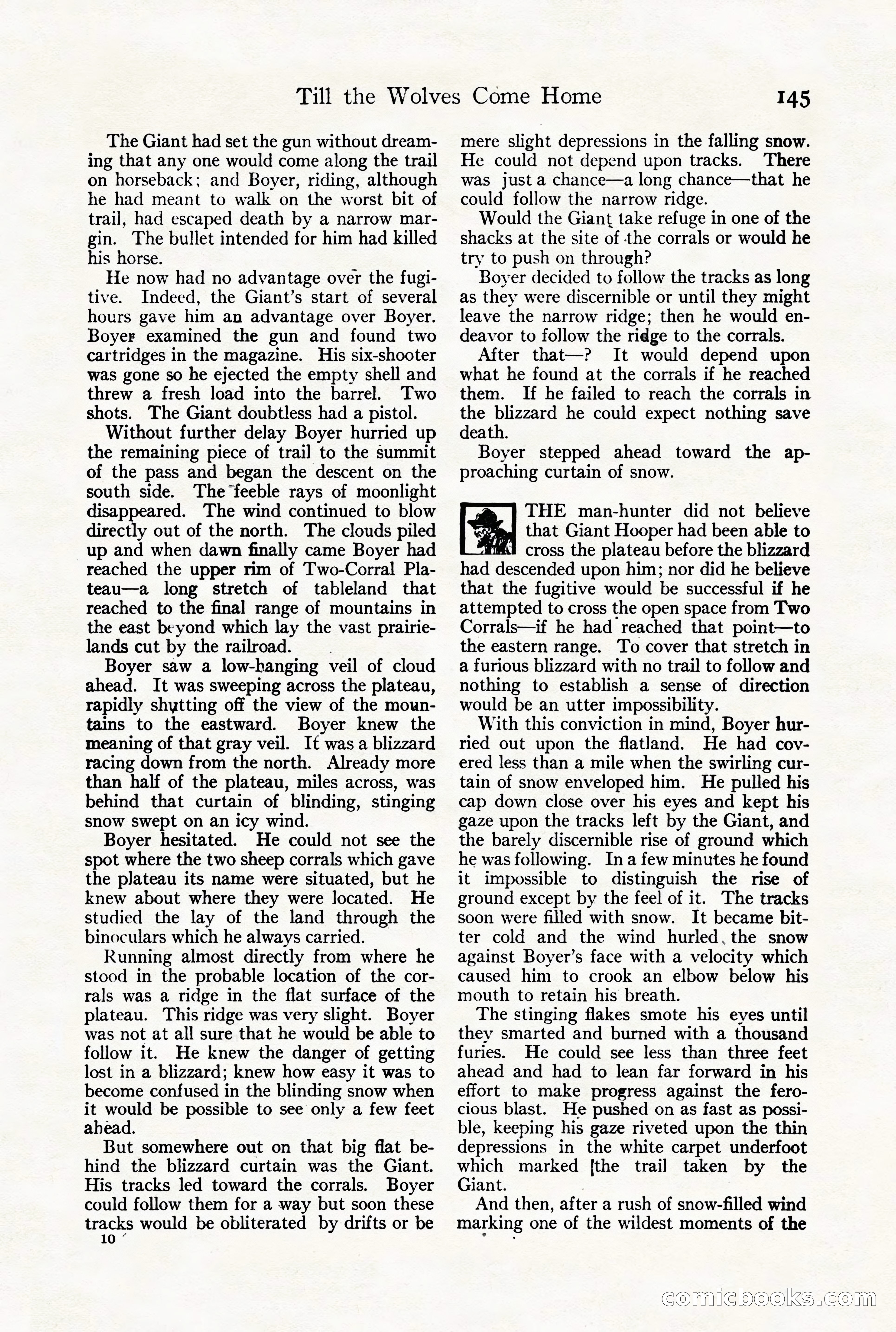
A restored page from Pulp Fiction, 1921. Page through the whole issue in the reader above.
📄 Transcribed text from this page (OCR, searchable)
Machine-transcribed from the original scan — historical spelling and the odd misread are preserved.
Till the Wolves Come Home 145 The Giant had set the gun without dream- ing that any one would come along the trail on horseback; and Boyer, riding, although he had meant to walk on the worst bit of trail, had escaped death by a narrow mar- gin. The bullet intended for him had killed his horse. He now had no advantage over the fugi- tive. Indeed, the Giant’s start of several hours gave him an advantage over Boyer. Boyer examined the gun and found two cartridges in the magazine. His six-shooter was gone so he ejected the empty shell and threw a fresh load into the barrel. Two shots. The Giant doubtless had a pistol. Without further delay Boyer hurried up the remaining piece of trail to the summit of the pass and began the descent on the south side. The feeble rays of moonlight disappeared. The wind continued to blow directly out of the north. The clouds piled -up and when dawn finally came Boyer had reached the upper rim of Two-Corral Pla- teau—a long stretch of tableland that reached to the fina] range of mountains in the east beyond which lay the vast prairie- lands cut by the railroad. Boyer saw a low-hanging veil of cloud ahead. It was sweeping across the plateau, rapidly shytting off the view of the moun- tains to the eastward. Boyer knew the meaning of that gray veil. It was a blizzard racing down from the north. Already more than half of the plateau, miles across, was behind that curtain of blinding, stinging snow swept on an icy wind. Boyer hesitated. He could not see the spot where the two sheep corrals which gave the plateau its name were situated, but he knew about where they were located. He studied the lay of the land through the binoculars which he always carried. Running almost directly from where he stood in the probable location of the cor- rals was a ridge in the flat surface of the plateau. This ridge was very slight. Boyer was not at all sure that he would be able to follow it. He knew the danger of getting lost in a blizzard; knew how easy it was to become confused in the blinding snow when it would be possible to see only a few feet ahead. But somewhere out on that big flat be- hind the blizzard curtain was the Giant. His tracks led toward the corrals. Boyer could follow them for a way but soon these tracks would be obliterated by drifts or be 10 “ mere slight depressions in the falling snow. He could not depend upon tracks. There was just a chance—a long chance—that he could follow the narrow ridge. Would the Giant take refuge in one of the shacks at the site of the corrals or would he try to push on through? Boyer decided to follow the tracks as long as they were discernible or until they might leave the narrow ridge; then he would en- deavor to follow the ridge to the corrals. After that—? It would depend upon what he found at the corrals if he reached them. If he failed to reach the corrals in the blizzard he could expect nothing save death. Boyer stepped ahead toward the ap- proaching curtain of snow. THE man-hunter did not believe <oommal that Giant Hooper had been able to HMml cross the plateau before the blizzard had descended upon him; nor did he believe that the fugitive would be successful if he attempted to cross the open space from Two Corrals—if he had reached that point—to the eastern range. To cover that stretch in a furious blizzard with no trail to follow and nothing to establish a sense of direction would be an utter impossibility. With this conviction in mind, Boyer hur- ried out upon the flatland. He had cov- ered less than a mile when the swirling cur- tain of snow enveloped him. He pulled his cap down close over his eyes and kept his gaze upon the tracks left by the Giant, and the barely discernible rise of ground which he was following. Ina few minutes he found it impossible to distinguish the rise of ground except by the feel of it. The tracks soon were filled with snow. It became bit- ter cold and the wind hurled, the snow against Boyer’s face with a velocity which caused him to crook an elbow below his mouth to retain his breath. The stinging flakes smote his eyes until they smarted and burned with a thousand furies. He could see less than three feet ahead and had to lean far forward in his effort to make progress against the fero- cious blast. He pushed on as fast as possi- ble, keeping his gaze riveted upon the thin depressions in the white carpet underfoot which marked |the trail taken by the Giant. ; And then, after a rush of snow-filled wind marking one of the wildest moments of the cCOmiclboolks CO