
Pulp Fiction, 1921 · page 152 of 204
Adventure Magazine Cover — page 152: what you’re looking at
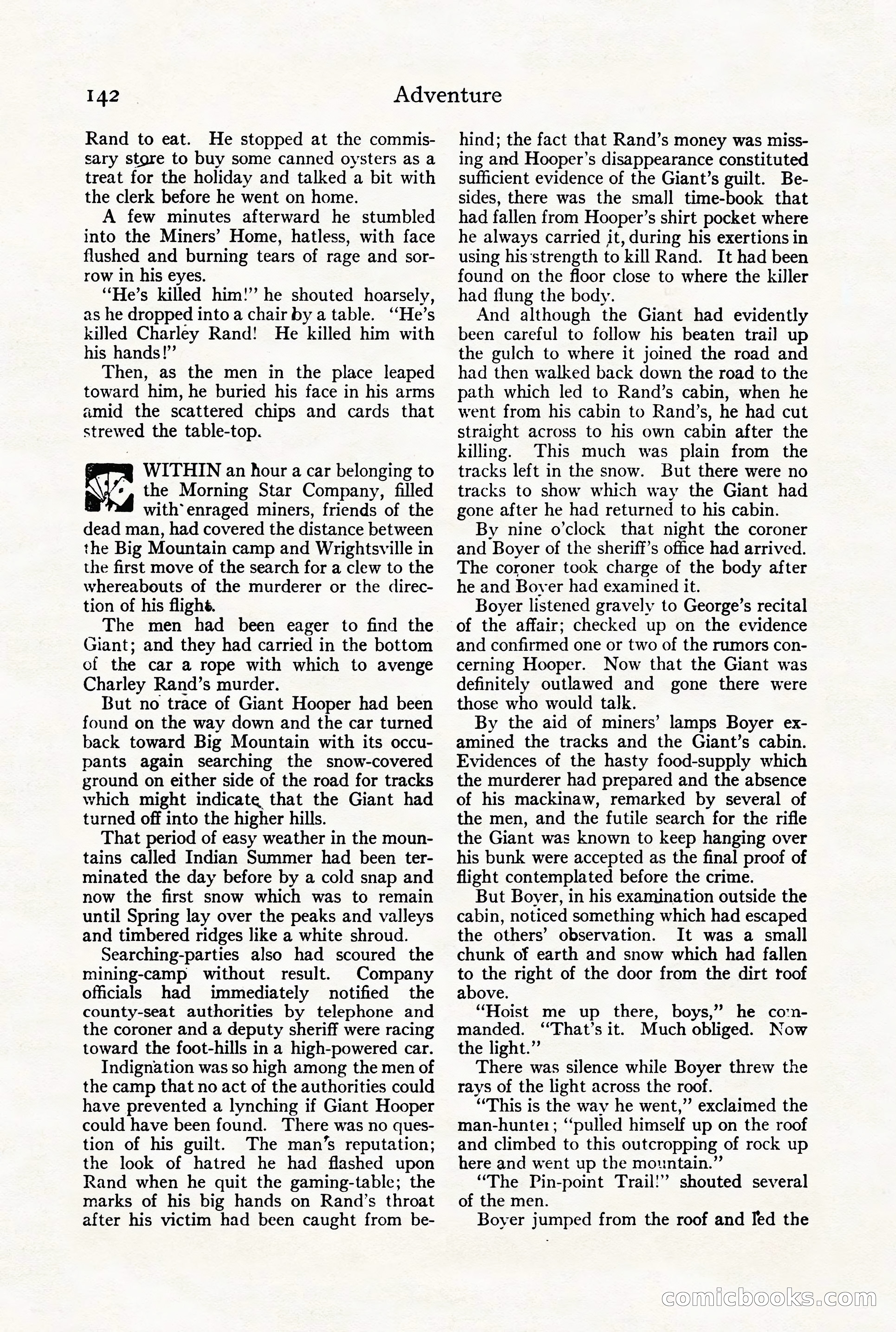
A restored page from Pulp Fiction, 1921. Page through the whole issue in the reader above.
📄 Transcribed text from this page (OCR, searchable)
Machine-transcribed from the original scan — historical spelling and the odd misread are preserved.
142 Rand to eat. He stopped at the commis- sary store to buy some canned oysters as a treat for the holiday and talked a bit with the clerk before he went on home. A few minutes afterward he stumbled into the Miners’ Home, hatless, with face flushed and burning tears of rage and sor- row in his eyes. ‘“‘He’s killed him!’ he shouted hoarsely, as he dropped into a chair bya table. ‘‘He’s killed Charley Rand! He killed him with his hands!” Then, as the men in the place leaped toward him, he buried his face in his arms amid the scattered chips and cards that strewed the table-top. 65 WITHIN an hour a car belonging to «, the Morning Star Company, filled with’ enraged miners, friends of the dead man, had covered the distance between the Big Mountain camp and Wrightsville in the first move of the search for a clew to the whereabouts of the murderer or the direc- tion of his flighé. The men had been eager to find the Giant; and they had carried in the bottom of the car a rope with which to avenge Charley Rand’s murder. But no trace of Giant Hooper had been found on the way down and the car turned back toward Big Mountain with its occu- pants again searching the snow-covered ground on either side of the road for tracks which might indicate that the Giant had turned off into the higher hills. That period of easy weather in the moun- tains called Indian Summer had been ter- minated the day before by a cold snap and now the first snow which was to remain until Spring lay over the peaks and valleys and timbered ridges like a white shroud. Searching-parties also had scoured the mining-camp without result. Company officials had immediately notified the county-seat authorities by telephone and the coroner and a deputy sheriff were racing toward the foot-hills in a high-powered car. Indignation was so high among the men of the camp that no act of the authorities could have prevented a lynching if Giant Hooper could have been found. There was no ques- tion of his guilt. The man’s reputation; the look of hatred he had flashed upon Rand when he quit the gaming-table; the marks of his big hands on Rand’s throat after his victim had been caught from be- Adventure hind; the fact that Rand’s money was miss- ing and Hooper’s disappearance constituted sufficient evidence of the Giant’s guilt. Be- sides, there was the smalJl time-book that had fallen from Hooper’s shirt pocket where he always carried it, during his exertions in using his‘strength to kill Rand. It had been found on the floor close to where the killer had flung the body. And although the Giant had evidently been careful to follow his beaten trail up the gulch to where it joined the road and had then walked back down the road to the path which led to Rand’s cabin, when he went from his cabin to Rand’s, he had cut straight across to his own cabin after the killing. This much was plain from the tracks left in the snow. But there were no tracks to show which way the Giant had gone after he had returned to his cabin. By nine o'clock that night the coroner and Boyer of the sheriff’s office had arrived. The coroner took charge of the body after he and Bover had examined it. Boyer listened gravely to George’s recital of the affair; checked up on the evidence and confirmed one or two of the rumors con- cerning Hooper. Now that the Giant was definitely outlawed and gone there were those who would talk. By the aid of miners’ lamps Boyer ex- amined the tracks and the Giant’s cabin. Evidences of the hasty food-supply which the murderer had prepared and the absence of his mackinaw, remarked by several of the men, and the futile search for the rifle the Giant was known to keep hanging over his bunk were accepted as the final proof of flight contemplated before the crime. But Bover, in his examination outside the cabin, noticed something which had escaped the others’ observation. It was a small chunk of earth and snow which had fallen to the right of the door from the dirt roof above. “Hoist me up there, boys,” he co:n- manded. ‘‘That’s it. Much obliged. Now the light.”’ There was silence while Boyer threw the rays of the light across the roof. “‘This is the wav he went,” exclaimed the man-hunter; “‘pulled himself up on the roof and climbed to this outcropping of rock up here and went up the mountain.” “The Pin-point Trail!” shouted several of the men. Boyer jumped from the roof and Ied the 33 COMmicloo S CO