
Pulp Fiction, 1921 · page 147 of 204
Adventure Magazine Cover — page 147: what you’re looking at
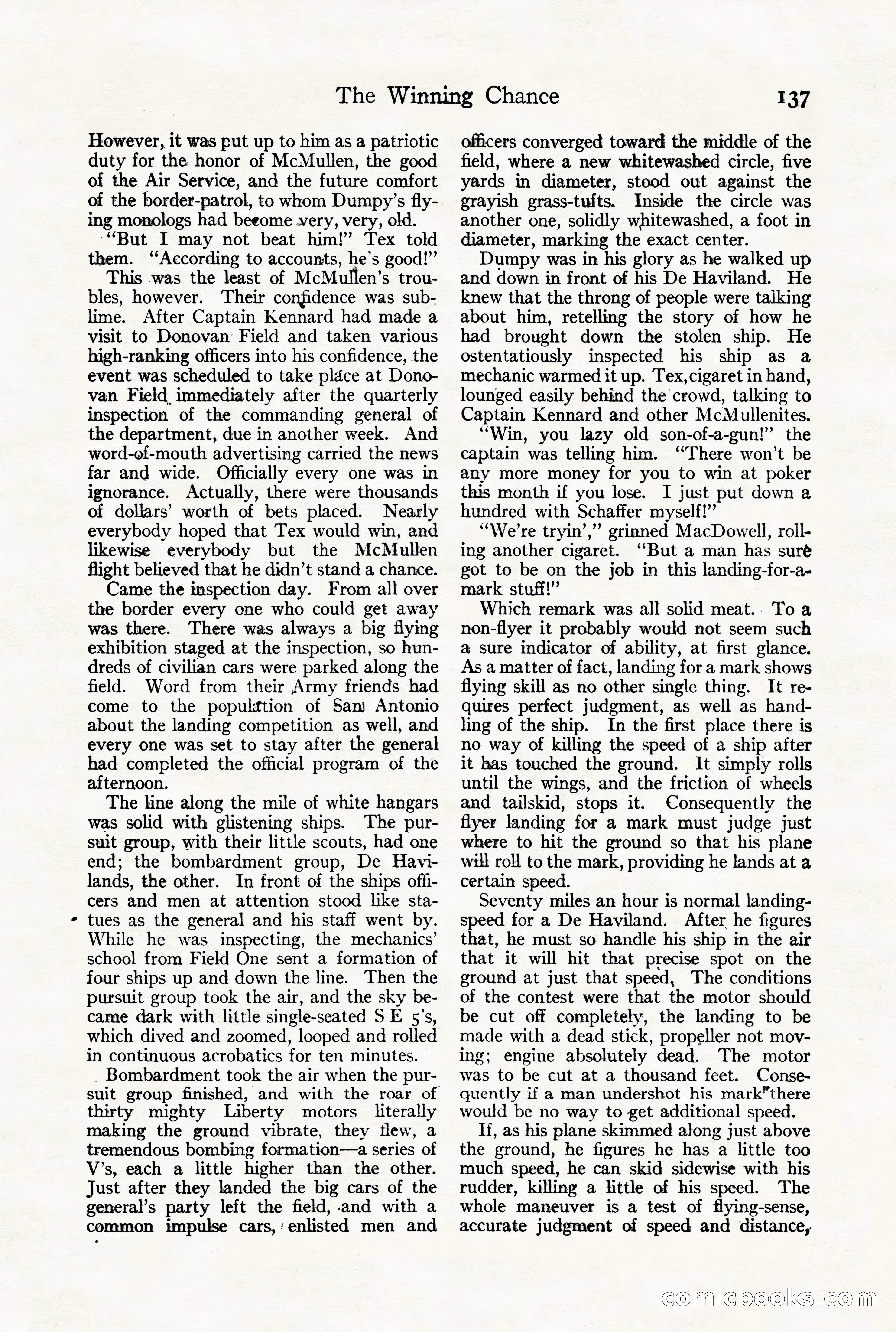
A restored page from Pulp Fiction, 1921. Page through the whole issue in the reader above.
📄 Transcribed text from this page (OCR, searchable)
Machine-transcribed from the original scan — historical spelling and the odd misread are preserved.
® The Winning Chance However, it was put up to him as a patriotic duty for the honor of McMullen, the good of the Air Service, and the future comfort of the border-patrol, to whom Dumpy’s fly- ing monologs had beeome very, very, old. “But I may not beat him!’ Tex told them. “According to accounts, he’s good!” This .was the least of McMullen’s trou- bles, however. Their confidence was sub- lime. After Captain Kennard had made a visit to Donovan Field and taken various high-ranking officers into his confidence, the event was scheduled to take pldce at Dono- van Field immediately after the quarterly inspection of the commanding general of the department, due in another week. And word-of-mouth advertising carried the news far and wide. Officially every one was in ignorance. Actually, there were thousands of dollars’ worth of bets placed. Nearly everybody hoped that Tex would win, and likewise everybody but the McMullen flight believed that he didn’t stand a chance. Came the mspection day. From all over the border every one who could get away was there. There was always a big flying exhibition staged at the inspection, so hun- dreds of civilian cars were parked along the field. Word from their Army friends had come to the populgtion of San} Antonio about the landing competition as well, and every one was set to stay after the general had completed the official program of the afternoon. The line along the mile of white hangars was solid with glistening ships. The pur- suit group, with their little scouts, had one end; the bombardment group, De Havi- lands, the other. In front of the ships off- cers and men at attention stood like sta- tues as the general and his staff went by. While he was inspecting, the mechanics’ school from Field One sent a formation of four ships up and down the line. Then the pursuit group took the air, and the sky be- came dark with little single-seated S E 5's, which dived and zoomed, looped and rolled in continuous acrobatics for ten minutes. _ Bombardment took the air when the pur- suit group finished, and with the roar of thirty mighty Liberty motors literally making the ground vibrate, they flew, a tremendous bombing formation—a series of V’s, each a little higher than the other. Just after they landed the big cars of the general’s party left the field, and with a common impulse cars,‘ enlisted men and 137 officers converged toward the middle of the field, where a new whitewashed circle, five yards in diameter, stood out against the grayish grass-tufts. Inside the circle was another one, solidly whitewashed, a foot in diameter, marking the exact center. Dumpy was in his glory as he walked up and down in front of his De Haviland. He knew that the throng of people were talking about him, retelling the story of how he had brought down the stolen ship. He ostentatiously inspected his ship as a mechanic warmed it up. Tex,cigaret in hand, lounged easily behind the crowd, talking to Captain Kennard and other McMullenites. ‘Win, you lazy old son-of-a-gun!” the captain was telling him. ‘““There won’t be any more money for you to win at poker this month if you lose. I just put down a hundred with Schaffer myself!’’ ‘We're tryin’,” grinned MacDowell, roil- ing another cigaret. “But a man has suré got to be on the job in this landing-for-a- mark stuff!’ Which remark was all solid meat.. To a non-flyer it probably would not seem such a sure indicator of ability, at first glance. As a matter of fact, landing for a mark shows flying skill as no other single thing. It re- quires perfect judgment, as well as hand- ling of the ship. In the first place there is no way of killing the speed of a ship after it has touched the ground. It simply rolls until the wings, and the friction of wheels and tailskid, stops it. Consequently the flyer landing for a mark must judge just where to hit the ground so that his plane will roll to the mark, providing he lands at a certain speed. Seventy miles an hour is normal landing- speed for a De Haviland. After he figures that, he must so handle his ship in the air that it will hit that precise spot on the ground at just that speed, The conditions of the contest were that the motor should be cut off completely, the landing to be made with a dead stick, propeller not mov- ing; engine absolutely dead. The motor was to be cut at a thousand feet. Conse- quently if a man undershot his mark"there would be no way to get additional speed. If, as his plane skimmed along just above the ground, he figures he has a little too much speed, he can skid sidewise with his rudder, killing a httle of his speed. The whole maneuver is a test of flying-sense, accurate judgment of speed and distance, Comicbhook C©