
Pulp Fiction, 1921 · page 143 of 204
Adventure Magazine Cover — page 143: what you’re looking at
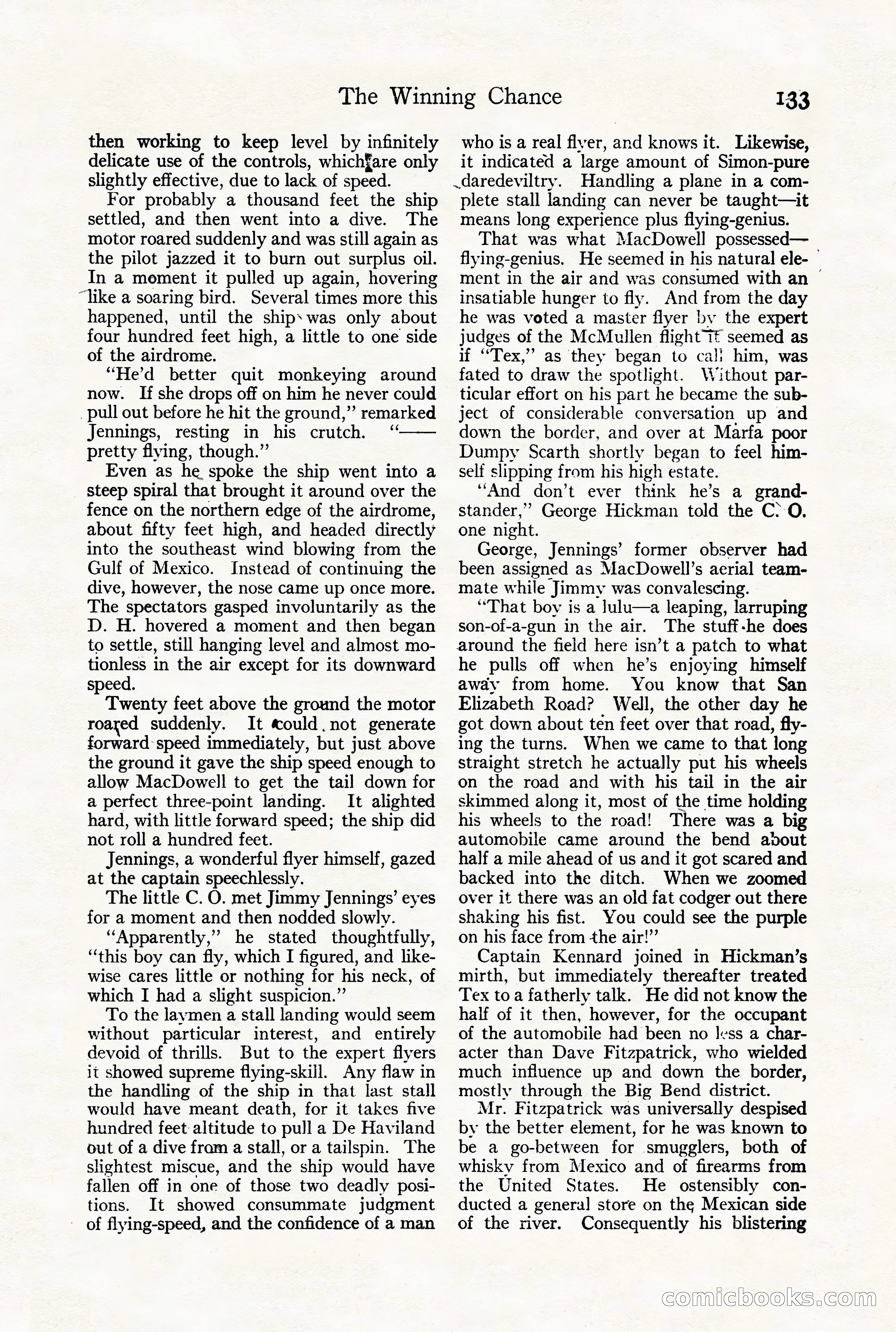
A restored page from Pulp Fiction, 1921. Page through the whole issue in the reader above.
📄 Transcribed text from this page (OCR, searchable)
Machine-transcribed from the original scan — historical spelling and the odd misread are preserved.
The Winning Chance then working to keep level by infinitely delicate use of the controls, whichfare only slightly effective, due to lack of ood For probably a thousand feet the ship settled, and then went into a dive. The motor roared suddenly and was still again as the pilot jazzed it to burn out surplus oil. In a moment it pulled up again, hovering “like a soaring bird. Several times more this happened, until the ships was only about four hundred feet high, a little to one side of the airdrome. “He’d better quit monkeying around now. If she drops off on him he never could _pull out before he hit the ground,” remarked Jennings, resting in his crutch. “ pretty flying, though.” Even as he spoke the ship went into a steep spiral that brought it around over the fence on the northern edge of the airdrome, about fifty feet high, and headed directly into the southeast wind blowing from the Gulf of Mexico. Instead of continuing the dive, however, the nose came up once more. The spectators gasped involuntarily as the D. H. hovered a moment and then began to settle, still hanging level and almost mo- tionless in the air except for its downward speed. Twenty feet above the ground the motor roared suddenly. It «ould. not generate forward speed immediately, but just above the ground it gave the ship speed enough to allow MacDowell to get the tail down for a perfect three-point landing. It alighted hard, with little forward speed; the ship did not roll a hundred feet. Jennings, a wonderful flyer himself, gazed at the captain speechlessly. The little C. O. met Jimmy Jennings’ eyes for a moment and then nodded slowly. “Apparently,” he stated thoughtfully, “this boy can fly, which I figured, and like- wise cares little or nothing for his neck, of which I had a slight suspicion.” To the laymen a stall landing would seem without particular interest, and entirely devoid of thrills. But to the expert flyers it showed supreme flying-skill. Any flaw in the handling of the ship in that last stall would have meant death, for it takes five hundred feet altitude to pull a De Haviland out of a dive fram a stall, or a tailspin. The slightest miscue, and the ship would have fallen off in one of those two deadly posi- tions. It showed consummate judgment of flying-speed, and the confidence of a man .daredeviltry. 133 who is a real flyer, and knows it. Likewise, it indicated a large amount of Simon-pure Handling a plane in a com- plete stall landing can never be taught—it means long experience plus flying-genius. That was what MacDowell possessed— flying-genius. He seemed in his natural ele- _ ment in the air and was consumed with an insatiable hunger to fly. And from the day he was voted a master flyer by the expert judges of the McMullen flight Tf seemed as if “Tex,” as they began to cali him, was fated to draw the spotlight. Without par- ticular effort on his part he became the sub- ject of considerable conversation up and down the border, and over at Marfa poor Dumpv Scarth shortly began to feel him- self slipping from his high estate. ‘‘And don’t ever think he’s a grand- stander,” George Hickman told the C? O. one night. George, Jennings’ former observer had been assigned as MacDowell’s acrial team- mate while Jimmy was convalescing. ‘That boy is a lulu—a leaping, larruping son-of-a-gun in the air. The stuff-he does around the field here isn’t a patch to what he pulls off when he’s enjoying himself awdy from home. You know that San Elizabeth Road? Well, the other day he got down about ten feet over that road, fly- ing the turns. When we came to that long straight stretch he actually put his wheels on the road and with his tail in the air skimmed along it, most of the time holding his wheels to the road! There was a big automobile came around the bend avout half a mile ahead of us and it got scared and backed into the ditch. When we zoomed over it there was an old fat codger out there shaking his fist. You could see the purple on his face from the air!”’ Captain Kennard joined in Hickman’s mirth, but immediately thereafter treated Tex toa fatherly talk. He did not know the half of it then, however, for the occupant of the automobile had been no |ess a char- acter than Dave Fitzpatrick, who wielded much influence up and down the border, mostly through the Big Bend district. Mr. Fitzpatrick was universally despised by the better element, for he was known to be a go-between for smugglers, both of whisky from Mexico and of firearms from the United States. He ostensibly con- ducted a general store on the Mexican side of the river. Consequently his blistering CoMmicbook CO