
Pulp Fiction, 1921 · page 141 of 204
Adventure Magazine Cover — page 141: what you’re looking at
A restored page from Pulp Fiction, 1921. Page through the whole issue in the reader above.
📄 Transcribed text from this page (OCR, searchable)
Machine-transcribed from the original scan — historical spelling and the odd misread are preserved.
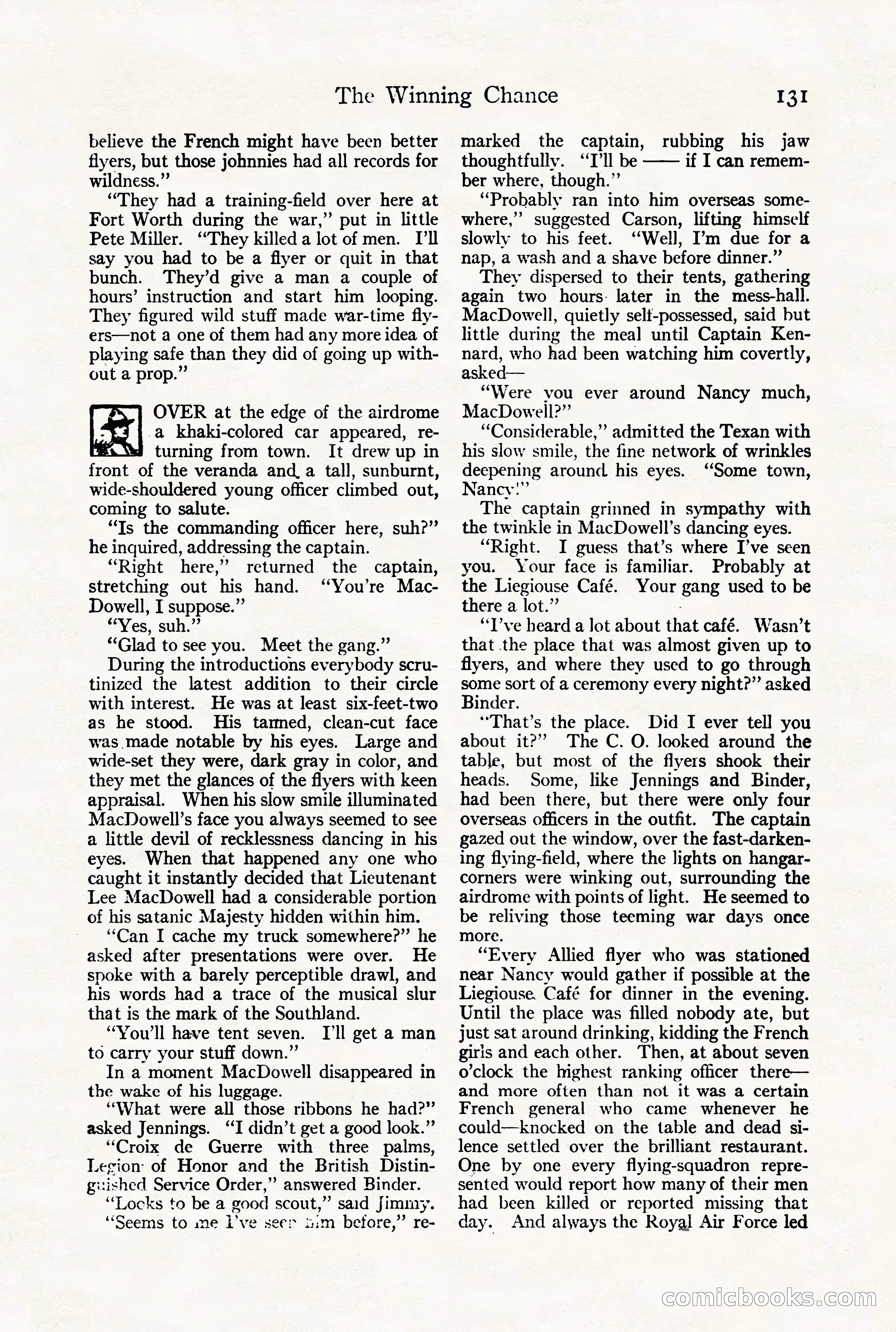
The Winning Chance believe the French might have been better flyers, but those johnnies had all records for wildness.” ‘“‘They had a training-field over here at Fort Worth during the war,” put in little Pete Miller. ‘They killed a lot of men. IU say you had to be a flyer or quit in that bunch. They’d give a man a couple of hours’ instruction and start him looping. They figured wild stuff made war-time fly- ers—not a one of them had any more idea of playing safe than they did of going up with- out a prop.” ay] OVER at the edge of the airdrome oe a khaki-colored car appeared, re- Mea Wd turning from town. It drew up in front of the veranda and_a tall, sunburnt, wide-shouldered young officer climbed out, coming to salute. “Ts the commanding officer here, suh?” he inquired, addressing the captain. “Right here,” returned the captain, stretching out his hand. ‘“You’re Mac- Dowell, I suppose.” “Yes, suh.” ‘“‘Glad to see you. Meet the gang.” During the introductions everybody scru- tinized the latest addition to their circle with interest. He was at least six-feet-two as he stood. His tarmed, clean-cut face was made notable by his eyes. Large and wide-set they were, dark gray in color, and they met the glances of the flyers with keen appraisal. When his slow smile illuminated MacDowell’s face you always seemed to see a little devil of recklessness dancing in his eyes. When that happened any one who caught it instantly decided that Lieutenant Lee MacDowell had a considerable portion of his satanic Majesty hidden within him. “Can I cache my truck somewhere?” he asked after presentations were over. He spoke with a barely perceptible drawl, and his words had a trace of the musical slur that is the mark of the Southland. “You'll have tent seven. I'll get a man to carry your stuff down.”’ In a moment MacDowell disappeared in the wake of his luggage. ‘‘What were all those ribbons he had?” asked Jennings. “I didn’t get a good look.” “Croix de Guerre with three palms, Legion: of Honor and the British Distin- guished Service Order,” answered Binder. “Locks to be a good scout,” said jimmy. —S seer f:m before,” re- Seems to ine l’ve 131 marked the captain, rubbing his jaw thoughtfully. “T’ll be —— if I can remem- ber where, though.” ‘Probably ran into him overseas some- where,” suggested Carson, lifting himself slowly to his feet. ‘Well, I’m due for a nap, a wash and a shave before dinner.”’ They dispersed to their tents, gathering again two hours: later in the mess-hall. MacDowell, quietly selt-possessed, said but little during the meal until Captain Ken- nard, who had been watching him covertly, asked— “Were vou ever around Nancy much, MacDowell?”’ ‘“‘Considerable,” admitted the Texan with his slow smile, the fine network of wrinkles deepening around his eyes. “Some town, Nancy:” The captain grinned in sympathy with the twinkle in MacDowell’s dancing eyes. “Right. I guess that’s where I’ve seen you. Your face is familiar. Probably at the Liegiouse Café. Your gang used to be there a lot.” “T’ve heard a lot about that café. Wasn’t that the place that was almost given up to flyers, and where they used to go through some sort of a ceremony every night?” asked Binder. ‘“That’s the place. Did I ever tell you about it?” The C. O. looked around the table, but most of the flyers shook their heads. Some, like Jennings and Binder, had been there, but there were only four overseas officers in the outfit. The captain gazed out the window, over the fast-darken- ing flying-field, where the lights on hangar- corners were winking out, surrounding the airdrome with points of light. He seemed to be reliving those teeming war days once more. “Every Allied flyer who was stationed near Nancy would gather if possible at the Liegiouse. Café for dinner in the evening. Until the place was filled nobody ate, but just sat around drinking, kidding the French giris and each other. Then, at about seven o'clock the highest ranking officer there— and more often than not it was a certain French general who came whenever he could—knocked on the table and dead si- lence settled over the brilliant restaurant. One by one every flying-squadron repre- sented would report how many of their men had been killed or reported missing that day. And always the Royal Air Force led CoMmicbook ©