
Pulp Fiction, 1921 · page 136 of 204
Adventure Magazine Cover — page 136: what you’re looking at
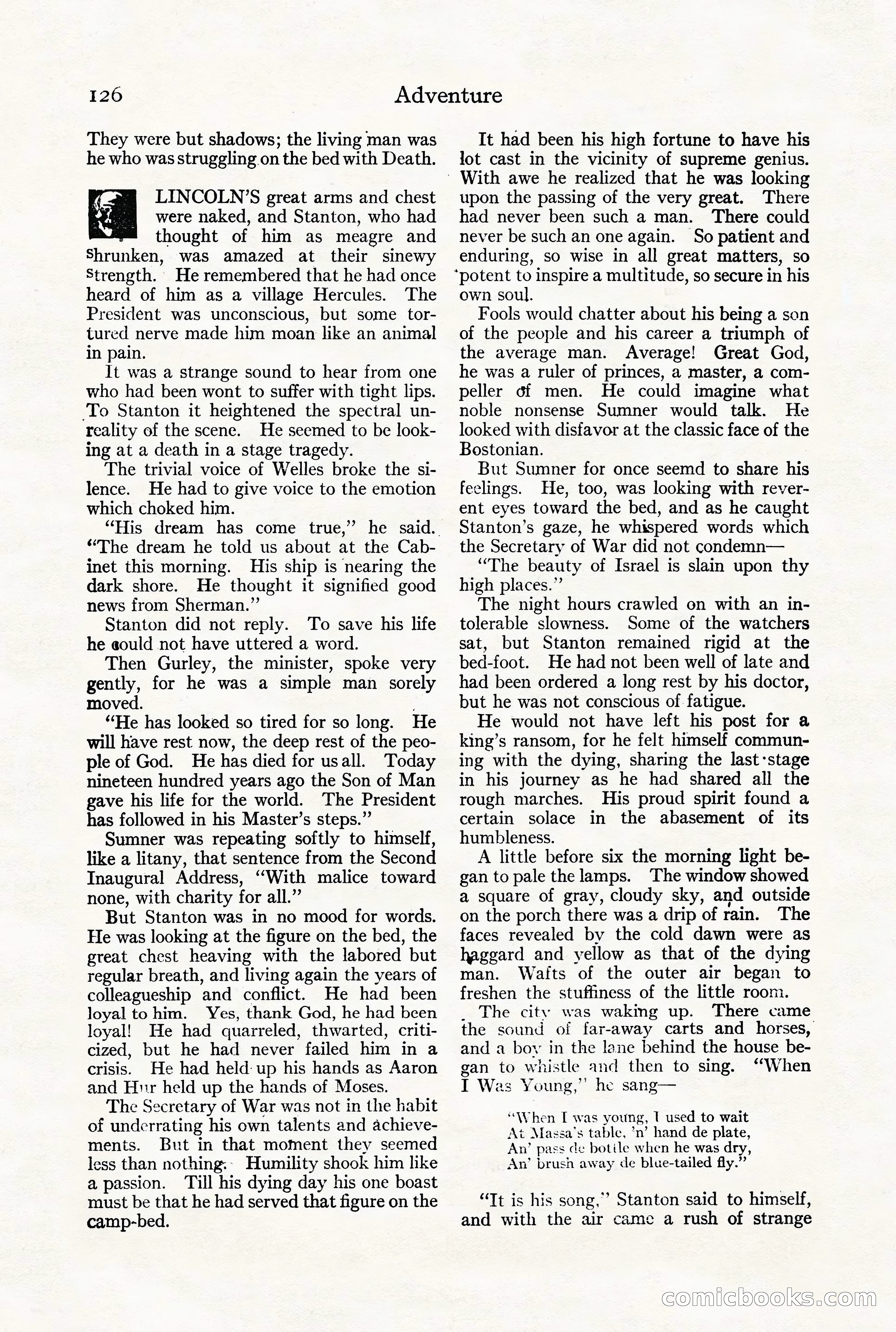
A restored page from Pulp Fiction, 1921. Page through the whole issue in the reader above.
📄 Transcribed text from this page (OCR, searchable)
Machine-transcribed from the original scan — historical spelling and the odd misread are preserved.
126 They were but shadows; the living man was he who was struggling on the bed with Death. LINCOLN’S great arms and chest were naked, and Stanton, who had thought of him as meagre and Shrunken, was amazed at their sinewy Strength. He remembered that he had once heard of him as a village Hercules. The President was unconscious, but some tor- tured nerve made him moan like an animal in pain. It was a strange sound to hear from one who had been wont to suffer with tight lips. To Stanton it heightened the spectral un- reality of the scene. He seemed to be look- ing at a death in a stage tragedy. The trivial voice of Welles broke the si- lence. He had to give voice to the emotion which choked him. “His dream has come true,” he said. “The dream he told us about at the Cab- inet this morning. His ship is nearing the dark shore. He thought it signified good news from Sherman.”’ Stanton did not reply. To save his life he gould not have uttered a word. Then Gurley, the minister, spoke very gently, for he was a simple man sorely moved. “He has looked so tired for so long. He will have rest now, the deep rest of the peo- ple of God. He has died for us all. Today nineteen hundred years ago the Son of Man gave his life for the world. The President has followed in his Master’s steps.” Sumner was repeating softly to himself, like a litany, that sentence from the Second Inaugural Address, “With malice toward none, with charity for all.” But Stanton was in no mood for words. He was looking at the figure on the bed, the great chest heaving with the labored but regular breath, and living again the years of colleagueship ‘and conflict. He had been loyal to him. Yes, thank God, he had been loyal! He had quarreled, thwarted, criti- cized, but he had never failed him in a crisis. He had held-up his hands as Aaron and Hur held up the hands of Moses. The Secretary of War was not in the habit of underrating his own talents and achieve- ments. But in that moment they seemed less than nothing:- Humility shook him like a passion. Till his dying day his one boast must be that he had served that figure on the camp-bed. Adventure It had been his high fortune to have his lot cast in the vicinity of supreme genius. ~ With awe he realized that he was looking upon the passing of the very great. There had never been such a man. There could never be such an one again. So patient and enduring, so wise in all great matters, so ‘potent to inspire a multitude, so secure in his own soul. Fools would chatter about his being a son of the people and his career a triumph of the average man. Average! Great God, he was a ruler of princes, a master, a com- peller of men. He could imagine what noble nonsense Sumner would talk. He looked with disfavor at the classic face of the Bostonian. But Sumner for once seemd to share his feelings. He, too, was looking with rever- ent eyes toward the bed, and as he caught Stanton’s gaze, he whispered words which the Secretary of War did not condemn— “The beauty of Israel is slain upon thy high places.” The night hours crawled on with an in- tolerable slowness. Some of the watchers sat, but Stanton remained rigid at the bed-foot. He had not been well of late and had been ordered a long rest by his doctor, but he was not conscious of fatigue. He would not have left his post for a king’s ransom, for he felt himself commun- ing with the dying, sharing the last-stage in his journey as he had shared all the rough marches. His proud spirit found a certain solace in the abasement of its humbleness. A little before six the morning light be- as to pale the lamps. ‘The window showed a square of gray, cloudy sky, and outside on the porch there was a drip of rain. The faces revealed by the cold dawn were as haggard and yellow as that of the dying man. Waits of the outer air began to freshen the stuffiness of the little room. _ The city was waking up. There came the sound of far-away carts and _ horses, and a boy in the lane behind the house be- gan to whistle and then to sing. “When I Was Young,” he sang— “When [ was young, | used to wait At Magsa’s table, ’n’ hand de plate, An’ pass de botile when he was dry, An’ brush away de blue-tailed fly.” “Tt is his song,” Stanton said to himself, and with the air came a rush of strange cCOmiclboolks CO