
Pulp Fiction, 1921 · page 126 of 204
Adventure Magazine Cover — page 126: what you’re looking at
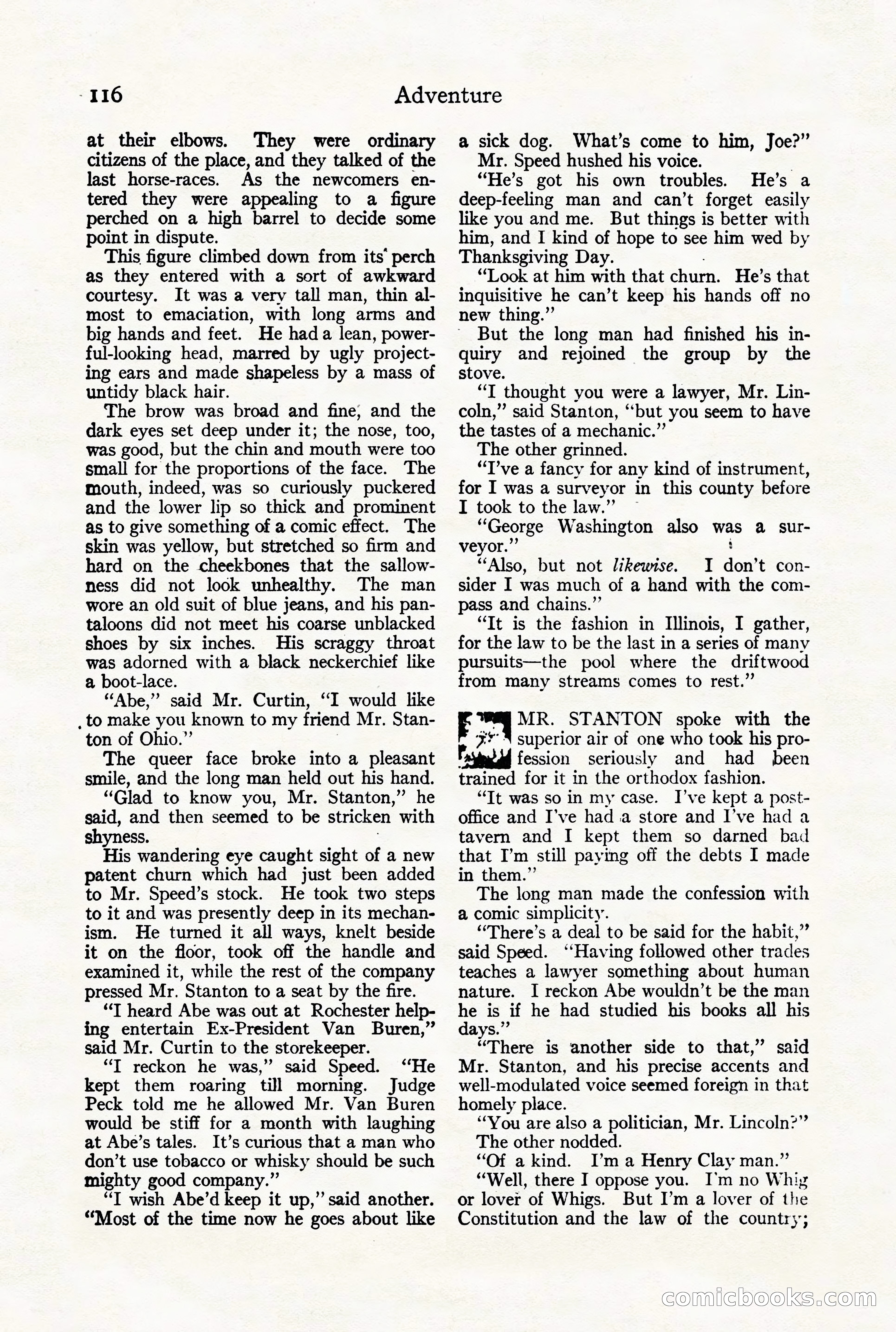
A restored page from Pulp Fiction, 1921. Page through the whole issue in the reader above.
📄 Transcribed text from this page (OCR, searchable)
Machine-transcribed from the original scan — historical spelling and the odd misread are preserved.
-J16 at their elbows. They were ordinary citizens of the place, and they talked of the last horse-races. As the newcomers en- tered they were appealing to a figure perched on a high barrel to decide some point in dispute. This figure climbed down from its perch as they entered with a sort of awkward courtesy. It was a very tall man, thin al- most to emaciation, with long arms and big hands and feet. He had a lean, power- ful-looking head, marred by ugly project- ing ears and made shapeless by a mass of untidy black hair. The brow was broad and fine, and the dark eyes set deep under it; the nose, too, was good, but the chin and mouth were too small for the proportions of the face. The mouth, indeed, was so curiously puckered and the lower lip so thick and prominent as to give something of a comic effect. The skin was yellow, but stretched so firm and hard on the cheekbones that the sallow- ness did not look unhealthy. The man wore an old suit of blue jeans, and his pan- taloons did not meet his coarse unblacked shoes by six inches. His scraggy throat was adorned with a black neckerchief like a boot-lace. “Abe,” said Mr. Curtin, “I would like , to make you known to my friend My. Stan- ton of Ohio.”’ The queer face broke into a pleasant smile, and the long man held out his hand. “Glad to know you, Mr. Stanton,” he said, and then seemed to be stricken, with shyness. His wandering eye caught sight of a new patent churn which had just been added to Mr. Speed’s stock. He took two steps to it and was presently deep in its mechan- ism. He turned it all ways, knelt beside it on the floor, took off the handle and examined it, while the rest of the company pressed Mr. Stanton to a seat by the fire. “T heard Abe was out at Rochester help- ing entertain Ex-President Van Buren,” said Mr. Curtin to the storekeeper. “T reckon he was,” said Speed. ‘He kept them roaring till morning. Judge Peck told me he allowed Mr. Van Buren would be stiff for a month with laughing at Abe’s tales. It’s curious that a man who don’t use tobacco or whisky should be such mighty good company.” “T wish Abe’d keep it up,’ said another. “Most of the time now he goes about like Adventure a sick dog. What’s come to him, Joe?” Mr. Speed hushed his voice. | *“He’s got his own troubles. He’s a deep-feeling man and can’t forget easily like you and me. But things is better with him, and I kind of hope to see him wed by Thanksgiving Day. “Look at him with that churn. He’s that inquisitive he can’t keep his hands off no new thing.”’ But the long man had finished his in- quiry and rejoined the group by the stove. “T thought you were a lawyer, Mr. Lin- coln,” said Stanton, ‘‘but you seem to have the tastes of a mechanic.”’ The other grinned. “T’ve a fancy for any kind of instrument, for I was a surveyor in this county before I took to the law.” ~ “George Washington also was a@ sur- veyor.’ ‘“‘Also, but not likewise. I aon con- sider I was much of a hand with the com- pass and chains.” “It is the fashion in Illinois, I gather, for the law to be the last in a series of many pursuits—the pool where the driftwood from many streams comes to rest.” Foe superior air of one who took his pro- y fession seriously and had _ pbeen trained for it in the orthodox fashion. “Tt was so in my case. I’ve kept a post- office and I’ve had a store and I’ve had a tavern and I kept them so darned bad that I’m still paying off the debts I made in them.” The long man made the confession with a comic simplicity. ‘“‘There’s a deal to be said for the habit,” said Speed. ‘‘Having followed other trades teaches a lawyer something about human nature. I reckon Abe wouldn’t be the man he is if he had studied his books all his days.” “There is another side to that,” said Mr. Stanton, and his precise accents and well-modulated voice seemed foreign in that homely place. “You are also a politician, Mr. Lincoln?” The other nodded. “Of akind. I’ma Henry Clay man.” ‘Well, there I oppose you. I’m no Whiz or lover of Whigs. But I’m a lover of the Constitution and the law of the country; MR. STANTON spoke with the COmiclbook CO