
Pulp Fiction, 1921 · page 118 of 204
Adventure Magazine Cover — page 118: what you’re looking at
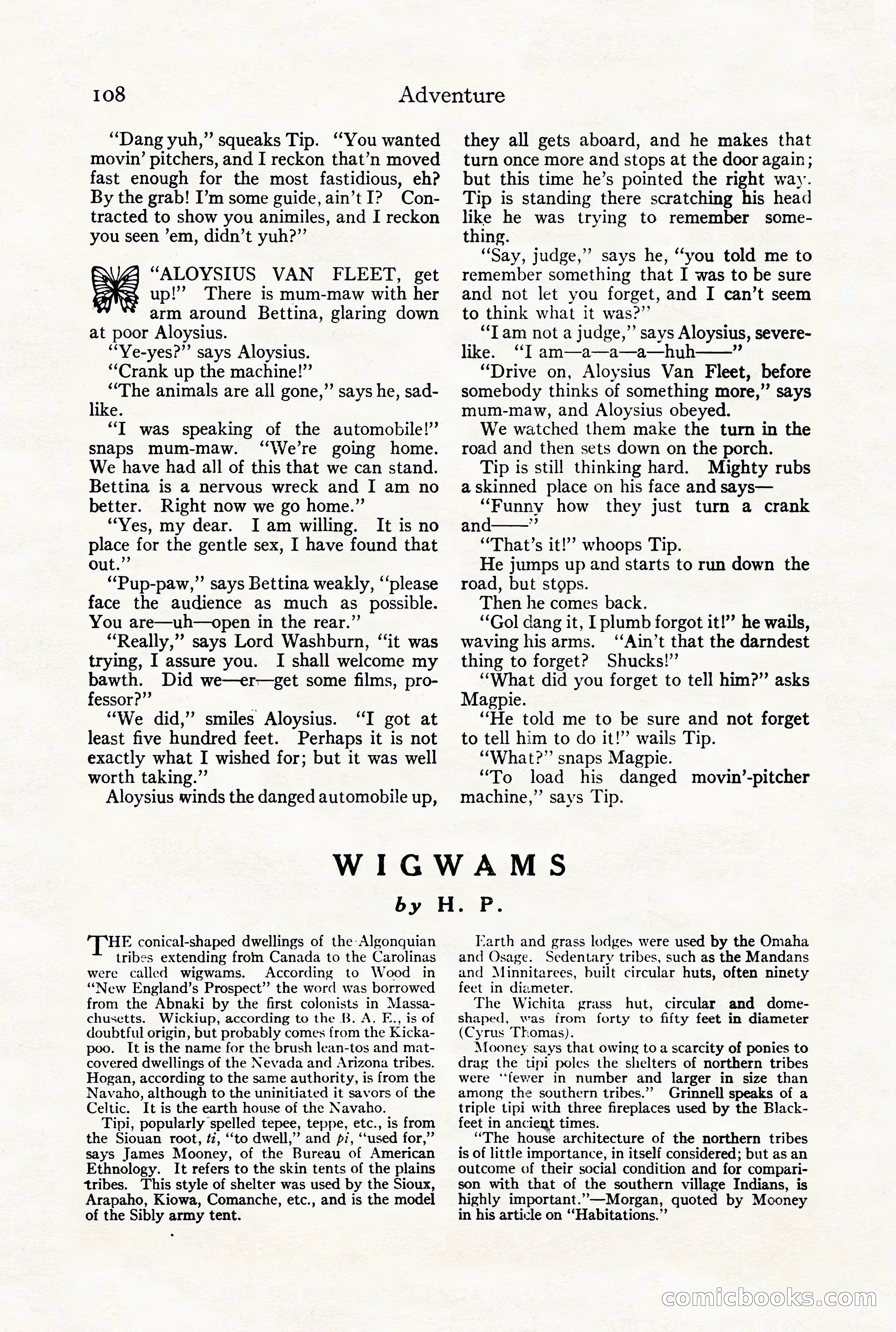
A restored page from Pulp Fiction, 1921. Page through the whole issue in the reader above.
📄 Transcribed text from this page (OCR, searchable)
Machine-transcribed from the original scan — historical spelling and the odd misread are preserved.
108 “Dang yuh,” squeaks Tip. ‘‘You wanted movin’ pitchers, and I reckon that’n moved fast enough for the most fastidious, eh? By the grab! I’m some guide, ain’t I? Con- tracted to show you animiles, and I reckon you seen ’em, didn’t yuh?”’ Be up!’ There is mum-maw with her : arm around Bettina, glaring down at poor Aloysius. ‘“Ye-yes?”’ says Aloysius. “‘Crank up the machine!” “‘The animals are all gone,” says he, sad- like. “I was speaking of the automobile!” snaps mum-maw. ‘We're going home. We have had all of this that we can stand. Bettina is a nervous wreck and I am no better. Right now we go home.” “Yes, my dear. I am willing. It is no place for the gentle sex, I have found that out.”’ “‘Pup-paw,”’ says Bettina weakly, “‘please face the audience as much as possible. You are—uh—open in the rear.”’ “Really,” says Lord Washburn, ‘it was trying, I assure you. I shall welcome my bawth. Did we—er-—get some films, pro- fessor?” “We did,” smiles Aloysius. “I got at least five hundred feet. Perhaps it is not exactly what I wished for; but it was well worth taking.” Aloysius winds the danged automobile up, “ALOYSIUS VAN FLEET, get Adventure they all gets aboard, and he makes that turn once more and stops at the door again; but this time he’s pointed the right way. Tip is standing there scratching his head like he was trying to remember some- thing. “Say, judge,” says he, “‘you told me to remember something that I was to be sure and not let you forget, and I can’t seem to think what it was?” “Tam not a judge,” says Aloysius, severe- like. “I am—a—a—a—huh——” “Drive on, Aloysius Van Fleet, before somebody thinks of something more,” says mum-maw, and Aloysius obeyed. We watched them make the turn in the road and then sets down on the porch. Tip is still thinking hard. Mighty rubs a skinned place on his face and says— “Funny how they just turn a crank and——”’ “That’s it!’ whoops Tip. He jumps up and starts to run down the road, but stops. Then he comes back. ‘“‘Gol dang it, I plumb forgot it!’ he wails, waving his arms. ‘‘Ain’t that the darndest thing to forget? Shucks!”’ “What did you forget to tell him?” asks Magpie. ‘“‘He told me to be sure and not forget to tell him to do it!” wails Tip. ‘“‘What?’’ snaps Magpie. “To load his danged movin’-pitcher machine,” says Tip. WIGWAMS by H. P. HE conical-shaped dwellings of the Algonquian tribes extending from Canada to the Carolinas were called wigwams. According to Wood in ‘“‘New England’s Prospect”’ the word was borrowed from the Abnaki by the first colonists in Massa- chusetts. Wickiup, according to the B. A. E., is of doubtful origin, but probably comes from the Kicka- poo. It is the name for the brush lean-tos and mat- covered dwellings of the Nevada and Arizona tribes. Hogan, according to the same authority, is from the Navaho, although to the uninitiated it savors of the Celtic. It is the earth house of the Navaho. Tipi, popularly spelled tepee, teppe, etc., is from the Siouan root, ti, ‘‘to dwell,” and pi, ‘‘used for,”’ says James Mooney, of the Bureau of American Ethnology. It refers to the skin tents of the plains tribes. This style of shelter was used by the Sioux, Arapaho, Kiowa, Comanche, etc., and is the model of the Sibly army tent. Earth and grass lodges were used by the Omaha and Osage. Sedentary tribes, such as the Mandans and Minnitarees, built circular huts, often ninety feet in diameter. The Wichita grass hut, circular and dome- shaped, was from forty to fifty feet in diameter (Cyrus Thomas). Mooney says that owing to a scarcity of ponies to drag the tipi poles the shelters of northern tribes were ‘‘fewer in number and larger in size than among the southern tribes.’’ Grinnell speaks of a triple tipi with three fireplaces used by the Black- feet in ancient times. “The house architecture of the northern tribes is of little importance, in itself considered; but as an outcome of their social condition and for compari- son with that of the southern village Indians, is highly important.”—Morgan, quoted by Mconey in his article on ‘‘Habitations.”’ cCOmiclboolks