
Pulp Fiction, 1921 · page 88 of 204
Adventure Magazine Cover — page 88: what you’re looking at
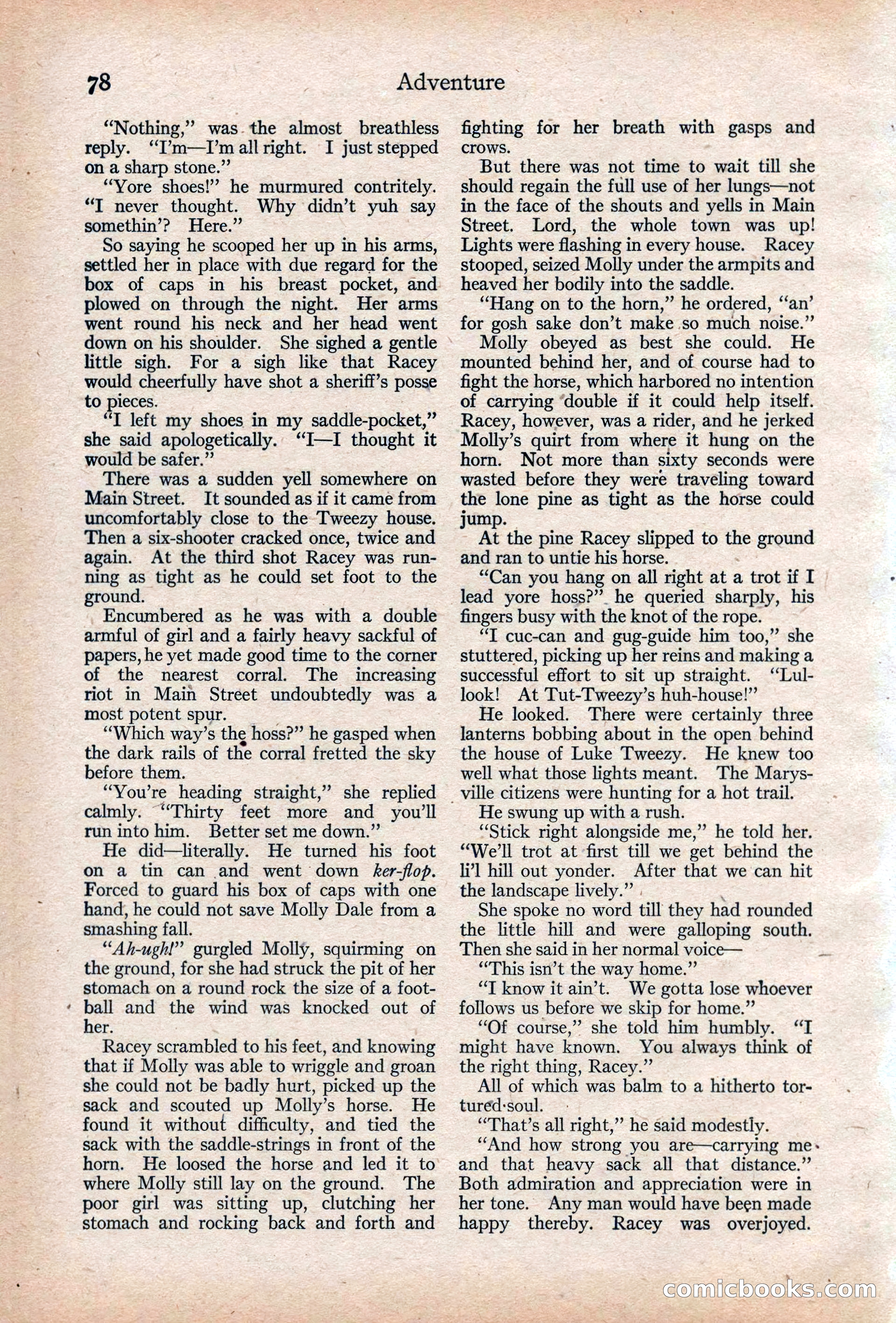
A restored page from Pulp Fiction, 1921. Page through the whole issue in the reader above.
📄 Transcribed text from this page (OCR, searchable)
Machine-transcribed from the original scan — historical spelling and the odd misread are preserved.
* 78 “Nothing,” was.the almost breathless reply. “I’m—I’mallright. I just stepped on a sharp stone.” “VYore shoes!’ he murmured contritely. “T never thought. Why didn’t yuh say somethin’? Here.” So saying he scooped her up in his arms, settled her in place with due regard for the box of caps in his breast pocket, and plowed on through the night. Her arms went round his neck and her head went down on his shoulder. She sighed a gentle little sigh. For a sigh like that Racey would cheerfully have shot a sheriff’s posse to pieces. “TI left my shoes in my saddle-pocket,” she said apologetically. “I—I thought it would be safer.” There was a sudden yell somewhere on Main Street. It sounded as if it came from uncomfortably close to the Tweezy house. Then a six-shooter cracked once, twice and again. At the third shot Racey was run- ning as tight as he could set foot to the ground. Encumbered as he was with a double armful of girl and a fairly heavy sackful of papers, he yet made good time to the corner of the nearest corral. The increasing riot in Main Street undoubtedly was a most potent Spur. “Which way’s the hoss?” he gasped when the dark rails of the corral fretted the sky before them. “You’re heading straight,” she replied calmly. ‘‘Thirty feet more and you'll run into him. Better set me down.”’ He did—literally. He turned his foot on a tin can and went down ker-flop. Forced to guard his box of caps with one hand, he could not save Molly Dale from a smashing fall. “Ah-ughl”’ gurgled Molly, squirming on the ground, for she had struck the pit of her stomach on a round rock the size of a foot- “en and the wind was knocked out of er. Racey scrambled to his feet, and knowing that if Molly was able to wriggle and groan she could not be badly hurt, picked up the sack and scouted up Molly’ s horse. He found it without difficulty, and tied the sack with the saddle-strings in front of the horn. He loosed the horse and led it to where Molly still lay on the ground. The poor girl was sitting up, clutching her stomach and rocking back and forth and Adventure — fighting for her breath with gasps and crows. But there was not time to wait till she should regain the full use of her lungs—not in the face of the shouts and yells in Main Street. Lord, the whole town was up! Lights were flashing in every house. Racey stooped, seized Molly under the armpits and heaved her bodily into the saddle. “Hang on to the horn,” he ordered, ‘‘an’ for gosh sake don’t make so much noise.”’ Molly obeyed as best she could. He mounted behind her, and of course had to fight the horse, which harbored no intention of carrying ‘double if it could help itself. Racey, however, was a rider, and he jerked Molly’s quirt from where it hung on the horn. Not more than sixty seconds were wasted before they were traveling toward the lone pine as tight as the horse could jump. At the pine Racey slipped to yes ground and ran to untie his horse. “Can you hang on all right at a trot if I lead yore hoss?’”. he queried sharply, his fingers busy with the knot of the rope. “T cuc-can and gug-guide him too,” she stuttered, picking up her reins and making a successful effort to sit up straight. ‘“Lul- look! At Tut-Tweezy’s huh-house!”’ He looked. There were certainly three lanterns bobbing about in the open behind the house of Luke Tweezy. He knew too well what those lights meant. The Marys- _ville citizens were hunting for a hot trail. He swung up with a rush. “Stick right alongside me,” he told her. “We'll trot at first till we get behind the li’l hill out yonder. After that we can hit the landscape lively.” . She spoke no word till they had rounded the little hill and were galloping south. Then she said in her normal voice— “This isn’t the way home.” “T know it ain’t. We gotta lose whoever follows us before we skip for home.” “Of course,’ she told him humbly. “TI might have known. You always think of the right thing, Racey.”’ All of which was balm to a hitherto tor- turéd:soul. “That’s all right,”’ he said modestly. ‘“‘And how strong you are—carrying me: and that heavy sack all that distance.” Both admiration and appreciation were in her tone. Any man would have been made happy thereby. Racey was overjoyed. Gomicbooks (e(6)