
Pulp Fiction, 1921 · page 77 of 204
Adventure Magazine Cover — page 77: what you’re looking at
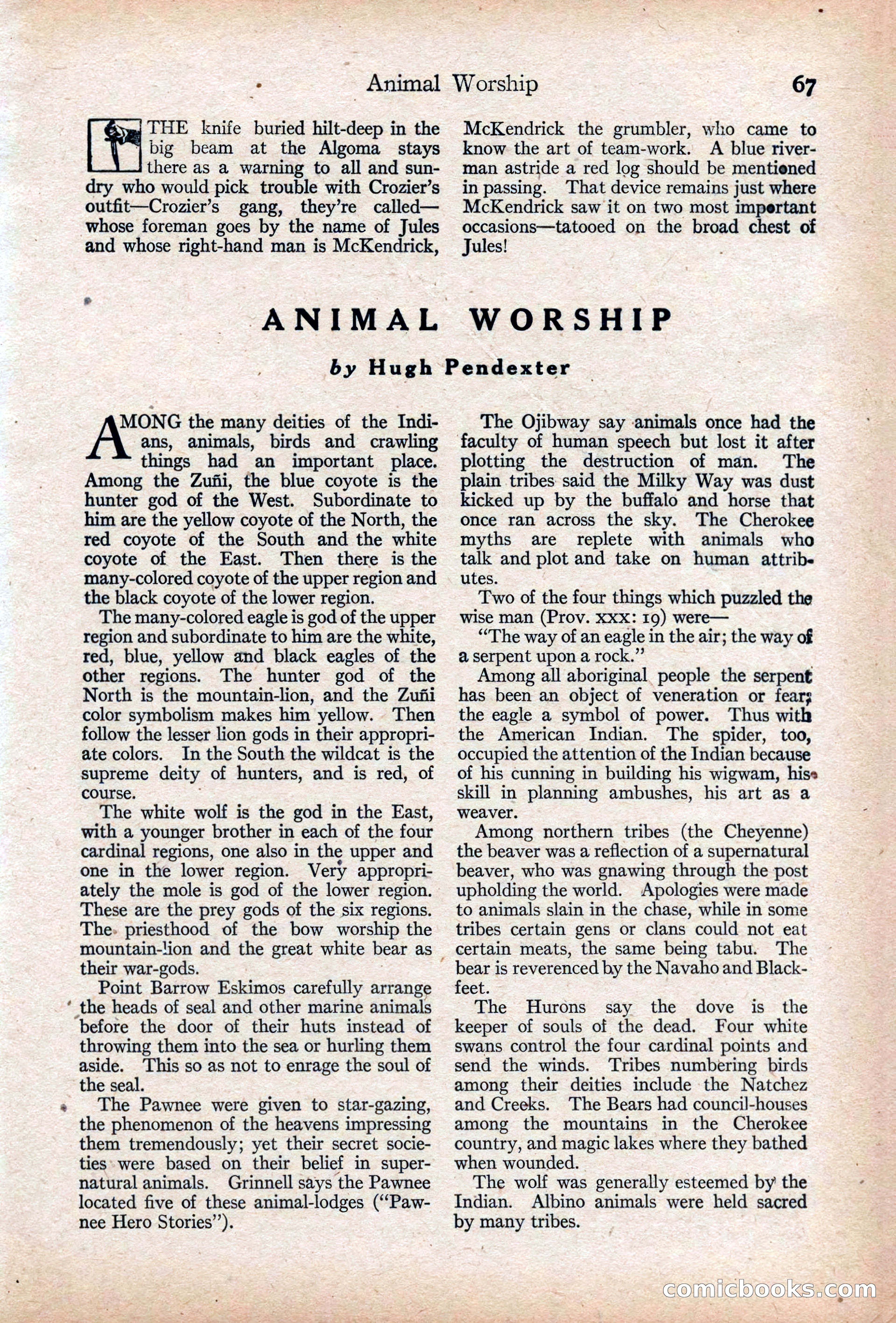
A restored page from Pulp Fiction, 1921. Page through the whole issue in the reader above.
📄 Transcribed text from this page (OCR, searchable)
Machine-transcribed from the original scan — historical spelling and the odd misread are preserved.
. ° Animal Worship ‘yeni LHE knife buried hilt-deep in the fe big beam at the Algoma stays there as a warning to all and sun- dry who would pick trouble with Crozier’s outfit—Crozier’s gang, they’re called— whose foreman goes by the name of Jules and whose right-hand man is McKendrick, ANIMAL 67 McKendrick the grumbler, who came to know the art of team-work. A blue river- man astride a red log should be mentiened in passing. That device remains just where McKendrick saw it on two most impertant occasions—tatooed on the broad chest of Jules! WORSHIP by Hugh Pendexter MONG the many deities of the Indi- A ans, animals, birds and crawling things had an important place. Among the Zufi, the blue coyote is the hunter god of the West. Subordinate to him are the yellow coyote of the North, the red coyote of the South and the white coyote of the East. Then there is the many-colored coyote of the upper region and the black coyote of the lower region. The many-colored eagle is god of the upper region and subordinate to him are the white, red, blue, yellow and black eagles of the other regions. The hunter god of the North is the mountain-lion, and the Zufi color symbolism makes him yellow. Then follow the lesser lion gods in their appropri- ate colors. In the South the wildcat is the supreme deity of hunters, and is red, of course. The white wolf is the god in the East, with a younger brother in each of the four cardinal regions, one also in the upper and one in the lower region. Very appropri- ately the mole is god of the lower region. These are the prey gods of the six regions. The. priesthood of the bow worship the mountain-lion and the great white bear as their war-gods. Point Barrow Eskimos carefully arrange the heads of seal and other marine animals before the door of their huts instead of throwing them into the sea or hurling them aside. ‘This so as not to enrage the soul of the seal. The Pawnee were given to star-gazing, the phenomenon of the heavens impressing them tremendously; yet their secret socie- ties. were based on their belief in super- natural animals. Grinnell says the Pawnee located five of these animal-lodges (“‘Paw- nee Hero Stories’’). The Ojibway say animals once had the faculty of human speech but lost it after plotting the destruction of man. The plain tribes said the Milky Way was dust kicked up by the buffalo and horse that once ran across the sky. The Cherokee myths are replete with animals who talk and plot and take on human attribe utes. Two of the four things which puzzled the wise man (Prov. Xxx: 19) were— “The way of an eagle in the air; the way of a serpent upon a rock.” Among all aboriginal people the serpent has been an object of veneration or fears the eagle a symbol of power. Thus with the American Indian. The spider, too, occupied the attention of the Indian because of his cunning in building his wigwam, hise skill in planning ambushes, his art as a weaver. Among northern tribes (the Cheyenne) the beaver was a reflection of a supernatural beaver, who was gnawing through the post upholding the world. Apologies were made to animals slain in the chase, while in some tribes certain gens or clans could not eat certain meats, the same being tabu. The bear is reverenced by the Navaho and Black- feet. The Hurons say the dove is the keeper of souls of the dead. Four white swans control the four cardinal points and send the winds. ‘Tribes numbering birds among their deities include the Natchez and Creeks. The Bears had council-houses among the mountains in the Cherokee country, and magic lakes where they bathed when wounded. The wolf was generally esteemed by the Indian. Albino animals were held sacred by many tribes. ibook (@) (EO)